First of all, this post is not at all as horrible as you might think. I think Harringtons books are fine. (Well the post may still be very very bad ...) You probably need to have Harringtons volume 3 to be able to answer the question I have.
In volume 3, problems 37-42 discuss all-in situations on the bubble. I think the theoretical discussion is correct, but there may be an error or two in his practical calculations.
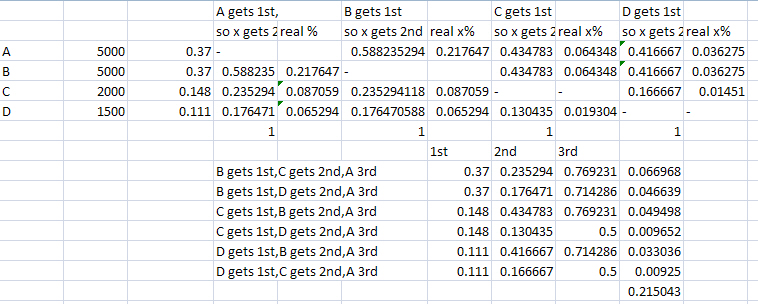
Question: Does anybody know for sure if the table on page 260 is correct or incorrect? I get slightly different numbers for the third and fourth places. Please see the tables below.
Harringtons numbers:
Player Stack First Second Third Fourth
A 5000 0.370 0.329 0.244 0.057
B 5000 0.370 0.329 0.244 0.057
C 2000 0.148 0.193 0.279 0.380
D 1500 0.111 0.150 0.232 0.507
My numbers:
Player Stack First Second Third Fourth
A 5000 0.370 0.329 0.215 0.086
B 5000 0.370 0.329 0.215 0.086
C 2000 0.148 0.193 0.313 0.346
D 1500 0.111 0.150 0.257 0.482
The numbers are supposed to add up to 1, both horizontally and vertically. They do in both tables when disregaring rounding errors.
You reasonably ask why I want to know this. I have translated the verbal theory to a mathematical formula for computing the probability of a player to finish in a given position given stack sizes. This formula is more ghastly than you might imagine if you haven't tried it yourself. (Even so if my particular formula happens to be incorrect.)
Then I have implemented the formula in a little computer program. (Some nontrivial issues arose there too.) My program spits out plausible numbers, but for Harringtons example they don't agree exactly.
Of course, I don't ask anyone to make the actual calculation. It's very painful to calculate the third column (or further columns) by hand. Bring in more players and it gets worse very very fast. Unless the formula can be simplified (mathematically) which I doubt it can, no human made computer can take on a large tournament with, say, 200 players left without making approximations.
So, if you for some reason know the answer to my question, please let me know. I'm sure that at least one other person than me has debugged Harrington ♦
/Johan =