Skip to forum
Probably the best p...
 
Notifications
Clear all

Probably the best plog in the world

1,275 Posts
68 Users
368 Reactions
196.4 K Views
Coach
Kyyberi
Joined: 09.07.2010

MOTIVATION AND GOALS

There is some discussion where the difference is between motivation and will power. I think that motivation is something that is born internally, and if we don't have we can't get it anywhere. When motivation ends, we need will power. Motivation can't be learned or exercised , will power can. Biggest problem for poker players is that we often have good motivation and will power to play, but not that great to study and practise.

Goals are the real double edged sword. They can be a great assett to boost our will power when the motivation runs out. But it can be a negative thing, if the goal is not realistic. If we set the goal too high, we are quaranteed to fail it. It can also drop the motivation or will power, when we realize that we will never achieve the goal.

In high level environment (like sports, companies etc.) good goal setting is crucial. We need to have long term goals and short term goals. And as short term goals as it's needed. Some athletes require daily goals to keep the will power running, for some weekly goals are enough. And they both should have long term (years ahead) goals. Poker players are humas there as everyone else. Good goal setting is a good way to back up the will power. But often at forum I see unrealistic goals. They are either too optimistic or too long. Like "getting to PLO500 in a year" and then the thread is forgotten in a month. Getting to PLO500 in a year might not be a bad goal, but it needs short term goals to guide the road. Monthly goals, weekly goals, daily goals. And if the short term goals are not met, we need to adjust the long term goal accordingly.

Sometimes there is no long term goal, especially if we play semi-casually. But then those short term goals can help us a lot. "play 1K hand a day", "stop session when getting upset", "make $100 and buy a widget" and so on.


Reply
Quote
ghaleon
Joined: 17.10.2007

Originally posted by Kyyberi
Now the real question, did I run good or bad in this session? :f_ugly: :f_ugly: :f_ugly:
I would say both :)


Reply
Quote
ghaleon
Joined: 17.10.2007

Originally posted by Kyyberi
To that last sentence the optimal answer is of course not, as changing strategy there would lover the EV. To be precise, it lowers the EV of our TOP LEVEL PERFORMANCE. If this was Madden, we wouldn't have the need to think about that. But in reality, we might start to play worse when running bad. Well, not just "might" but we do. Everyone of us will drop from top level performance when running bad enough. The key is to be self aware and realistic about our own thresholds and dangers. So sometimes changing strategy lowers the EV less than continuing without adjusting.

This can sometimes be tricky especially in very good table or versus one of total maniac opponents. One thing where I sometimes start leaking is becoming somewhat too sticky versus maniacs. Its also tough to evaluate how much and what spots we want to widen our range. In general we want to tighten flop to be able to take heat on later streets. But especially on spots like paired board its tough. Had one guy couple days ago who I had seen x-r paired flop, fire turn and check river with total air and no real bd draws or blockers. Then later had similar spot with AA but this time he fires third barrel. But yeah its also question of understanding where to give that rope. Like sometimes these guys are way too aggro on spots where board changes and you check meaning there is lot of incentive to trap with strong hand.

Also, we get information on poker table constantly. The more we look for it, the more we get it. Without huds, every single hand gives us information on every other player. Solver doesn't care about reads, info or notes. If we focus too much on solver output, we lose our ability to use those pieces of information to gain bigger edge to our opponents, and therefore incease our EV. It's good to remember, that solver output is never the optimal strategy versus any opponent. Never.

I would focus on concepts behind solver outputs whatever studying or in game. Reads on opponents are good but have to remember we rarely have sample or hands shown that we should change our default line hugely. Especially versus feel based players. Even if they show hand that would be one of prime bluff candicates as give up they might in fact bluff decent amount but with "wrong type of hands". Or they just thought that specific spot bad to bluff.

One common over adjusted spot could be one where we have weak top two or other weaker two pair combo. Versus passive opponent it can be better to go more aggressively for value but it does also mean our ranges (both betting and checking) become somewhat weaker (or perhaps "mergier") on later streets. That can backfire as we build bigger pot with hand that doesnt necessarily handle board changes well at all (one of reasons why solver prefers to check). At same time we assume opponent doesnt stab that aggressive versus missed cbet but we rarely have that much info on opponent approach. So we could also end up overfolding with our already weaker than default check range. So I would say its also easy to overadjust based on too small sample.


Reply
Quote
Coach
Kyyberi
Joined: 09.07.2010

Definitely. Back in the days of HUD's this was very common. Players just checked hud stat and made huge adjustments. Without understanding what the stat actually told and whan not.

I will cover this in next post.


Reply
Quote
Coach
Kyyberi
Joined: 09.07.2010

Skill and strategy

Kind of no-brainer, that our poker skills affect our performance level. They are the #1 thing. Our poker skills dictate where our A game is. Due to other affections it drops pretty much always. Our non-poker strategy skills affect the drop, the better we are in those the less our performance level drops.

I am quite fascinated how much other things affect our performance level. I have a feeling, that average pokerstrategy member undervalues the meaning of those. We often put a lot of effort to increase our poker skills, and often that is the best way to increase our performance level. But the better we become, the less we gain from studying. So the better we become, the more we should focus on other areas than strategy.

Poker skills are also quite wide area. We have mathematics, estimation skills, strategy skills, strategy adjustment skills, and so on. And even the basic strategy can be divided into areas and we are not equal in those. Like even the simples dividing would be preflop open, call and 3bet, flop/turn and river both HU and multiway, both IP and OOP. That is 15 areas. Once we start to divide them into flop categories, hand strength buckets and so on, even our "default strategy" is made from dozens of different basic situations. Often we are better in some, worse in some.

On of the most valuable skills for poker players is realistic perspection of ourselves. When we know where we struggle, we can focus to overcome it.

Also one topic that constantly pops up is adjusting. How much information is enough? Poker is a game of imperfect information, so any piece of information is valuable. But it has to be put into context. I have heard so often that "if you have less than 100 hands on opponent, the information is useless". That is just plain wrong. That thought comes from the hud world, and under 100 hand sample size has a lot of variance. But still, that information can't be useless, it's just not 100% reliable. In poker, we constantly have to weight information. Let's say that opponent opens 10 hands in a row, and is 100/100/0 in our hud. He might be total maniac, or he might have had 10 good hands. We don't know. But if we had to bet whether he is super tight or super loose, would it be 50/50? Of if at the site the ratio is 30/70, would the odds still be the same 30/70 after those 10 hands? If you think yes, then you really shouldn't do any sports betting. :)

It's not 0/100, but it starts to weight to either end after every tiny piece of information. After 10 hands, there should be slightly increased chance that he has is openening more than average opponent. So we should adjust a little. Once we get more information, we should adjust again. And so on.

If we see one hand from opponent where he 3bets 8862r, can we make any estimations to his player profile? Is it more or less likely that he is a nit? That he is an aggro?

The key is to give proper weight to information. Sometimes players go from one end to the other too fast. I have seen players widening their 4bet range a LOT when HUD says opponent has 16% 3bet. They didn't check that opponent had 3bet 1/6 or 2/12 times. So we don't know that he is 3betting wide, we know that he has 3bet once or twice. That information shouldn't weight that much. But if the sample size for those 3bets is 100/600, it does have weight. Or that one hand went to showdown and was 8862r.

I think solver has killed in someway the information gathering and using that to adjust. People are quite fixated to what solver does, and forgetting the player pool, average opponent and adjusting. Or they are very "scared" to deviate from solver strategy as they are afraid they are making "mistakes". I would say that in any low stakes pool (PLO25 and lower) average opponent calls too much, bluffs too little and big bets and most raises are weighted heavily towards value hands. If we think that is true, then our default strategy in that player pool should not be solver strategy. We should fold more to big bet and raises, valuebet a bit more and bluff a bit less.

But we shouldn't forget and skip solver strategy. Just understand what it is and what it's not. Same thing as with any information: What it tells and what it doesn't tell.


Reply
Quote
Coach
Kyyberi
Joined: 09.07.2010

Our mental and physical resources

We all have different thresholds and abilities to withstand stress, pressure, anxiety etc. Human is very complex thing, where everything affects everything. Our physical well being affects our psychilogical well being and vice versa. Poker is a game that delivers negative situations on constant basis. And our brain is not built to understand nor accept that variance. And that variance is the reason why someone can make money in poker. It's kinda paradoxal.

Physical well being is quite easy to fix. We can decide how we train and how we eat. Mental well being is a different story, as it's based on emotions. And we just can't decide our emotions. We can learn to cope with them, we can learn to focus on opposite emotion (thinking happy stuff when we are sad) but we can't decide that we won't feel an emotion. Still many players think they can just decide "I am not going to tilt anymore". It's not a decision you can just make.

We can decide how we react when the emotions rise, like shutting down the client or taking a break. We can decide to work on our mental game. But if someone thinks they can just decide that they won't do stupid stuff when angry, it doesn't work.

I think that one of the biggest reasons why someone doesn't make profits in poker when he has good strategy skills is mental game. Not just tilting, but the mental resources for poker. Good sleep, good rest, suitable stress, good nutrition all help us to achieve the highest potential in our performance level, instead of capping it with poor mental resources. This is something that all of the pro players I know have fixed to stay in the business. Back in the old school era of online poker pro players were partying all the time, drinking and going out. Nowadays they are quite strict on the life outside poker tables, as they understand how much it affects the performance level.


Reply
Quote
Coach
Kyyberi
Joined: 09.07.2010

Last 3 sessions I have played have been the same. Going good, then one good customer starts to hit everything. Either he wins allin with a draw or builds a sick setup for stacks. And suddenly just wins hand after hand after hand and my session goes several buyins down. Then just before the end I win couple of big multiway allins and get close to break even. Nothing special, but stressfull as hell. As the money on my bankroll is going to Christmas stuff. Mental wise that´s a very poor decision, but logically it´s solid. Still running a LOT under EV while making profits. Will post the graph from past couple of months as soon as I manage to merge two PT4 databases and get hands from my third computer. PT4 license is good for 2 computers, and I am playing from three different ones.

Today one table started to die and I was left with a REALLY good customer in HU. The one we all dream of. Never bluffs, and bets only for value. Also doesn´t fold easily. The one who thinks PLO is like scratch lottery. You pay money and see if you win. We played few hands and I collected some chips. Then I got top set, money in and he has a flush draw. Makes it. Following hand, I 3bet and hit top2 with flush draw, money in and he has a gutshot. Hits it. Third hand, I open, he calls and I get middle set on AJ5ss. I pot, he calls. Turn is blank, I pot, he calls. River pairs the low card, I shove and he calls with AA. Didn´t see that one coming. Few hands later he again won 3 stacks in repeating hands, in similar spots. I was thinking that this is not fun anymore.

I have had a lot of session where I run quite bad. Overall I am thinking that I´m about 20-30 buyins under EV in 10-20K hands. But still making quite good profits. It´s sometimes quite hard to remind myself that the money will come, just be patient when those shitstorms happen.


Reply
Quote
Coach
Kyyberi
Joined: 09.07.2010

HEALTH

If we are in fever, it's harder to concentrate and think. If we are really sick, it becomes even harder. But health is a bit more. If we are in a good shape, it's often easier to reach the top level of our mental game. And vice versa. Ancient wisdom "healthy body, healthy mind" is quite true.

LIFE SITUATION AND STRESS

These often go hand in hand. And the single biggest stress sources is money. If one has money problems, he is probably very stressed. Think about playing poker, and your rent for next month depends on if you win enough or not. In that situation, it would be very hard to play optimal poker. And every bad beat would hit a lot harder than usually. If bankroll is static (= we can't deposit more in case of a downswing) that might cause a stress.

Any relationship problems, work problems and any problems in life creates stress. And while stressed, the chance of mental game flaws increases a lot. On the other hand, if poker doesn't create any stress that isn't good either. Slight stress increases the performance level. Too low, it drops. And too high, it definitely drops.

Think about situation where you have had an argument with your significant other, and then you sit down at poker tables. How easy it is to deal with sick bad beats?

CONCLUSION

So as we can see, there's a lot of things that affect our performance level. And it's never a static one. It goes up and down in every session. And it goes up and down between the sessions. The more we focus on different areas and make them as good as possible, the less variance there is between those up and downs. The same concept applies to all sports. For great players the difference between "good day" and "bad day" is quite small. For not-so-great players it might be huge. Same for poker players. There are players who's top level is really good. But they drop from it often and heavily. Then there are players who are not top level players, but keep up good consistency in their slightly profitable performance level.

We often think ourselves as robots, who play with same EV day after day, session after session. Which is not true. Our performance level can change from hand to hand. When the hand is played, we might have a lot of action on other tables and we miss focus and information on one table. Or the cat jumps to our lap in the middle of a hand. Or we get tired, get emotions, phone rings and so on. If we happen to get a big and important hand during that sudden drop in performance level, it will affect our EV heavily. If we get the drop while folding hands preflop, it doesn't affect our EV at all.

So there's even more variance in poker. And the long term winrate is the average EV and our performance level in that sample, with the error marginal based on variance. If we want to increase it, we should be thinking all the areas that affects it. Not just the strategy part. Sometimes focusing on all the other areas instead of strategy gives good results. Sometimes the other areas are ok, and focusing on the strategy is the best option.


Reply
Quote
Coach
Kyyberi
Joined: 09.07.2010

Decided to make one post, where all the things are at one place (in case someone want to link it etc.)

WHAT AFFECTS OUR EV, WHAT IS PERFORMANCE LEVEL?

When players want to improve as poker players (= make more money), they often focus on strategy. Solvers are a big thing and there is a big market for all solver based apps that you can get easy access to solver outputs.

But the truth is that strategy is only a small thing that affects our performance. If we ask random non-pro players how big affect on their strategy knowledge is to their results, I am quite sure that most of them would answer that the impact is very significant.

Here is a short list of things that affect our performance (poker, work, school etc.)
- Environment
- Our expectations
- Our ability to adapt and adjust
- Motivation and goals
- Skils and strategy
- Our mental and physical resources
- Health
- Life situation
- Stress

ENVIRONMENT

Spoiler

If you have kids, you know whether they increase or decrease your EV if they come to you while you play. There might be a construction workers outside your window, or someone is making noises at your house. Your chair might a bit uncomfortable and so on. On the other hand, good environment works for your favor. Nice setup in a nice room, where colors comfort you. Maybe a plant or two and a good scenery from the window.

OUR EXPECTATIONS

Spoiler

One of the most common mental game flaws is to expect the money you will win. We think or know that we are winning players. And when you sit down on the tables, you might already think how much you might win. Problem is when it doesn't happen, it creates a negative feeling. And any feelings are poker player's worst enemy. Stronger the feeling (positive or negative), the less we can use our rational thinking. Another problem might be that we expect ourselves to play really good poker. And when that doesn't happen for some reason, we see it as a failure. We might be disappointed to ourselves, creating another negative feeling.

On the other hand, realistic and good expectations can help us when poker tries to give us negative feelings. If the expectation is to play as good poker as possible, while understanding that we can't play our A game always, it helps us to monitor our game level realisticly and cope with minor drops in our level.

OUR ABILITY TO ADAPT AND ADJUST

Spoiler

I am quite sure that most of you immediately thought that this is about adjusting to opponent's strategies. Well, part of it is that. But we need adaptation skills when everything else is not optimal. If there is that annoying sound from construction site, how do we react and adapt? If we are tired, do we react on strategical level? When we run bad, do we change our strategy?

To that last sentence the optimal answer is of course not, as changing strategy there would lover the EV. To be precise, it lowers the EV of our TOP LEVEL PERFORMANCE. If this was Madden, we wouldn't have the need to think about that. But in reality, we might start to play worse when running bad. Well, not just "might" but we do. Everyone of us will drop from top level performance when running bad enough. The key is to be self aware and realistic about our own thresholds and dangers. So sometimes changing strategy lowers the EV less than continuing without adjusting.

Also, we get information on poker table constantly. The more we look for it, the more we get it. Without huds, every single hand gives us information on every other player. Solver doesn't care about reads, info or notes. If we focus too much on solver output, we lose our ability to use those pieces of information to gain bigger edge to our opponents, and therefore incease our EV. It's good to remember, that solver output is never the optimal strategy versus any opponent. Never.

MOTIVATION AND GOALS

Spoiler

There is some discussion where the difference is between motivation and will power. I think that motivation is something that is born internally, and if we don't have we can't get it anywhere. When motivation ends, we need will power. Motivation can't be learned or exercised , will power can. Biggest problem for poker players is that we often have good motivation and will power to play, but not that great to study and practise.

Goals are the real double edged sword. They can be a great assett to boost our will power when the motivation runs out. But it can be a negative thing, if the goal is not realistic. If we set the goal too high, we are quaranteed to fail it. It can also drop the motivation or will power, when we realize that we will never achieve the goal.

In high level environment (like sports, companies etc.) good goal setting is crucial. We need to have long term goals and short term goals. And as short term goals as it's needed. Some athletes require daily goals to keep the will power running, for some weekly goals are enough. And they both should have long term (years ahead) goals. Poker players are humas there as everyone else. Good goal setting is a good way to back up the will power. But often at forum I see unrealistic goals. They are either too optimistic or too long. Like "getting to PLO500 in a year" and then the thread is forgotten in a month. Getting to PLO500 in a year might not be a bad goal, but it needs short term goals to guide the road. Monthly goals, weekly goals, daily goals. And if the short term goals are not met, we need to adjust the long term goal accordingly.

Sometimes there is no long term goal, especially if we play semi-casually. But then those short term goals can help us a lot. "play 1K hand a day", "stop session when getting upset", "make $100 and buy a widget" and so on.

SKILL AND STRATEGY

Spoiler

Kind of no-brainer, that our poker skills affect our performance level. They are the #1 thing. Our poker skills dictate where our A game is. Due to other affections it drops pretty much always. Our non-poker strategy skills affect the drop, the better we are in those the less our performance level drops.

I am quite fascinated how much other things affect our performance level. I have a feeling, that average pokerstrategy member undervalues the meaning of those. We often put a lot of effort to increase our poker skills, and often that is the best way to increase our performance level. But the better we become, the less we gain from studying. So the better we become, the more we should focus on other areas than strategy.

Poker skills are also quite wide area. We have mathematics, estimation skills, strategy skills, strategy adjustment skills, and so on. And even the basic strategy can be divided into areas and we are not equal in those. Like even the simples dividing would be preflop open, call and 3bet, flop/turn and river both HU and multiway, both IP and OOP. That is 15 areas. Once we start to divide them into flop categories, hand strength buckets and so on, even our "default strategy" is made from dozens of different basic situations. Often we are better in some, worse in some.

On of the most valuable skills for poker players is realistic perspection of ourselves. When we know where we struggle, we can focus to overcome it.

Also one topic that constantly pops up is adjusting. How much information is enough? Poker is a game of imperfect information, so any piece of information is valuable. But it has to be put into context. I have heard so often that "if you have less than 100 hands on opponent, the information is useless". That is just plain wrong. That thought comes from the hud world, and under 100 hand sample size has a lot of variance. But still, that information can't be useless, it's just not 100% reliable. In poker, we constantly have to weight information. Let's say that opponent opens 10 hands in a row, and is 100/100/0 in our hud. He might be total maniac, or he might have had 10 good hands. We don't know. But if we had to bet whether he is super tight or super loose, would it be 50/50? Of if at the site the ratio is 30/70, would the odds still be the same 30/70 after those 10 hands? If you think yes, then you really shouldn't do any sports betting. :)

It's not 0/100, but it starts to weight to either end after every tiny piece of information. After 10 hands, there should be slightly increased chance that he has is openening more than average opponent. So we should adjust a little. Once we get more information, we should adjust again. And so on.

If we see one hand from opponent where he 3bets 8862r, can we make any estimations to his player profile? Is it more or less likely that he is a nit? That he is an aggro?

The key is to give proper weight to information. Sometimes players go from one end to the other too fast. I have seen players widening their 4bet range a LOT when HUD says opponent has 16% 3bet. They didn't check that opponent had 3bet 1/6 or 2/12 times. So we don't know that he is 3betting wide, we know that he has 3bet once or twice. That information shouldn't weight that much. But if the sample size for those 3bets is 100/600, it does have weight. Or that one hand went to showdown and was 8862r.

I think solver has killed in someway the information gathering and using that to adjust. People are quite fixated to what solver does, and forgetting the player pool, average opponent and adjusting. Or they are very "scared" to deviate from solver strategy as they are afraid they are making "mistakes". I would say that in any low stakes pool (PLO25 and lower) average opponent calls too much, bluffs too little and big bets and most raises are weighted heavily towards value hands. If we think that is true, then our default strategy in that player pool should not be solver strategy. We should fold more to big bet and raises, valuebet a bit more and bluff a bit less.

But we shouldn't forget and skip solver strategy. Just understand what it is and what it's not. Same thing as with any information: What it tells and what it doesn't tell.

OUR MENTAL AND PHYSICAL RESOURCES

Spoiler

We all have different thresholds and abilities to withstand stress, pressure, anxiety etc. Human is very complex thing, where everything affects everything. Our physical well being affects our psychilogical well being and vice versa. Poker is a game that delivers negative situations on constant basis. And our brain is not built to understand nor accept that variance. And that variance is the reason why someone can make money in poker. It's kinda paradoxal.

Physical well being is quite easy to fix. We can decide how we train and how we eat. Mental well being is a different story, as it's based on emotions. And we just can't decide our emotions. We can learn to cope with them, we can learn to focus on opposite emotion (thinking happy stuff when we are sad) but we can't decide that we won't feel an emotion. Still many players think they can just decide "I am not going to tilt anymore". It's not a decision you can just make.

We can decide how we react when the emotions rise, like shutting down the client or taking a break. We can decide to work on our mental game. But if someone thinks they can just decide that they won't do stupid stuff when angry, it doesn't work.

I think that one of the biggest reasons why someone doesn't make profits in poker when he has good strategy skills is mental game. Not just tilting, but the mental resources for poker. Good sleep, good rest, suitable stress, good nutrition all help us to achieve the highest potential in our performance level, instead of capping it with poor mental resources. This is something that all of the pro players I know have fixed to stay in the business. Back in the old school era of online poker pro players were partying all the time, drinking and going out. Nowadays they are quite strict on the life outside poker tables, as they understand how much it affects the performance level.

HEALTH

Spoiler

If we are in fever, it's harder to concentrate and think. If we are really sick, it becomes even harder. But health is a bit more. If we are in a good shape, it's often easier to reach the top level of our mental game. And vice versa. Ancient wisdom "healthy body, healthy mind" is quite true.

LIFE SITUATION AND STRESS

Spoiler

These often go hand in hand. And the single biggest stress sources is money. If one has money problems, he is probably very stressed. Think about playing poker, and your rent for next month depends on if you win enough or not. In that situation, it would be very hard to play optimal poker. And every bad beat would hit a lot harder than usually. If bankroll is static (= we can't deposit more in case of a downswing) that might cause a stress.

Any relationship problems, work problems and any problems in life creates stress. And while stressed, the chance of mental game flaws increases a lot. On the other hand, if poker doesn't create any stress that isn't good either. Slight stress increases the performance level. Too low, it drops. And too high, it definitely drops.

Think about situation where you have had an argument with your significant other, and then you sit down at poker tables. How easy it is to deal with sick bad beats?

CONCLUSION

Spoiler

So as we can see, there's a lot of things that affect our performance level. And it's never a static one. It goes up and down in every session. And it goes up and down between the sessions. The more we focus on different areas and make them as good as possible, the less variance there is between those up and downs. The same concept applies to all sports. For great players the difference between "good day" and "bad day" is quite small. For not-so-great players it might be huge. Same for poker players. There are players who's top level is really good. But they drop from it often and heavily. Then there are players who are not top level players, but keep up good consistency in their slightly profitable performance level.

We often think ourselves as robots, who play with same EV day after day, session after session. Which is not true. Our performance level can change from hand to hand. When the hand is played, we might have a lot of action on other tables and we miss focus and information on one table. Or the cat jumps to our lap in the middle of a hand. Or we get tired, get emotions, phone rings and so on. If we happen to get a big and important hand during that sudden drop in performance level, it will affect our EV heavily. If we get the drop while folding hands preflop, it doesn't affect our EV at all.

So there's even more variance in poker. And the long term winrate is the average EV and our performance level in that sample, with the error marginal based on variance. If we want to increase it, we should be thinking all the areas that affects it. Not just the strategy part. Sometimes focusing on all the other areas instead of strategy gives good results. Sometimes the other areas are ok, and focusing on the strategy is the best option.

Also the BIG takeaway is to understand when there are things in our life that affects negatively to our EV. That way we can monitor and think whether it's even +EV to play. Or should we play at lower stakes? Maybe fever tables?


Reply
Quote
Coach
Kyyberi
Joined: 09.07.2010

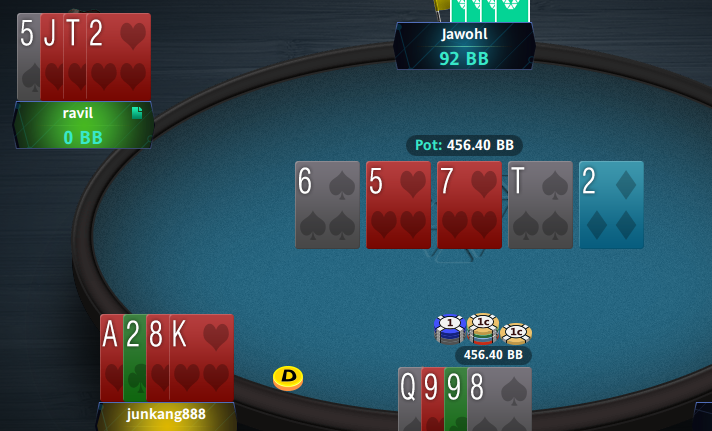
Sometimes I might complain how opponents have sick luck. Today I got some sick holds with nuts versus aggros. I sort of killed the afternoon games as I stacked off aggros few times and they all quit. This was one of the last hands of the session, after this one (stacked yellow aggro and green good customer) the games died. Money went in on the flop in single raised pot.

Spoiler


Reply
Quote
Coach
Kyyberi
Joined: 09.07.2010

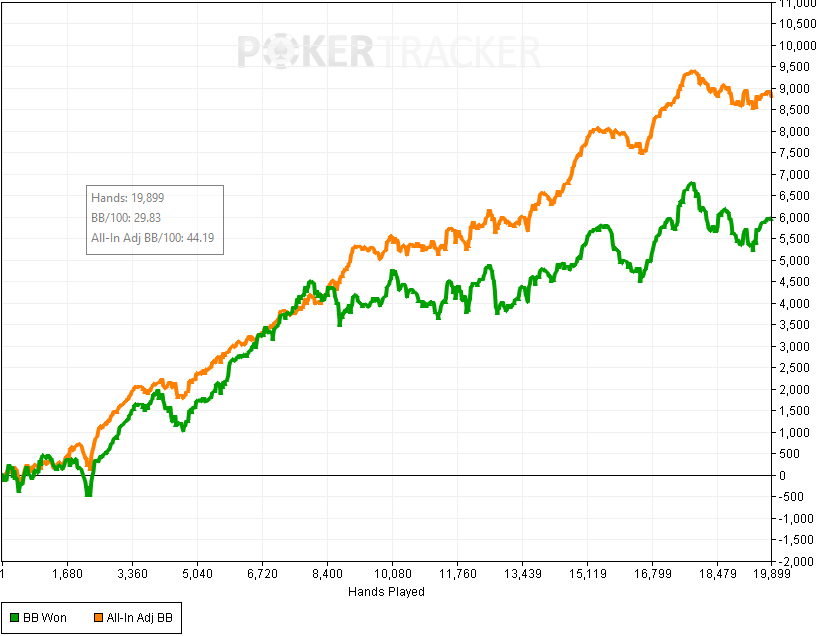
Here is the graph from last 2 months. Combination of PLO5, PLO10 and PLO20. It seems to miss some hands, as the profits don't add up to what I see on the balance. I am up over twice as much that is shown in the graph. I tried to get all hands from my 3 computers, but looks like I missed some. So my real graph would be probably even more sick.

Spoiler


Reply
Quote
Coach
Kyyberi
Joined: 09.07.2010

Today in stream I got this idea of making a AoF PLO project during the holidays. Few days of leaderboard grinding, and we can see if the games are beatable or not. And if possible, we could have a raffle for status upgrades and maybe more for prediction of the results.


Reply
Quote
NemoKala
Joined: 21.09.2008

Totally awesome writings from you :f_thumbsup:


Reply
Quote
Coach
Kyyberi
Joined: 09.07.2010

Another session with really mixed feeling. Can't take graph as I don't have PT4 on this computer. But session started well, and then I lost 600bb pot with flopped nuts and straight after that 400bb pot when opponent had 3 outs on turn all-in. Also quite many set vs flush draws lost. Grinded back up and in the end the day was virtually break even. EV very profitable, so should be happy. But still...

There was also known maniacs at the tables, and damn it's frustrating to play against them when the strategy just doesn't pay off. Draws miss, flopped sets get horrible runouts, every slowplay is lost cos opponent hits that 2 outer on the river and you end up paying the value, and when you get the money in with nuts he sucks out. But it's important to remember, that those guys are down a lot versus me. Long run matters, and good question to ask yourself when running bad (running under EV a lot) is this:

If the lines are switched on the graph (EV turns to winnings and winnings turn to EV), would you be happier than now?


Reply
Quote
leveleleven47
Joined: 13.08.2023

PLO is a tough nugget. Variance wise like spins. At least that what i have encountered.
Quite often I experience stretches of hundreds of games where everyone always gets there, values are valueless, aces get a walk, and every whale becomes a pro herocaller with their bottom range.

You said, `EV is very profitable, so should be happy. `
Maan, no one is every happy losing, especially when losing a lot and fast regardless of the EV, well I can’t speak for everyone, but it is very true for me. As for other way around, I don’t really care or think about that much as I know what’s the EV in the long run. I know it’s a little paradox, but it is what it is.

This year I got much, much better at handling swings. Basically, I have managed to kind of remove emotional input in that regard. I have set my goals and daily quotes and that’s all that matters.
So, when a rough stretch happens then I just say to myself, well anyway I put in x number of games.

I think that last year’s 6k games downswing made me stronger and taught me not to emotionally invest and ruminate about it but rather strongly focus on playing my best, when best rested and prepared.

Btw very cool post you made above.
WHAT AFFECTS OUR EV, WHAT IS PERFORMANCE LEVEL?

GL


Reply
Quote
Moderator
aedigao
Joined: 28.09.2011

following :f_drink:


Reply
Quote
Coach
Kyyberi
Joined: 09.07.2010

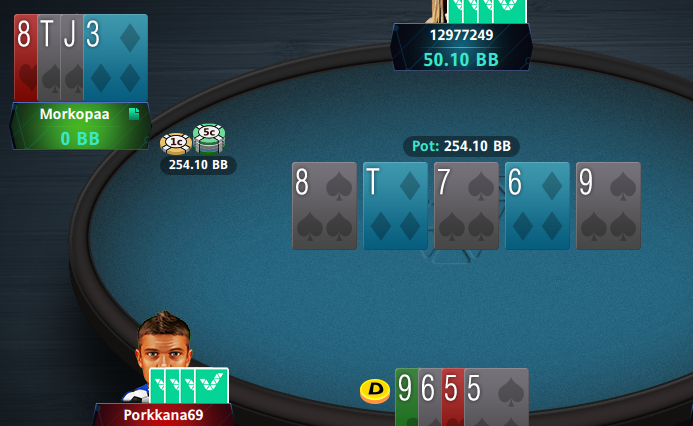
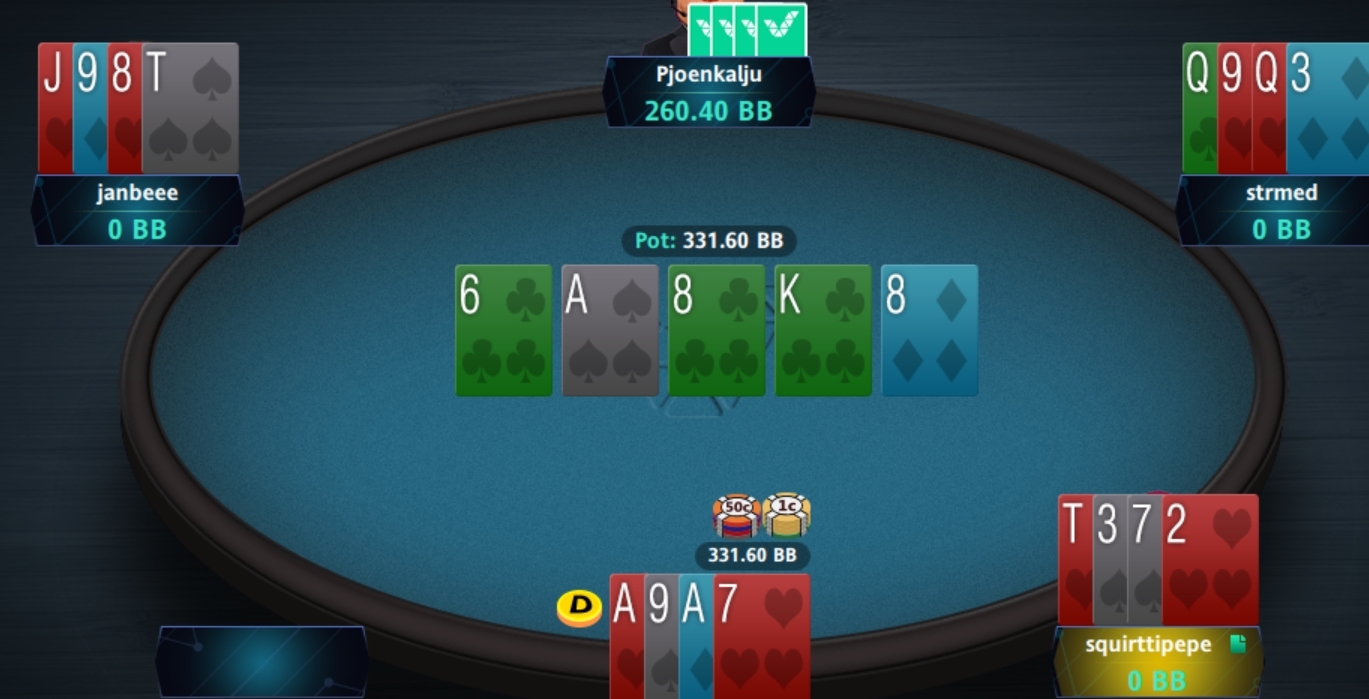
Got my first straight flush vs straight flush ever today. Too bad there's no bad beat jackpot on the site.

Spoiler

Of course opponent is good customer who stacks off on the flop with any flush draw, 2 pairs etc. Money went in on the flop and I was happy to see the river for a second.

Also one 98/3/0 gentleman decided to first get quads vs my nut boat and then twice hitting nut flush versus my 2nd nut flush. Kinda player who calls down post flop with any flush draw and calls the river bet, of course I valuebet river big with K high flush. He had a sun run and just hit everything. Session went up and down, in the end patience paid off and ended couple buyins in profit. But got so many bad beats that I wasn't even that happy after the session. When session ends in +16bb/100 winrate, it should be considered as good session. But all the lost and missed chances felt like I was robbed.


Reply
Quote
Coach
Kyyberi
Joined: 09.07.2010

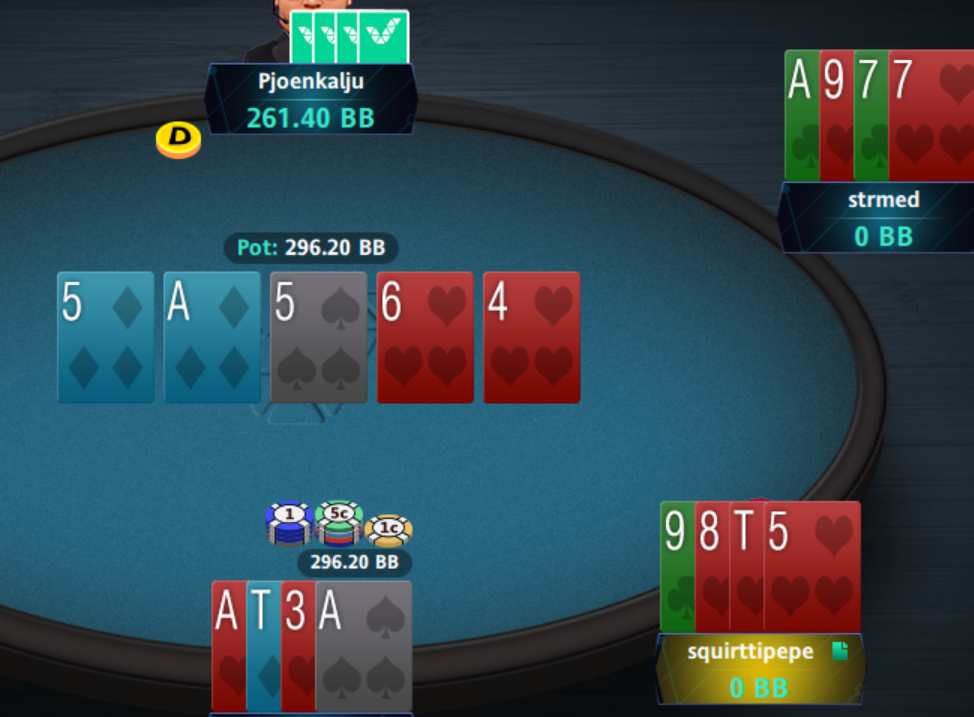
Got a sick hold today. And then 2 hands later got another sick hold. Both of these were preflop allins.

Spoiler


There was one player on tables, a bit aggro reg. I won one pot from him with a suckout, and oh boy did he tilt! He started 3betting 100% of hands, and pretty much potting flops almost 100% of times. Played 8 tables, so there were chips flying all over! I did get few buyins on top of those two big pots, but most of the times didn't really connect with the flops well enough. Not sure how his evening ended, as his stacks were going up and down on all tables. But most opponents played badly versus him, calling with weak draws on flop and turn and then folding rivers to third barrell.


Reply
Quote
Gothicrow
Joined: 15.11.2010

In the years I've been playing I have learn 3 things:

1. Variance is WAY bigger than we think.

2. A lot of our win rate comes from loosing less when variance is against us.

3. Most of our winnings come from small pots when we are NOT all in.

It is relatevily easy to play good poker when cards goes our way, but the important thing is to play good poker when cards doesn't go well for us.

Good luck man!


Reply
Quote
ghaleon
Joined: 17.10.2007

Minor tilt issues there. Was it even big suckout with 10% or less equity? :)


Reply
Quote