What's going on Pokerstrategy? As an NL100 online cash game reg and micro stakes coach, I was naturally the number one choice to go smash the $40,000,000 WPT World Championship as a replacement for Barry Carter. Follow my blog and smash that subscribe button on my youtube channel!. During my preparations I discovered a not well-known secret - there is this thing called "ICM", and all the papers claim it doesn't actually mean "Ice Cream Madness" but...
The Independent chip model.
What is it? It was originally a horse racing results prediction tool by David Harville developed in 1973, and later adapted by Mason Malmuth for poker. I've run the math and surprisingly, there is a slightly higher chance that the poker variant will be more important to me at WPT, so let's focus on that.

Tournaments are like a river - a river is a river, there's still water, but the environment changes. Sometimes it goes fast, sometimes slow, sometimes it's a very dangerous steep stream between large rocks, and sometimes it's what we in my country call the "Oil", or an eddy, where you can rest, and beg the front and back people to let you steer the canoe for once, trying to tell them that you won't tip everyone over this time. But enough about the boat camp when I was ten, overweight and my parents dressed me in pink.

The point is, that tournament poker is still poker, but when you change the incentive structure, such as payouts, the optimal NLH strategy will take this into account and change as well, much like an experienced canoe operator at a wild river. ICM is just a simplified model that tries to approximate a VERY complex of holdem with payouts. Much like my workout routine and diet not counting on that future action of the meatloaf at midnight after a few pints, ICM doesn't account for example for future action, skill and mistakes of you and opponents and the fact that different stack sizes can realize equity differently.
The principles of the ICM
The main principle is that in tournaments, every chip you earn is worth less than every chip you lose. The reasons are pretty simple - you bust out, so does your tournament life, and you earn 0. You busting out also increases the EV of everyone else.
Graph for average stack size:
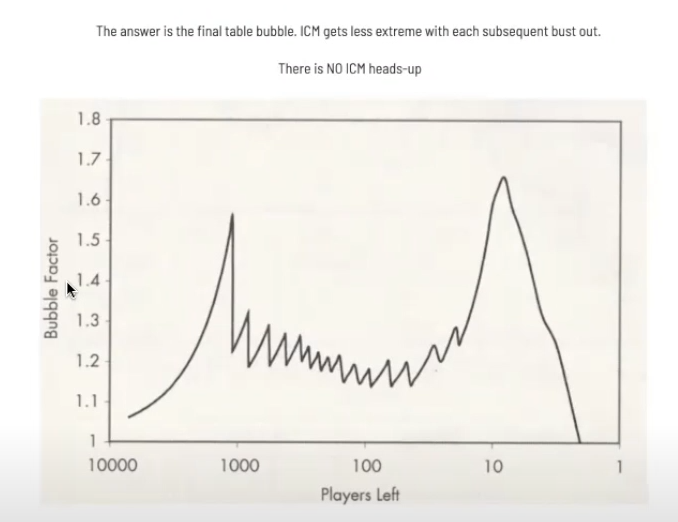
When you are at risk of busting out, there is a "risk premium" on your losses, and what they call a bubble factor.

Yeah, that's right - the more bubbles you can blow at a party, the more of the opposite sex you will attract, everybody knows that. It is also the ratio between how much tournament equity ($EV) you'd lose getting stacked, divided by how much $EV you'd gain stacking another player in the tournament. ICM Isn't much of a factor early on, the more people get eliminated, the more ICM has an impact. Before the final table, the impact is the highest and drops with every elimination. So the nearer you are to these peaks, the more ICM comes into play.
The extremity of ICM difference to ChipEV is the highest
- right before the bubble
- right before the final table bubble.
Why is that? Well, let's take an extreme example. You play a satellite in WPT World Championship. 3/4 Places are paid, 4th place gets nothing and you are on the button. Co has a tiny stack and has folded, and now you are up against two bigger stacks.
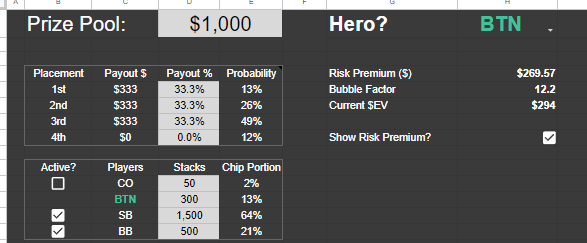
Your bubble factor will be absolutely gigantic here because you have a 6x bigger stack than the shifty CO who folded and hopes you do something like this:

In this case, if we double up, we get a solid $24 in equity. That's compared to $294 loss if we lose our stack. There is just a gigantic risk premium added for you throwing away your stack when you have a tiny stack in who takes "your place" when you let one of the bug guys stack you off.
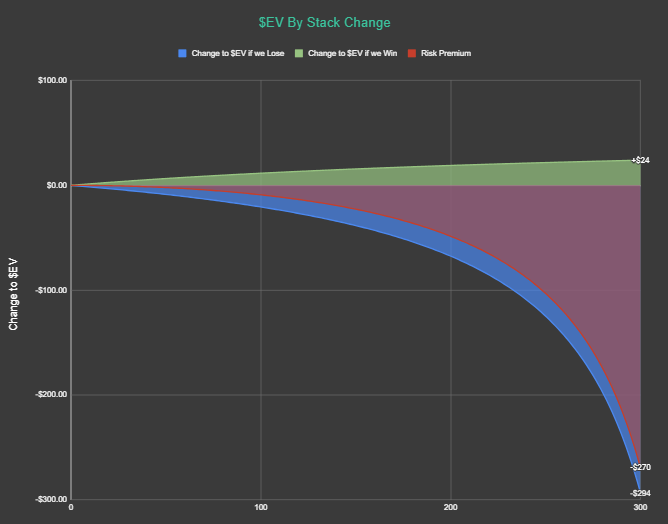
Spots like these are the times when you can look at aces and consider throwing them in the muck

This is more of an extreme example. If we take e.g. 4 handed payouts of 50%,30% and 20% and everyone has equal chips, your risk premium on busting out will be about 2.1, or you lose 2.1x more equity if lose your stack than if you double up.
Spoiler
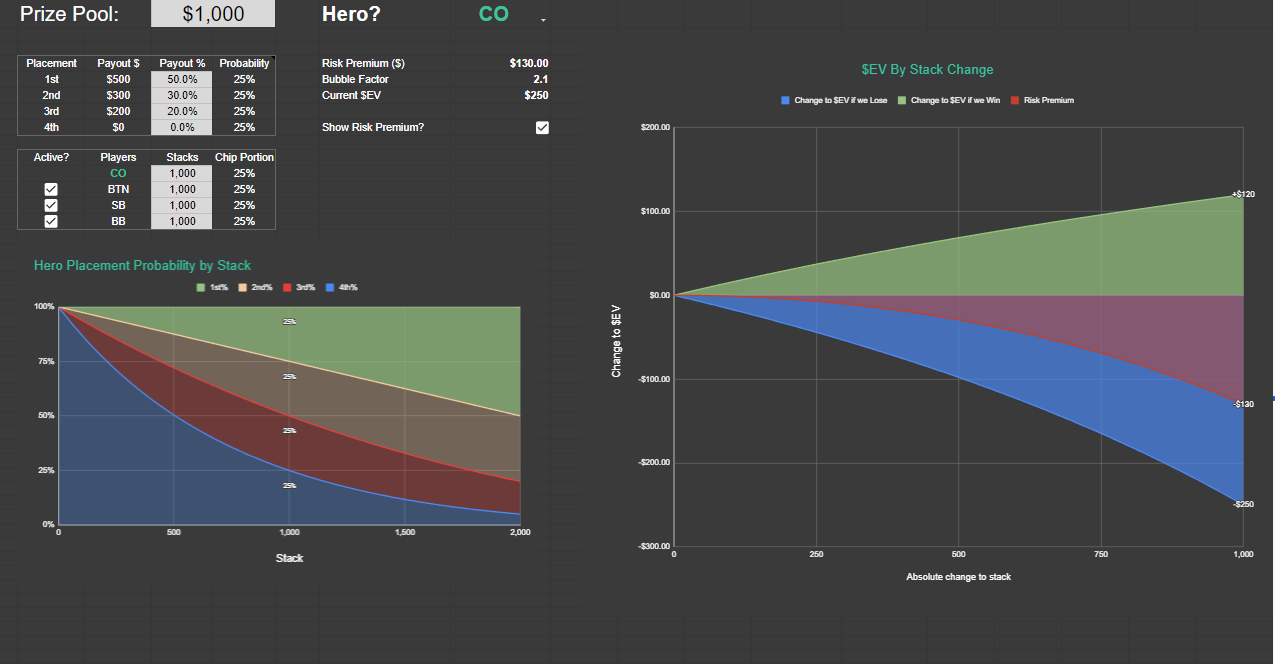
When you play a middling stack that can be at risk, when other people are low and can bust out, ICM will always be a big factor in "high ICM pressure" situations.
Those who do not have to care about ICM much, and who have a low-risk premium are either very big or very small stacks.

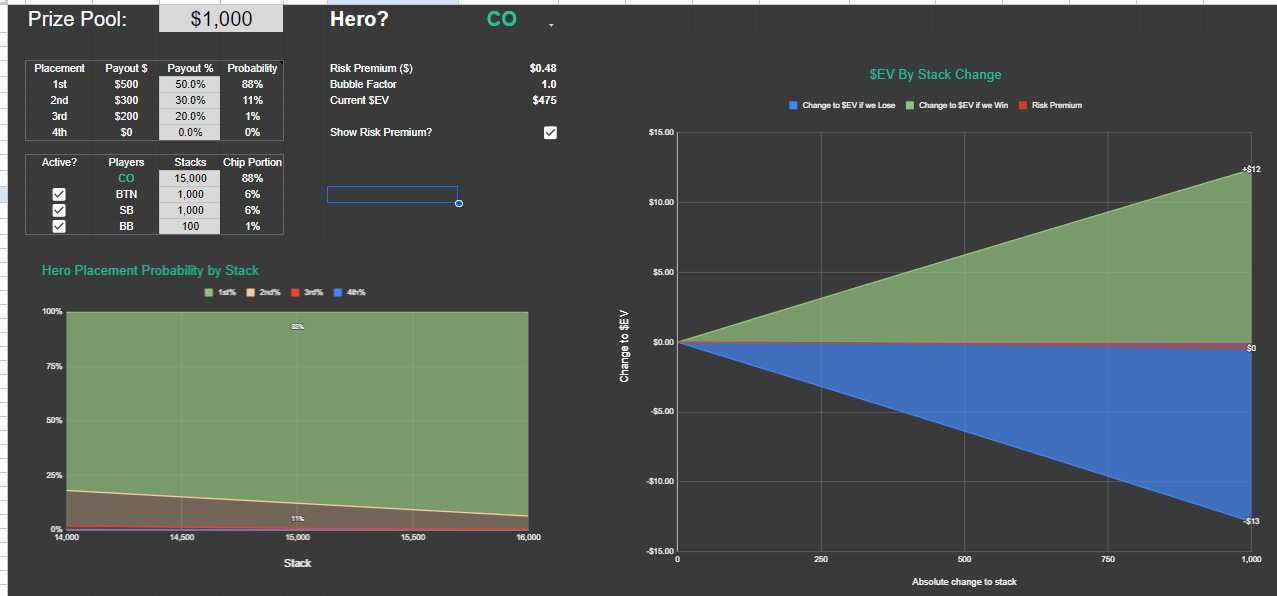
Let's say you have 50% 30% and 20% payouts, and you somehow take your small-stakes cash games coaching skills like Mr. MTT noob Lemon over here to smash everyone and build up a 15,000 chip stack size, two more players have 1000 chips, one last straggler, let's call him Kyyberi has only 100 remaining. Well, you are not at risk at all when you stack off, taking a guy out bumps you up a notch, you ain't risking much by jamming on one of the shorties. Or, somewhat surprisingly if you look at it from the other perspective, the chips in your big stack are not worth as much in $equity as the little ones. You got 88% chips in play, but can only get the first place prize, your risk premium is tiny and so is your bubble factor.
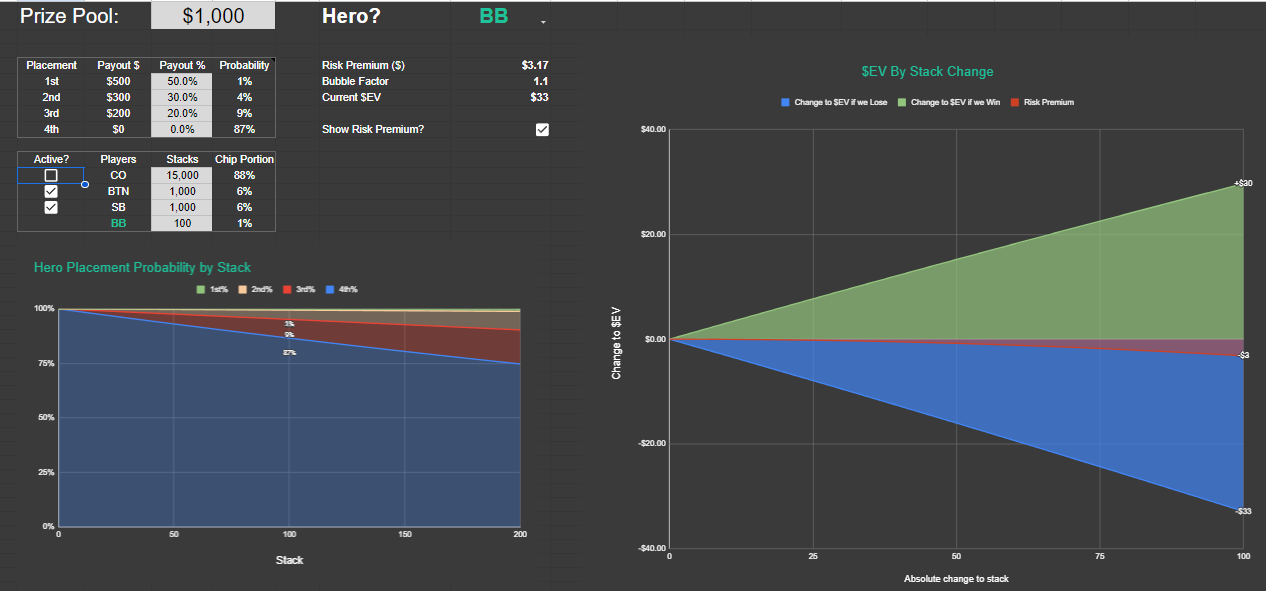
And what if you are that PLO Donkey who I will smash in worms along with Barry Carter when we will recap the poker year 2023 between the holidays? Well, you are pretty much wrecked, your chances are low, and you have 10x bigger stacks above you, but your chips are still worth a bit more than what they would be in cash games. You just play near normal ranges with your small bubble factor.
What does it ACTUALLY do?
Well, now the fun begins. Obviously, you have a risk factor, sometimes a massive one - unless you are the YOLO tiny stack or the big bully honey badger stack who just doesn't care, you will need to play tighter when you can risk your stack, be real cautious not to bust out and let the other players take your place on the ladder.

Naturally, this goes both ways - the stacks with much lower risk premiums can apply what's called ICM PRESSURE and bully the hell out of you. This means that you have to tighten your preflop ranges, and they get to loosen them, it creates asymmetry in optimal play - you are both playing with a different bubble factor all of a sudden, pot odds related to money don't work as they should do, and the universe is upside down.

The fun thing for cash game donkeys who see MTTs as a "short stack, I jam" kinda of deal is, that as the risk premiums increase, every chip is worth more and ICM effectively deepens the stack effectively.
The Practicalities
Well, really this is a relatively new thing. The main resource is the Holdem Resource Calculator everyone uses, e.g. Pairrd pre-run for you and gives you access to a neat little database where you can click between ChipEV and ICM. You can toy and check out GTOWizard to see the difference between ChipEV and ICM as well, they are currently working on adding post-flop as well. What I hope I showed you is that every scenario is unique, in big fields it gets extremely complex to quantify than in the 4 handed simplifications, most MTT players get a "feel" and are master adapters.
ICM Also is a static model, it's only a simplification, a lot of stuff can "depend" on actual circumstances.
E.g. if there is a 3way tournament for $1000 and Chips are distributed
Player A = 500 chips
Player B = 300 chips
Player C = 200 chops
The button will be able to realize more equity, and players can realize more equity at different chip sizes, e.g. smaller stack sizes will have an easier time realizing their equity arguably as they can just jam their stack. Your standard open ranges go out of the window based on players behind you, e.g. - If the short stack with a low-risk premium who should be jamming near wide ChipEV ranges don't shove enough behind you you can now be flatting loads more hands in late positions. If people ignore ICM and don't play tighter, and 3bet more you can make big adjustments of your own - the situations are so ever-changing and complex that almost nobody can play perfectly, definitely not post-flop and in practice you will be just guesstimating.
Thank you so much for reading this cash game donkey's couple days of study of ICM, I don't see how I can now not win the World Poker Tour World Championship. Point out my errors, let's have some examples and advice.
Sources/Resources:
ICM Quiz by Barry carter and bencb
Visualising ICM in poker - GTOWizard
ICM visualiser 4 handed - used in for examples, you can change them yourselves.
ICM With Dara O'Kearney podcast
What is ICM - Article and video by BenCB
Fedor on ICM limitations