Skip to forum
Planning, working, ...
 
Notifications
Clear all

Planning, working, learning => winning (starting NL2) => moved up to NL5

21 Posts
6 Users
8 Reactions
1,733 Views
Talisker74
Joined: 17.08.2009

Hi,

this blog is just another microstakes blog...
Hopefully you will look in from time to time and give me some constructutive feedback.
I try to answer evry constructive comment, even it would take some time, the reason for this is, that i am a recrenational player and poker is "just" my number one "hobby".
I have a job, family and friends and therefore not more than lets say 2 hours time per day for poker, sometime a bit more on the weekend, but not always.

So what can you expect here?

I want to improve my poker skills and mindset and climb up the stakes from the very ground (NL2) up to? -> who knows no specific limit.
So the start is on NL2, playing regular tables only on 888 poker.
I will play 2 - 4 tables to have focus and implement things i learned into my game.

This blog is to force me a bit to be consequent and follow up my rules and get support from the community.
Actal I`m highly motivated to put in effort and work on my game.
So i started to write down a list of my leaks, i wanted to sort the list and than start working on the leak with the highes priority...
but the list was way to long... within just a few minutes i had more than 30 bullet points on it!
That showed me, that i have to make a lot of theory...
So i looked at my poker material and, what should i say it is really much...
So i struggeld in sorting it and find a good start.

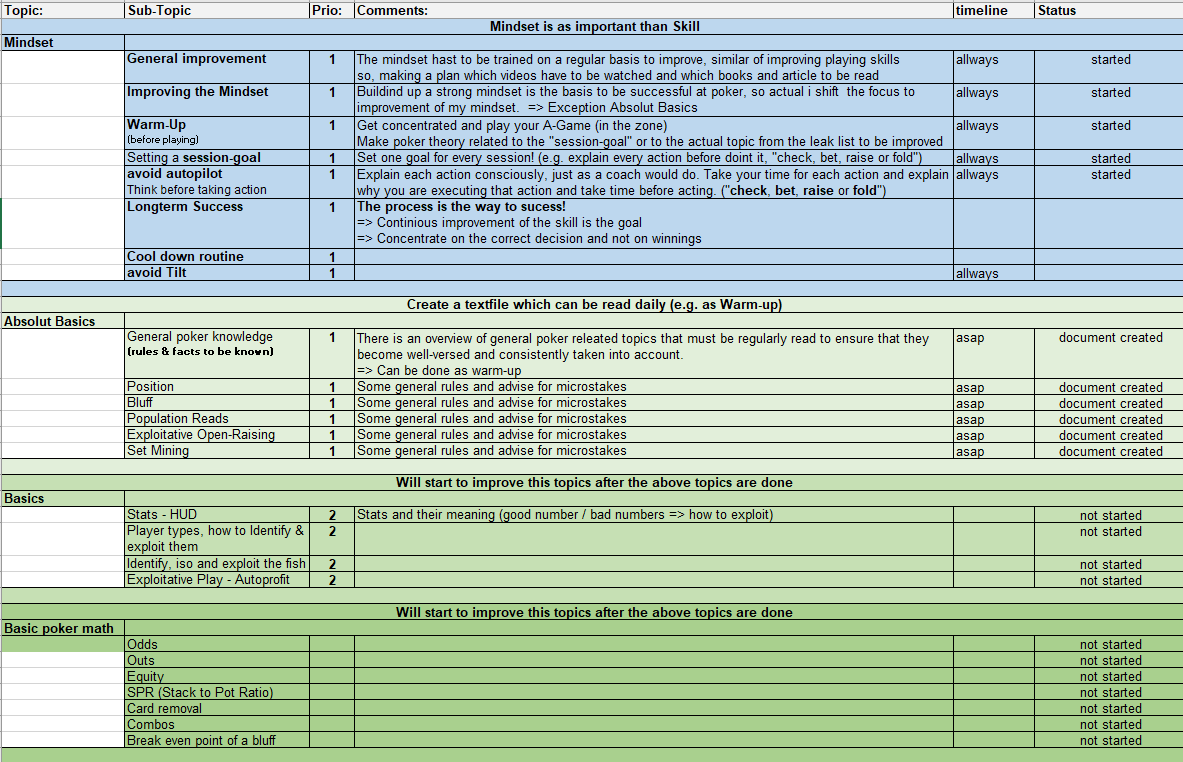
But i do not want to waste time in learning 20 topics in parallel , so i decided to make a list of topics i have to learn as a starting point:

So that list is set to stone, if you have suggestions for changes, please feel free to tell me.

I started before starting the blog, so first mindset outcome:
Developing good Poker habits
Play regular tables only
Define one goal for each session
Make a warm-up for every session.
Table select -> at least one weaker player at the table
Colour-code players to exploit them
Take care of the information from your HUD to exploit the villains (take care of sample size)
Work on your leaks on a daily basis (identify, prioritize, fix)

So, actual my focus is on improving my mindset and focus on the basics.
Playing NL2 might help to gain self confidence and improving step by step.

The process is the way to sucess! => continious improvement of the skill is the goal.

So lets start and take action.

Thanks for reading and GL at the tables


Reply
Quote
20 replies
Talisker74
Joined: 17.08.2009

Hi pokerfriends,

i worked on my learning and made some changes, because goals have to be timeboxed,so my actual plan so far.
The next update will be given on mid of October:

And here what i have written in a textfile as a warum-up:
• The two biggest traits of a winning microstakes player:
=> Ability to make thin value-bets vs. weak opponents who call too much
=> Ability to make big exploitative laydowns in spots where opponent is rarely bluffing (e.g. folding overpairs (AA & KK))

• Focus on the correct decision and not on profits
• It is a marathon and not a sprint -> sample size

• Always stick to your BRM! It will protect your roll and lower your risk of ruin!
• Take short and agressive shots to next limit
• Losing is part of the game -> AA vs any PP = 80:20 every 5 times AA will loose
• Every BAD BEAT shows me that i played the hand totally correct

• Controlled, aggressive positional play is the key to success in No-Limit Holdem
• Patiently wait for strong hands
• Big pots are for big hands and small pots are for small hands
• Tight is right!
• Winning by folding!

• Take time before making a decision -> think about why taking this action (check, call, bet, raise, fold)
• Take care of the ranges => attack capped ranges very often
• Bet mostly for value (including strong draws - nut potential) -> bet for thin value vs. weaker players
• Make thin value bets (on river) bet small -> target are players with a "WTSD% 25+" on the HUD (sample size)
• Why do i bet? - value - protection - bluff - dead money
• hand planning -> on which cards can i bet? How many outs do i have?
=> think ahead => exploits on later streets (stats/sample)
• The best playability have PocketPairs, Ace King, suited Aces and suited connectors
=> Sets, Straights, Flushes and top pairs with Top Kicker (best with position on villain)

• Play as exploitable as possible! (pool tendencies and colour coding)
=> use autoprofit actions whenever possible (e.g. Float bets, Probe bets, bet check bet)
• Oversteal Preflop (especially from BTN and SB)
• take care of marked players (e.g. don`t bluff yellow and green players -> they will fold to less)
• check raise flops OOP more often => Nuts, Nut draws and some weak (backdoor) draws (sometimes air vs. good regulars)

• bluff less (We can bluff best based on reads and stats -> against regulars / good players who are able to fold)
• Bluffs should be small over 1 or to 2 streets (vs. thinking player) => generally villains call too much, so it doesn't work well
• We don't make money with bluffs by trying to get weak players to fold medium or strong hands

• Take attention to your open raise size / bet size
=> think carefully about your own sizing, try to exploit villain

• Don`t go all in with...
=> AQ -> especially pre-flop!
=> 65s -> trips with a bad Kicker
=> J9s -> with straights that are not nuts
=> 45s -> never go all in with baby flushes

• Monsterdraw (OESD with FD) go only All-in at the flop, => at the turn there is a big loss of exsisting equity
=> continue playing passively on turn and river without hitting
• A set at the flop is always a monster
=> Never fold on the flop
=> earliest street to fold is turn, better on the river => we have 9 outs to make a Fullhouse and 1 additional out to make quads

Postion:
=> Play IP most of the time, because
=> Information advantage
=> You can close the action
=> It is more easy to Pot-Control => both, playing for a smaller or a bigger pot (check, call or raise)
=> take care of your and villains position => Precieved Ranges

Bluff:
=> Should we bluff on the micros? Yes, but:
• The majority of our bluffs should be small and only last one or two streets
• Big bluffs should only be made against good thinking players who can fold
• We don't make money by trying to get bad players to fold strong hands
• Our best bluffs on the micro-stakes are based on stats (sample) or reads (notes)
• Do not bluff against calling stations
• Don't blow up pots with bluffs
• Bluff rather when your hand can still improve
• Bluff only players who can also give up and are able to fold
• Don't bluff against multiple players
• Bluff only if you can also represent something and your opponents have rarely hit well
• Never bluff on the turn if you have no backup that you can hold the best hand on the river

Population Reads for micro stakes:

• Limp 3bet = trapped KK+ = nuts => overfold
• minbet 3bet on Flop => nearly always nuts => overfold
• X/r as PFR => nearly always a set or better => overfold
• Turn check min raise => Nearly always the nuts => overfold
• River raises = nuts (at least very often) => overfold
• Call – call – donk (if draw completes) = nuts => overfold
• triple barrel = very strong value line = nuts => overfold
• The Pot Size bet over multiple streets = nuts => overfold
• 2nd barrel in 3bet pot => nearly always nuts => overfold
• Raise/Leads in Multi-Way Pots => mostly value only => overfold

• Overfold vs. agression espically vs raises on the river => take time for thinking!

Exploitative Open-Raising
• Only balance if necassary => vs good players
• raise larger for value vs. weak opponents
• raise larger when our postflop expectation is high
• raise smaller when our postflop expectation is low
• raise smaller when our opponent 3bet agressevely
• raise smaller to increase proftitability of steals
• raise smaller vs. shortstacks
• raise smaller with hands that benefit from a high SPR
• raise larger with hands that benefit from a lower SPR

Set Mining

Set-Mining vs. 3bets

Is it possible to set-mine in 3bet pots?
• Only if stacks are deep (risk/reward)
• Only if the pot will be multi-way and we get better implied-odds

But it is possible to setmine in a 3bet pot 100bb deep?
• In most cases NO!
• However it is ok in situations where our opponent has an extremly tight range and doesn`t 3bet overly large
• Position increases implied-odds
• Most common situation is we open UTG/MP and got 3bet by one of the blinds
• Opening smaller makes it easier to set-mine
• Recommended to primarily set-mine 88+ for set over set reasons and also so we don`t start calling 3bets too wide

Postflop strategy when set-mining:
• Fold often if we miss our set, doesn`t matter if we have an overpair
• Fold nearly always if on the board are two or more overcards

Equity on Flop
• set on the Flop is allways a very strong hand
=> bet big for value
=> never fold on the flop => we have 9 outs for an full-house and 1 Out for quads
=> if we are forced to fold than on the river

Any thoughts on that?

Thanks for reading and GL at the tables

Talisker


Reply
Quote
taavi1337
Joined: 29.05.2009

inspiring! I am also learning textfile creation and reading as a new gamedev business launcher, owner and programmer.

By Microstakes you mean NL2 ? Or NL2-NL25 ? Cause already NL2 and NL10 can differ quite a bit.


Reply
Quote
Talisker74
Joined: 17.08.2009

Hi Tavi,

thanks for yur replay.Micros are NL2 up to NL10, even in my eyes.

GL at the tables.
Talisker


Reply
Quote
Talisker74
Joined: 17.08.2009

Hi guys,

actual I`m working on a new tagging system for my villains..
Iwould be great if an experienced player could give some feedback to the playertypes.... and if my thoughts to identify them are correct:

Most common player types
TAG (red) => 23/18 good // 25/20 19/15 Range
Limper/Bad/ (lime) =>
Shortstack (yellow) => below 70bb
LAG (light blue) => 35/30 - 30/25
Nit (purple) => 18/14 and lower
Loose Passive (yellow green) => 30/5
Tight Passive (green) => 20/6 oder 15/6
Whale (orange) => 50/5
Maniac (deep pink) => 40/35 and above /allways a high PFR
Calling Station (dark blue)

GL at the tables
Talisker


Reply
Quote
AdyeDan2
Joined: 12.10.2016

Great way to start your poker career, with planning and action anything is possible. Good luck man!


Reply
Quote
Talisker74
Joined: 17.08.2009

Hi guys,

maybe you can give some feedback if my assumptions are coreect.
And if possible how to identify calling stations? - high went to show down, but what means high?

Adapation vs Player Type

Regular (TAG) Range 19/15 bis 25/20 gut 23/18 (red)
• Avoid if possible => Money is easier to win
• Bluffs with a very low frequency, bets nearly for value only => overfold
• Action, raises, big bets, (River) are nearly allways the nuts => overfold
• has a game plan, thinks ahead and is bluffable => selective bluffs (1* - continues only with strong holdings)
• Only use good reasonable spots as a bluff => betting as a bluff, 1* max 2*
• Only bed strong value hands, pay attention to the board => Avoid difficult spots
• betting only nut draws as semi-bluff => generate value
• barrel nuts over all streets (2pair+) => generate value
• Marginal hands, best fold preflop => Avoid difficult spots

Limper, Recreational player, Fisch (green) => weaker Spieler
• Often calls down due to curiosity => do not bluff, but instead bet for value
• normaly plays passive, no bluff-induce possible => bet yourself
• Bluffs the river more often than a regular => bluff catching possible
• do not bluff, but instead bet for value => expand the value range
• bet bigger with strong hands => generate more value
• check down with marginal hands => realize showdown value

Shortstack (yellow) => weaker player
• take care of effective stacksizes => bet smaller
• drawing hands sometimes not worth playing => suited connectors, small PP (make more folds preflop)
• make more value bets, widen the value range => e.g. Bottom Pair
• bluff only rarely (specifically) => make more value bets, widen the value range
• bluffs the river more often than a regular => bluff catching possible

Loose agressive 35/30 - 26-21 (LAG) (hellblau)
• play tighter preflop
• make less steals with a LAG sitting in the blinds
• If we have a thin decision on the flop, think about calling, because of wide 3 betting range

Nit 18/14 and lower (purple) => weaker player
• super tight => attack Blinds frequently -> makes to many folds
• super tight, action often only with QQ+ AK, sets => overfold vs action
• Speculative hands are valuable (suited connectors) => two pair, sets, straights, flushes are paid off very often
• if we beat pocket aces => bet for value (sets, straight, flushes)

Whale 50/5 (orange) => very bad player
• Often calls down with air due to curiosity => Massively expand the value range (A high!)
• do not bluff, but instead bet for thin value => expand the value range
• bet bigger with strong hands => generate more value
• normaly plays super passive, no bluff-induce possible => bet yourself
• bluffs the river more often than a regular => bluff catching possible
• check down with marginal hands => realize showdown value

Maniac 35/30 and above /allways a high PFR
=> that does the maniac => This is how we play
• often cold calls an open raise => be tight -> ask your self -> Am i going to go all-in with my hand?
• is very agressive (cold 4 bets) => be consequent, call him down or fold directly, latest on the flop
• more often all-in preflop with small PP or Ax or broadways => You can go all-in preflop a bit looser than normal (TT+ and AQ+)
• bluffs very often => you can slow play your big hands for bluffinduce
• often bets and raises very big, potsize or even higher => be consequent, call him down or fold directly, latest on the flop
• plays a wide (weaker) range of hands => play tight

Calling Station = >How to identify?
• do not bluff, but instead bet for thin value => expand the value range (weak second pair+)
• bet bigger with strong hands => generate more value
• normaly plays super passive, no bluff-induce possible => bet yourself
• check down with marginal hands => realize showdown value

Thank you for reading

GL at the tables


Reply
Quote
Talisker74
Joined: 17.08.2009

Hi,

here are some routines i want to execute every time when i play poker.
Any thoughts on that?

Every time i play until end of the year, i will take care of the following:

Play regular tables only
Define one goal for each session
Make a warm-up for every session
Table select -> at least one weaker player at the table
Colour-code players to exploit them
Take care of the information from your HUD to exploit the villains (sample size)
Work on your leaks on a daily basis (identify, prioritize, fix)

I will do that at least until end of this year, hope that helps to develop some good poker habits.

Thanks for reading.

GL at the tables
Talisker


Reply
Quote
Talisker74
Joined: 17.08.2009

Hi,

so actual i managed starting to implement some positive poker habits:

Play regular tables only => done
Define one goal for each session => done
Make a warm-up for every session => done
Table select -> at least one weaker player at the table => done
Colour-code players to exploit them => done
Take care of the information from your HUD to exploit the villains (sample size) => done
Work on your leaks on a daily basis (identify, prioritize, fix) => done

Can someone recommend some good stuff to learn to improve the blind play?
I mean stealing and restealing?
Maybe some vids or articles?

Thanks a lot guys.

GL at the tables
Talisker


Reply
Quote
Talisker74
Joined: 17.08.2009

Hello,

I would like to document my goals and progress related to poker in this blog, and regularly update it to ensure continuous improvement and exchange with other players. Below, you will find my bankroll management (BRM) strategy adapted for 888 Poker and the goals I have set for myself to achieve by the end of the year.

Next, I will focus on statistics, specifically on the important ones that should be included in the HUD. I would appreciate any feedback you can provide on the information I have gathered so far.I would also greatly appreciate any recommendations for learning materials and information on the number of hands needed to make initial conclusions in different situations.

Here what i have so far:

Stats => The more information/hands we have, the better informed our decisions and actions can be

VPIP (Voluntary Put in Pot) => some hundred hands needed => 250 hands minimum
PFR (Preflop raiser) => some hundred hands needed => 250 hands minimum
3bet Preflop => average 4% => good 7-8% (less than 4% tight > 8 quite light)
1 = Nuts => KK+
2 = ridiculous tight => QQ+ & AK
3 = very tight => JJ+ & AK sometimes AQ & TT
4 = tight => all premium hands
5 = moderate => strong range and some semi bluffs
6 = slightly loose => good balance of strong hands and light holdings
7 = fairy loose => a few more light hands than value hands
9 = slightly out of line => light holdings and bluffs quiete often => play back
10+ = out of line => very bluff heavy
Fold to3bet Preflop => average 50% => good 60% (more than 67% directly exploitable)
Cold Call => 11 to 12% good
4bet =>
4bet range =>
Fold to 4bet => if 60% => bet aggressive (sample needed – at least 2.5k hands)
4bet ratio => 2.5k hands are needed
1 = KK+ => sometimes QQ & AK
2 = All premiums most of the time
3 = All premiums most of the time => + some light holdings or (semi) bluffs
4 = lots of strong holdings => + some light holdings or (semi) bluffs
Limp => open limp -> identify “fish”
Limp fold to raise =>
ATS (Attemt to Steal) => 40% quiete good => if larger than 150 => open any 2 => autoprofit
FTS (Fold to steal) => more as 67% is directly exploitable
Fold BB vs SB Steal => 50% quiete good
RFI by position => UTG – 13 / MP – 18 / CO – 26 / BTN – 48 / SB - 38 some hundred hands needed
Cbet Flop => 50 to 55%
Fold to flop cbet => 40% (average) => 50% good (Turn and River more easy to play)
raise vs flop cbet => 7% average => 12-15% is a good number
fold cbet to raise => higher 55% - raise aggressive
Donk Flop => 10-15% good (multiway: -leading with Nuts and Semi-Bluffs)
Fold to Flop Donk => higher 60% directly exploitable
Cbet Turn - % => 52 to 55% good
Ftcbet Turn - % => higher 60% directly exploitable
Cbet River =>
Fold to River Cbet => (sample needed – at least 2.5k hands)
AF => 2 good (2 means betting is 2 time often than calling, checking or folding)
1 = extreme passiv
2 = passiv
3 = average agression
4 = very agressive
5 = maniac agressive
Afq => 14% good (combined with other preflop stats)
# hands - gives samplesize of hands of opponent
WTSD => 25% good (even slightly lower)
WWSF => 50% good
W$SD => combination required, not easy to interpretate

Thanks for reading.

GL at the tables
Talisker


Reply
Quote
N3bojsa
Joined: 03.06.2012

Originally posted by Talisker74

Next, I will focus on statistics, specifically on the important ones that should be included in the HUD. I would appreciate any feedback you can provide on the information I have gathered so far.I would also greatly appreciate any recommendations for learning materials and information on the number of hands needed to make initial conclusions in different situations.

Hi there ;) I would suggest you two things:
Firstly, don't get too caught up in statistics. Some of the stats require huge sample size and honestly focusing on stats takes your attention away from what is really important. I am not saying stats are bad, just be careful to make big decisions solely because of stats only. For example, it not that unlikely your opponent will have good hands couple of times in a row (=will run hot) and because of that you might make huge mistake... Try to use stats for categorizing players mostly (fishes and nits are most common opponents at these stakes, then you have couple of weak regs), but overall focus on playing good poker
Secondly, your best study material is your own database. Try to go over hands that you played and look for patterns. What types of hands are your opponents showing you in certain lines? Do they bluff? What lines they always have nuts in? And then, try to think about how can you counter/punish those plays. Where it makes sense to fold and why, where you can valuebet...

Your plan an study routine seems solid, good luck on your journey! ;)


Reply
Quote
Talisker74
Joined: 17.08.2009

Hi Guys,

i need some help from you.
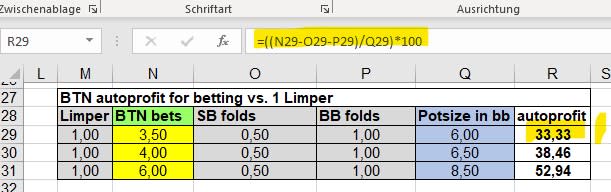
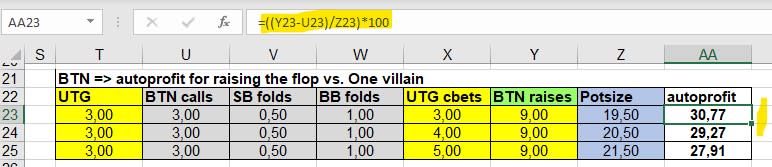
I started to learn some maths and created some formula in excel:

Can you please check if these two formula are correct and provide me some feedback?

Tanks a lot!

GL at the tables!

Talisker


Reply
Quote
Rhodriguez
Joined: 01.10.2006

Saw the other post Need help for some poker maths first.

To summarize my post there, the correct formula is RISK / (RISK + REWARD) where in your case the denominator is Potsize

Which meand the formula should be

=(N29/Q29)*100 = 58.33
=(Y23/Z23)*100 = 46.15

Keep that pace! Only one small question. Why having routines you only plan to have till the end of year?


Reply
Quote
Talisker74
Joined: 17.08.2009

Hi Rhodriguez,

Thank you for your help.

To answer your question, I have recently established my objectives for the end of the year, as I want to implement new routines into my schedule. Additionally, I plan to set further goals and try to integrate additional routines into my daily routine. Currently, I am focusing on learning as much as possible, and I would be grateful for any recommendations for free learning materials on the following topics:
(Or anybody else, would be very nice)

Thinking in Ranges
Blind Play
Defend The Blinds
Steals and Resteals

GL at the tables
Talisker


Reply
Quote
N3bojsa
Joined: 03.06.2012

Hi Talisker, took a look at your formulas, but Rhodriguez already pointed you in right direction, so I will just leave my two cents here...

Firstly you have decent work ethic here! Off table work always pays out in the long run. ALWAYS! However most people have no idea how long can actually long run will be (it is pretty long trust me...). Because of that it is important to allocate your study time wisely and effectively.

As mentioned above (and also in my previous post), don't get too fixated on stats, especially when entering waters like raising, check raising and so on. Keep in mind that in those spots, it is way better to focus on general tendencies and use macro approach rather than looking at individual stats of each player. I mean of course extremes do exist, but they are more rare than you think.

To give you simple idea, go into your database and pick the opponent you have MOST hands on. Then look at his raise/check raise frequency. And then - look at the amount of hands he actually was in that situation, how many opportunities he had to take this line. Then ask yourself a question - how would his stat change, if he happened to have nuts (or raising hand let's say) just two more times?

You see where I am trying to get with this? So rather than trying to figure what exact percentage they need to fold vs action x, or you can steal to autoprofit... Smarter approach might be to study most commonly used sizings first and know how to navigate vs those. If you don't know which, pick one sizing, the one people use. And then take it from there, have general idea, like "vs biger raise you can fold lot more" or "if they fold vs steal above value X, I can steal wider" and use those more general metrics, rather than dwelling on exact number. Your game will have less random noise and you can focus more on playing good poker overall.

As time goes, day by day, you will improve faster (and smarter)... And then you will actually have time and capacity to go deeper and deeper. To end up this rant I would like to encourage you to watch the following video, hope you find it valuable as I did:

Spoiler

GL at the tables (and off tables too, of course) ;)


Reply
Quote
Talisker74
Joined: 17.08.2009

Hi N3bojsa,

thank you again for your answer and the video.

I guess the video helped me to follow my plan.
I want to take the HUD for help, when I face difficult decisions and not know what to do.
So what i know right now, it will help me to make roughly estimates about different player types, because i have way to less sample to really exploit villains due to their HUD Stats.

Actual I spend a lot of time with maths, because i watched some videos about it and I think, that knowing the maths behind it will help me to improve my understanding and the gameplay. It is not the case that want to exploit villains "fold to check raise in a single raised pot" stats. But i want to understand where the autoprofit thereshold is in that spot. Because i want to make some analysis of Flops and try to figure out about the range villain could have in these spots. Than i can think about making a value check/raise (maybe with a semi bluff -> some draws to nuts). If villain folds -> good, because I win the pot. If he calls I will try to come as cheap as possible to shown down not having a strong value hand and figure out if my assumption about he range was correct.
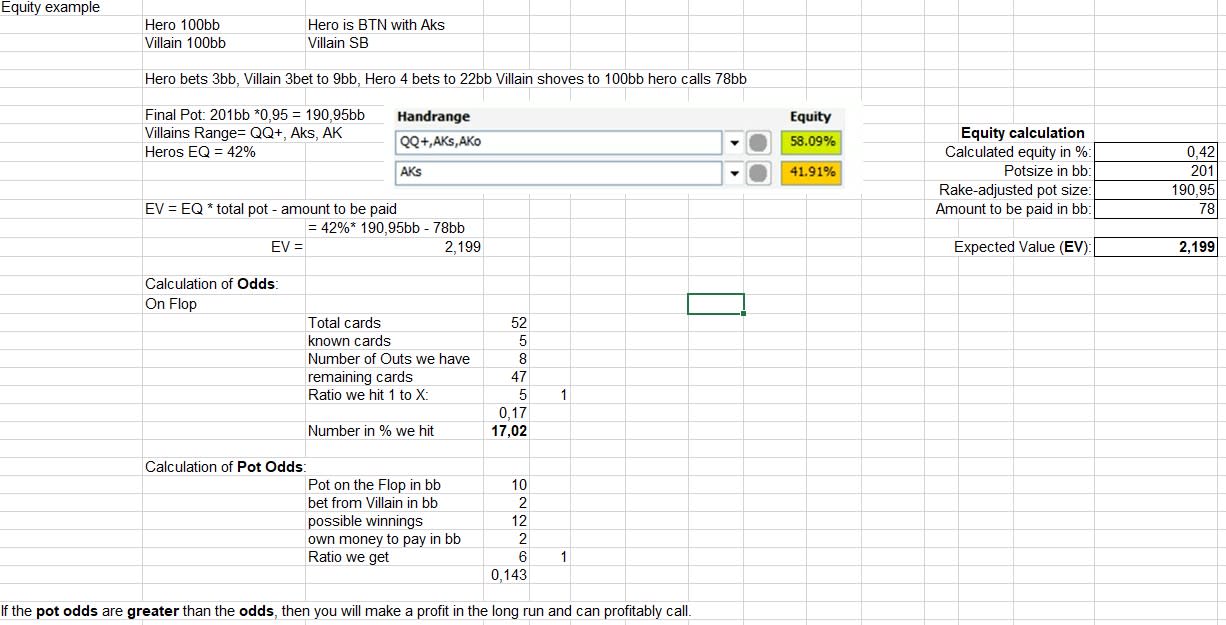
So i will start trying to figure out my equity with different hands vs. different player types on different boards:

In the past i did not make calculations of odds, pot ods and implied odds as well. So hopefully the math will help me to improve my overall understanding about poker and to improve other factors, like betsizing.

By the way can you (or anybody else) recommend some learn material about:

Thinking in Ranges
Blind Play
Defend The Blinds
Steals and Resteals

GL at the tables
Talisker


Reply
Quote
marsa08
Joined: 30.01.2014

Originally posted by Talisker74
recommend some learn material about:

Thinking in Ranges
Blind Play
Defend The Blinds
Steals and Resteals

GL at the tables
Talisker

Hi,

I don't have any traning material on this, but I would start by creating default defence ranges vs common sizes. One for SB and one for BB.

Once you have default ranges after that its easy. (All topics you mentioned)


Reply
Quote
Talisker74
Joined: 17.08.2009

Hi guys,

after making these restart i played round about 7k hands on NL2 -> which means i don`t have sample size to make some conclusions.
So i just can say that the green line is up and i can take a shot to NL5.

So what i can say is:
You have a decent amount of bad players on NL2.
Tables are bricking quiete often when a very bad player leaves the table
Tables are often not full (just 3-4 players).
Still profitable to play if you have at least position on one weaker opponent.

So lets see how it will go on on NL5.
Focus is still to improve my game and learn about the basics to have a good understanding of the game.

First experience at NL5:
Tables are often not full (just 3-4 players).
Tables brick quiete often, when bad players leave the table.
Still a decent amount of weaker players

GL at the tables
Talisker


Reply
Quote
Talisker74
Joined: 17.08.2009

Hi guys,

here myweekly summary about my poker habits:

Play regular tables only => done
Define one goal for each session => done
Make a warm-up for every session => done
Table select -> at least one weaker player at the table => done
Colour-code players to exploit them => done
Take care of the information from your HUD to exploit the villains (sample size) => done (as long as possible)
Work on your leaks on a daily basis (identify, prioritize, fix) => skipped, because i have to many leaks actual, i will have a list at myleaksend of this year again...

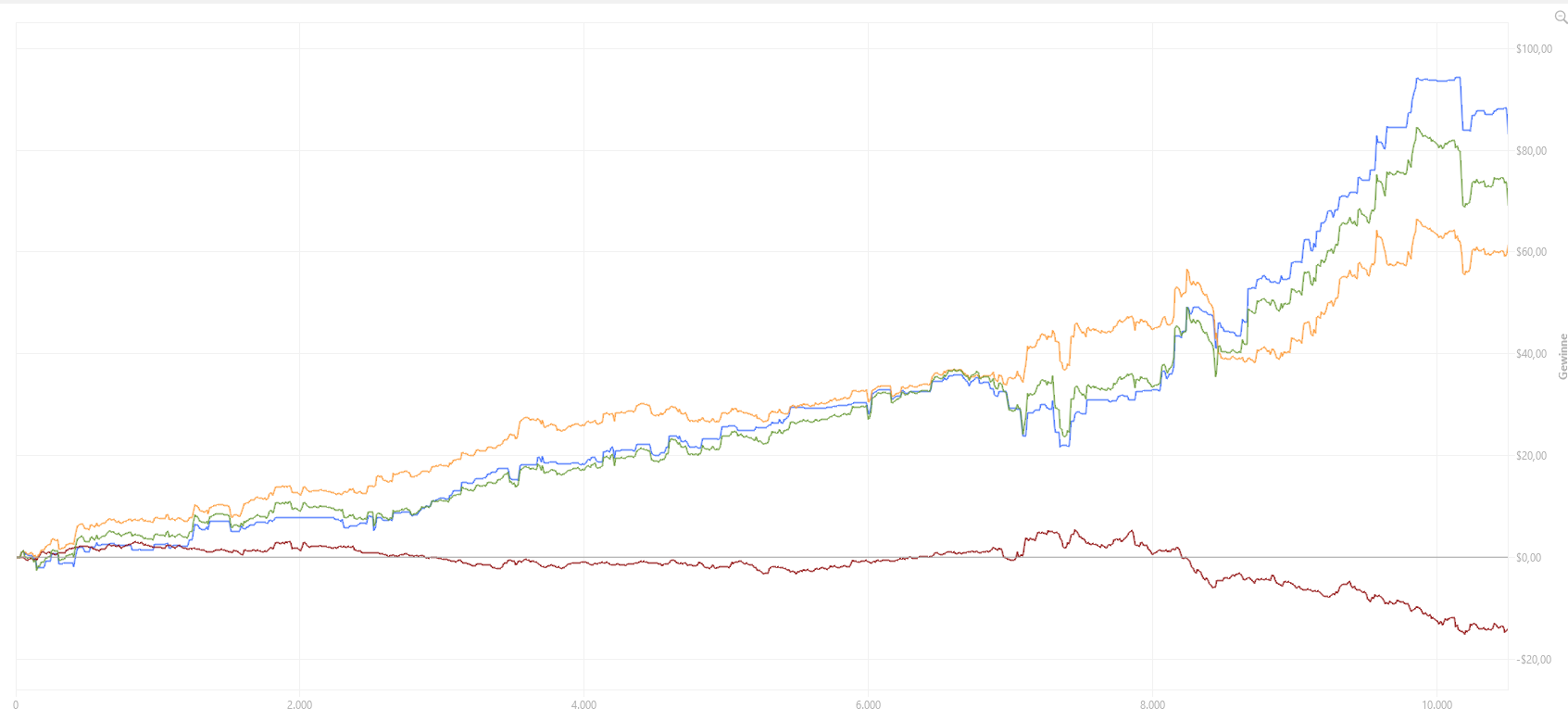
Because i have my first 10k hands hereare some stats and the graph, if anybody is interested:

Thanks for reading!

GL at the tables
Talisker


Reply
Quote
Talisker74
Joined: 17.08.2009

Hi guys,

here myweekly summary about my poker habits:

Play regular tables only => missed
Define one goal for each session => done
Make a warm-up for every session => done
Table select -> at least one weaker player at the table => done
Colour-code players to exploit them => done

So a lot of work is infront of myself.I had kind of tilt because a lost a few byins on NL5 and played some hands on NL10 regular tables and SNAP.
Lucky i was i just stopped losing and I`m back to NL5 regular tables again.

So hopefully i will stick to my BRM from now on and be more patient and except:
=>Losing is part of the game!

Thanks for reading!

GL at the tables
Talisker


Reply
Quote