Hi pokerfriends,
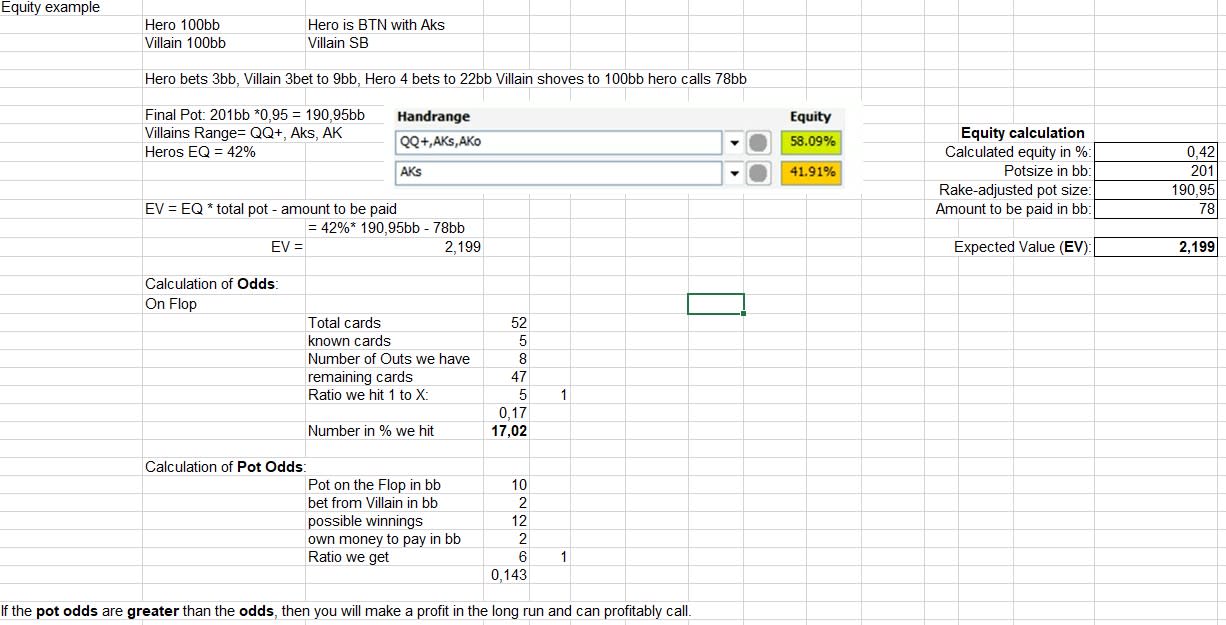
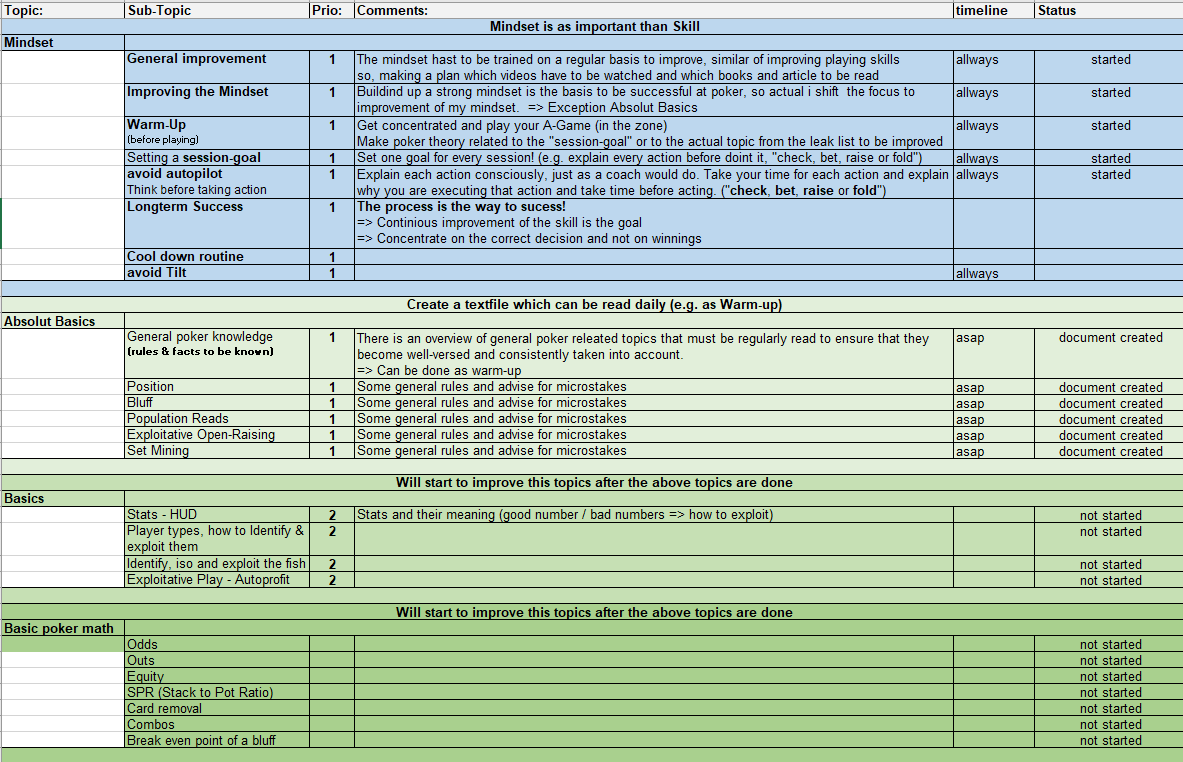
i worked on my learning and made some changes, because goals have to be timeboxed,so my actual plan so far.
The next update will be given on mid of October:


And here what i have written in a textfile as a warum-up:
• The two biggest traits of a winning microstakes player:
=> Ability to make thin value-bets vs. weak opponents who call too much
=> Ability to make big exploitative laydowns in spots where opponent is rarely bluffing (e.g. folding overpairs (AA & KK))
• Focus on the correct decision and not on profits
• It is a marathon and not a sprint -> sample size
• Always stick to your BRM! It will protect your roll and lower your risk of ruin!
• Take short and agressive shots to next limit
• Losing is part of the game -> AA vs any PP = 80:20 every 5 times AA will loose
• Every BAD BEAT shows me that i played the hand totally correct
• Controlled, aggressive positional play is the key to success in No-Limit Holdem
• Patiently wait for strong hands
• Big pots are for big hands and small pots are for small hands
• Tight is right!
• Winning by folding!
• Take time before making a decision -> think about why taking this action (check, call, bet, raise, fold)
• Take care of the ranges => attack capped ranges very often
• Bet mostly for value (including strong draws - nut potential) -> bet for thin value vs. weaker players
• Make thin value bets (on river) bet small -> target are players with a "WTSD% 25+" on the HUD (sample size)
• Why do i bet? - value - protection - bluff - dead money
• hand planning -> on which cards can i bet? How many outs do i have?
=> think ahead => exploits on later streets (stats/sample)
• The best playability have PocketPairs, Ace King, suited Aces and suited connectors
=> Sets, Straights, Flushes and top pairs with Top Kicker (best with position on villain)
• Play as exploitable as possible! (pool tendencies and colour coding)
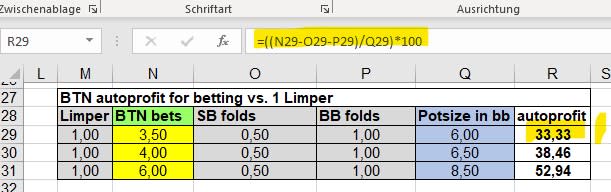
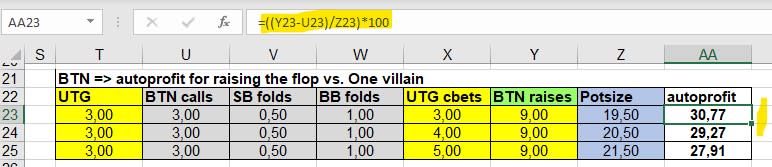
=> use autoprofit actions whenever possible (e.g. Float bets, Probe bets, bet check bet)
• Oversteal Preflop (especially from BTN and SB)
• take care of marked players (e.g. don`t bluff yellow and green players -> they will fold to less)
• check raise flops OOP more often => Nuts, Nut draws and some weak (backdoor) draws (sometimes air vs. good regulars)
• bluff less (We can bluff best based on reads and stats -> against regulars / good players who are able to fold)
• Bluffs should be small over 1 or to 2 streets (vs. thinking player) => generally villains call too much, so it doesn't work well
• We don't make money with bluffs by trying to get weak players to fold medium or strong hands
• Take attention to your open raise size / bet size
=> think carefully about your own sizing, try to exploit villain
• Don`t go all in with...
=> AQ -> especially pre-flop!
=> 65s -> trips with a bad Kicker
=> J9s -> with straights that are not nuts
=> 45s -> never go all in with baby flushes
• Monsterdraw (OESD with FD) go only All-in at the flop, => at the turn there is a big loss of exsisting equity
=> continue playing passively on turn and river without hitting
• A set at the flop is always a monster
=> Never fold on the flop
=> earliest street to fold is turn, better on the river => we have 9 outs to make a Fullhouse and 1 additional out to make quads
Postion:
=> Play IP most of the time, because
=> Information advantage
=> You can close the action
=> It is more easy to Pot-Control => both, playing for a smaller or a bigger pot (check, call or raise)
=> take care of your and villains position => Precieved Ranges
Bluff:
=> Should we bluff on the micros? Yes, but:
• The majority of our bluffs should be small and only last one or two streets
• Big bluffs should only be made against good thinking players who can fold
• We don't make money by trying to get bad players to fold strong hands
• Our best bluffs on the micro-stakes are based on stats (sample) or reads (notes)
• Do not bluff against calling stations
• Don't blow up pots with bluffs
• Bluff rather when your hand can still improve
• Bluff only players who can also give up and are able to fold
• Don't bluff against multiple players
• Bluff only if you can also represent something and your opponents have rarely hit well
• Never bluff on the turn if you have no backup that you can hold the best hand on the river
Population Reads for micro stakes:
• Limp 3bet = trapped KK+ = nuts => overfold
• minbet 3bet on Flop => nearly always nuts => overfold
• X/r as PFR => nearly always a set or better => overfold
• Turn check min raise => Nearly always the nuts => overfold
• River raises = nuts (at least very often) => overfold
• Call – call – donk (if draw completes) = nuts => overfold
• triple barrel = very strong value line = nuts => overfold
• The Pot Size bet over multiple streets = nuts => overfold
• 2nd barrel in 3bet pot => nearly always nuts => overfold
• Raise/Leads in Multi-Way Pots => mostly value only => overfold
• Overfold vs. agression espically vs raises on the river => take time for thinking!
Exploitative Open-Raising
• Only balance if necassary => vs good players
• raise larger for value vs. weak opponents
• raise larger when our postflop expectation is high
• raise smaller when our postflop expectation is low
• raise smaller when our opponent 3bet agressevely
• raise smaller to increase proftitability of steals
• raise smaller vs. shortstacks
• raise smaller with hands that benefit from a high SPR
• raise larger with hands that benefit from a lower SPR
Set Mining
Set-Mining vs. 3bets
Is it possible to set-mine in 3bet pots?
• Only if stacks are deep (risk/reward)
• Only if the pot will be multi-way and we get better implied-odds
But it is possible to setmine in a 3bet pot 100bb deep?
• In most cases NO!
• However it is ok in situations where our opponent has an extremly tight range and doesn`t 3bet overly large
• Position increases implied-odds
• Most common situation is we open UTG/MP and got 3bet by one of the blinds
• Opening smaller makes it easier to set-mine
• Recommended to primarily set-mine 88+ for set over set reasons and also so we don`t start calling 3bets too wide
Postflop strategy when set-mining:
• Fold often if we miss our set, doesn`t matter if we have an overpair
• Fold nearly always if on the board are two or more overcards
Equity on Flop
• set on the Flop is allways a very strong hand
=> bet big for value
=> never fold on the flop => we have 9 outs for an full-house and 1 Out for quads
=> if we are forced to fold than on the river
Any thoughts on that?
Thanks for reading and GL at the tables
Talisker





 I would suggest you two things: