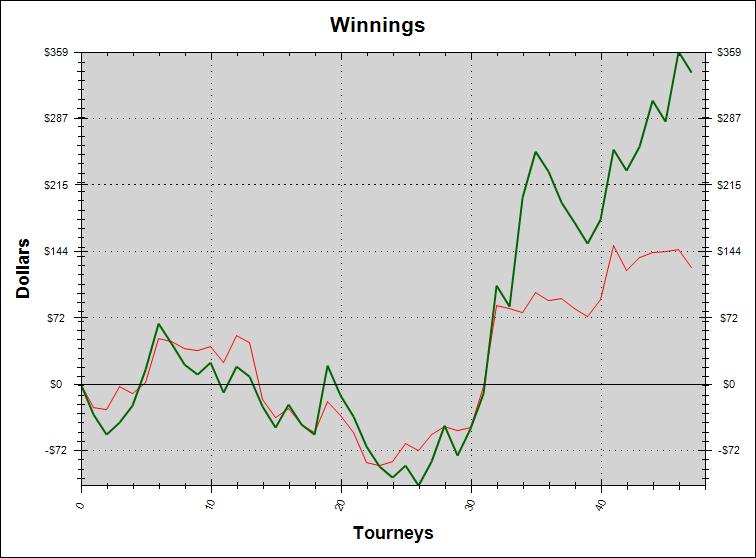
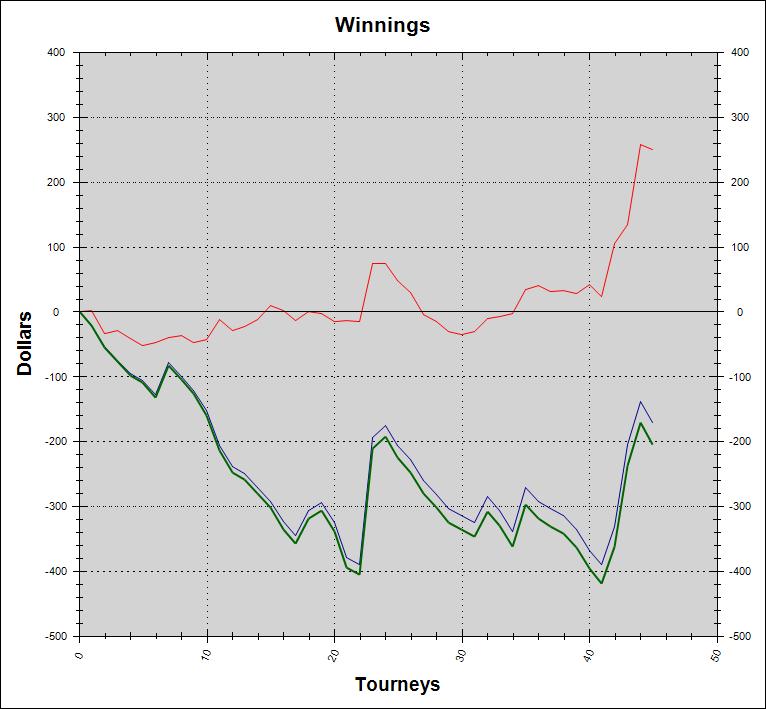
Originally posted by lessthanthreee
i think the link between bigger roi and "variance" is not directly related, but indirectly related. variance is the square of the standard deviation. the standard deviation comprises of (is a measure of) a number of risk factors. in poker its things like number of players, quality of players, payout structures, your own skill. Often poker players dont understand that the term 'variance' is a statistical measure of risk. Whether one has a 'low variance' or 'high variance' style is something that a lot of people will misunderstand because there are a lot of factors that go into the variance of poker, most of which have never been studied or sampled over millions of hands.
@tim, im talking about a 150BI downswing in the green line. The red line isn't really relevant to a statistical sample in poker (it would be a purely theoretical sample) and a risk of ruin study because the whole point of it is to include the 'swings'. The red line is by definition, a measure (well an attempt because its not 100% accurate) to remove a large factor of risk in poker (luck).
What you would need to do is run a risk of ruin on a red line sample, and a risk of ruin on a green line sample. you will discover the red line sample has a significantly reduced chance of downswings compared to the green line because the 'luck factor' is such a massive component of risk in poker which will comprise most of the 'variance'.
Hope that makes sense..... brings me back to 2nd year finance.
The most important thing is to make sure you understand the difference between the statistical definition of 'variance' and the slang poker term 'variance'. They are essentially the same, but poker players have misused and misinterpreted the term 'variance' which causes a lot of confusion in the poker world to people who have no clue about stats.
Thankyou thankyou thankyou. I just did a simple math quiz to help me understand some of these concepts ( http://www.mathsisfun.com/data/standard-deviation.html - hope np with this link, PS  ).
).
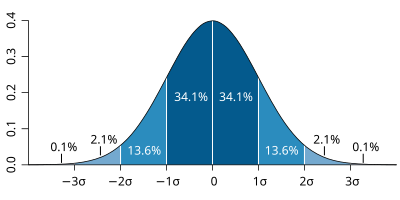
I remember hearing that the std deviation for 9 (or was it 10?) man sngs is 1.7 And that this std deviation is in buyins. So if ROI is 10% then you make 0.1 of a BI per Sng, with a std deviation of 1.7 BI. But what does that mean? Because, intuitively, you cant lose more than 1 BI per SnG?
Now, say we have the following ROI results for 5* 1000 * $10 game tranches of Sngs: 5%; -3%; -9%; 14%; 6%.
($500 -$300 -$900 +$1400 +$600 = $1300 up at the end) i.e. overall ROI of 2.6%.
My SD Calc ( http://www.mathsisfun.com/data/standard-deviation-calculator.html )
tells me that the SD is 7.9% and the Variance is 62.64
But, what does this mean in practice?

Originally posted by jbpatzer
Originally posted by lessthanthreee
The most important thing is to make sure you understand the difference between the statistical definition of 'variance' and the slang poker term 'variance'. They are essentially the same, but poker players have misused and misinterpreted the term 'variance' which causes a lot of confusion in the poker world to people who have no clue about stats.
This, definitely. I sometimes see people using 'variance' when they mean 'risk of ruin'.
That's nothing. I hear people calling it variance when someone hits a two outer on them. 





 :heart: