



Hi peoples! 
I am still new to this game but trying my best. Here is a hand which I have played and where I think I made several mistakes. Would be nice to have some of your opinions!
$0.02 NL (6 max) - Holdem - 6 players
BB: $2.04 (VPIP: 29.41, PFR: 20.59, 3Bet Preflop: 0.00, Hands: 34)
Hero (UTG): $4.34
MP: $2.16 (VPIP: 61.29, PFR: 9.68, 3Bet Preflop: 5.26, Hands: 32)
CO: $2.00 (VPIP: 13.73, PFR: 9.80, 3Bet Preflop: 3.85, Hands: 52)
BTN: $2.73 (VPIP: 21.05, PFR: 14.74, 3Bet Preflop: 14.29, Hands: 95)
SB: $2.00 (VPIP: 27.94, PFR: 23.53, 3Bet Preflop: 11.11, Hands: 70)
SB posts SB $0.01, BB posts BB $0.02
Pre Flop: (pot: $0.03) Hero has K♦ Q♦
Hero raises to $0.06, fold, fold, BTN raises to $0.18, fold, fold, Hero calls $0.12
Flop: ($0.39, 2 players) J♣ J♦ 5♠
Hero checks, BTN bets $0.18, Hero raises to $0.62, BTN calls $0.44
Turn: ($1.63, 2 players) 3♣
Hero bets $1.18, BTN raises to $1.93 and is all-in, fold,

thoughts
villain:
I had 95 hands on this villain. Here are some stats:
Spoiler
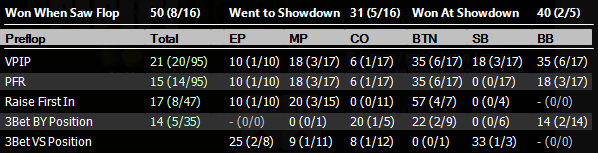


pre-flop:
I am assigning him a linear range of:
QQ+,AQ+
Calling with KQs seems very bad in retrospect, as on most flop-textures most of villains combos will dominate me and I only have 26.50% equity against his range. I was giving myself good implied odds, which is how I justified the call when on the table.
flop/turn:
evaluation:
Without having properly defined my preflop-calling-range, I still somehow thought I would have range adavantage here, as he doesn‘t have any Jacks in his range. I was certainly mistaken, as with QQ+ (12 combos after discounting) he has 1/3, while AK and AQ make the rest of his range with 24 combos altogether. After discounting there wouldn‘t be a lot of Jacks left in my range and most of my potential non-jack combos are far behind his range.
action-plan:
As he seems to fold relatively often OTT I was planning to raise OTF and bet OTT. Also I had 2 good backdoor-draws, which I thought could make the attempt profitable.
chain of calculations:
Spoiler
If we assume that he would fold his AQ (i.e. 1/3 of his range) combos and only consider raw equity for his continuing range (I have 14.22% against it). The EV of my 2bet OTF is:
0.33*119 + 0.66*0.1422*163 - 62 = - 7.43
0.33*119 = fold equity
0.66 = likelyhood for villain to call
0.1422*163 = my EV for villains call
62 = my bet
When we do the same calculation for my bet OTT (assuming he would fold AK and maybe 1 of his QQ combos, which leaves me with 0% equity against his continuing range and creates with 14 combos a 54.17% probabillity for him to fold), I get an EV of:
0.5417*281 - 118 = 34.2177
0.5417*281 = fold equity
118 = my bet
If we merge both calculations together, assume that he wont 3bet OTF and that I have 0% equity if villain doesn‘t fold, we get an EV of:
0.33*57 + 0.66*(0.5417*281 - 180) = 0.47
0.33*57 = fold equity OTF
0.66 = probabillity to continue to the turn
0.541*281 = fold equity OTT
180 = my bet OTF + my bet OTT
...so my flop-turn play might actually have been about break-even.
mistakes which I think I made:
- calling pre-flop
- basing villains willingness to fold on a too small sample-size
- probably assigning a too weak pre-flop 3betting-range to villain (if I would exclude AQ for example I would have significantly less fold equity post-flop, which would make my post-flop line definitely -EV)
- not considering that a 3bet-pot plays different to a 2bet-pot and that which might have been a good - exploitative line for a 2bet-pot wasn‘t good in a 3bet-pot
questions:
What range should I give villain after his 3bet pre-flop?
How should my pre-flop-calling-range look like?
With which hands would you 2 bet the flop / play a similiar line?


