Skip to forum
Poker from the Insi...
 
Notifications
Clear all

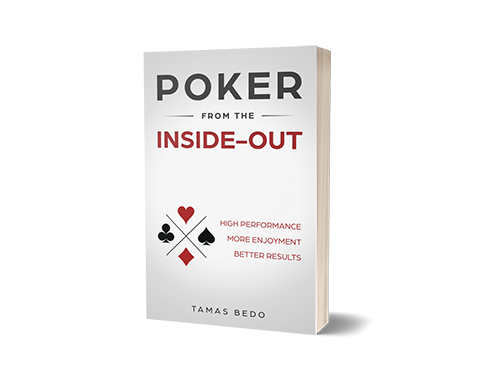
Poker from the Inside-out: High Performance, More Enjoyment, Better Results

18 Posts
4 Users
5 Reactions
3,497 Views
Naturalwest
Joined: 16.10.2011

Hey everyone!

I have decided to share some parts of my book that has just got published recently, because I believe many people can gain valuable insights from it. Let me share a bit about my background, as I haven't been active in the international community.

I have played poker professionally in the past, which gave me the financial background to leave it in 2013 and transition into my passion full time which was coaching and running seminars. I was always passionate about understanding how human beings work and how we can tap more into our potential and create a more enjoyable and successful experience of life. Over the last couple years I had the opportunity to coach people from all fields of life, top athletes, business leaders, entrepreneurs, and over 300 poker players, mostly from the Hungarian community, where I was blogging regularly for years.

Working with players from lower to the highest stakes in different game formats gave me a really great opportunity to see what factors play a role in having a successful, and enjoyable poker profession. I could see what changes helped players get unstuck and move to higher limits, increase their win rates, find more emotional well-being and stability, and enjoy their profession and lives more.

I wrote this book because I felt I want to leave something behind for the international poker community based on my experience with coaching so many players. I wasn't sure how long I will keep actively working with players so I wanted to capture my insights as long as I still do. My intention with the book is to spread the insights in it, which I believe can help a lot of players.

I would share the whole book openly, but I had many poker players talk me out of it, saying people don't value free stuff enough, which I must agree with. However I decided to share some parts from the book, and hopefully it will spark some insights for players and if someone feels they want to read more, they can go ahead and find the book on Amazon.

If you have any question or feedback, please feel free to post here or send me a pm.

I hope these sections from the book will serve as an inspiration, and give you new insights that can help you on your journey.

Bests,
Tamas

* * * * *

Here is a bit more professional description from the book cover:

This book is not about poker strategies. It is also not about hustling the way to poker success, hoping to find happiness at the end of the road. More and more players seek not just success in poker, but a deeper meaning in their profession and lives as well. Trying to add even more willpower and hustle often leads to just more stress or burnout.

What if there is a way to approach poker that not only creates high performance and better results, but makes poker an enjoyable profession as well with less stress and more freedom?

After coaching hundreds of poker players up to the highest stakes over the years, Tamas Bedo has created a 3-step process that readers can use to create radical changes in their poker results. With additional client stories the book will reveal how players can access more of their potential by making certain changes in their approach to poker.

The ideas and practices shared in the book have helped countless players improve their win rates, play their best more consistently, advance to higher limits and find more enjoyment in their poker careers and lives.

* * * * *

Here is the Table of content to get an idea of the 3 steps and topics covered inside:


Reply
Quote
17 replies
Naturalwest
Joined: 16.10.2011
INTRODUCTION

Dear Reader,

I have written this book for poker players around the world, even though the ideas here are also relevant in other professions or areas of life. If you picked up the book, I will assume you are a poker player, and you're interested in gaining an edge in today's competitive games and reaching more of your potential in poker.

There are tons of information available that poker players can use to become better. There are sites and books to learn strategies, they can talk to other players, hire coaches, and watch videos. There is a great amount of knowledge on the mental aspects of the game as well, and many interviews with some of the best players sharing their mindset and practices.

All the information is available for a player to advance to higher levels. However, as Derek Sivers said “If more information was the answer, we would all be billionaires with six-pack abs.”

There is a difference between information vs. transformation. Information and strategies are important in any field, but what matters even more is the mentality of the person, which will determine how much he can access his potential and use the available strategies.

Real transformation happens when there is a shift in how the player looks at himself, his potential and his approach to the games, causing a change in his decisions and actions, which will lead to different results.

Poker can be a challenging profession. Many players get into it because they enjoyed the games initially and liked the appealing freedom they thought it can provide to their lives. However, it’s easy to forget about the initial inspiration towards poker, and ending up feeling trapped by the daily grind.
More and more players seek not just success in poker, but a deeper meaning in their profession and lives as well. Trying to add even more willpower and hustle often leads to just more stress or burnout. However, I believe there is a different way to approach poker, which we will explore through the book.

Over the years, I've seen how the ideas and practices in this book helped countless players jump up in stakes, earn more money, enjoy their work more, have a higher self-esteem, greater relationships with others and all around become more fulfilled people.

I'm not here to tell you what to do or how to approach the games. I don't consider myself to have the ultimate answer, but over the years, life has taken me in a direction where I could gain some valuable insights on this area. Let me share a bit about my background.

Over ten years ago, I was just an introverted guy from a little town with lots of frustrations and felt I wanted to become a more social and open person. I wanted more freedom and power in my life. So, I went online to see how I could create a different future for myself. This was the starting point of my journey in personal development, which over the next couple years, radically changed my life. Later on, I became a poker player for two years, which provided me with many personal lessons and gave me the financial background to move on in 2013. Towards the end I looked at poker as a stepping stone for me that could provide the opportunity to go after my passion at that stage of my life. I wanted to be an entrepreneur, so after that, I was building a marketing consultancy business, but shortly thereafter, at an event I attended, this realization hit me that deep down I knew what my direction was, and it was time to step into that.

I knew I had an innate gift and talent in working with people and supporting them to have their own transformations. I decided from then on, that if that was my role here in this life, I would owe it to myself to gain mastery in that. So over the years, I’ve become obsessed with learning about human transformation, high performance, mental game, psychology, eastern philosophies, anything that could give me more insight into how human beings work and what creates results in our lives. I've spent a great amount of time and money traveling and learning from the best people in these fields, and be personally mentored, trained or coached by them.

Adding to that, over the last decade, I've put in my thousands of hours of studying books and other materials, and personally coaching hundreds of individuals from all walks of life. This gave me the opportunity to work with a wide variety of people including some of the highest achievers like world-class athletes, top level CEOs, business leaders and over 300 poker players up to the highest stakes in different games, mostly in the Hungarian poker community.

I wrote a digital book for the community in my country in 2013 with the title of Mental Preparation and Maximum Performance, which spread around and impacted many players. Then I joined the ProPoker Backing group consisting of about 200 players and had been their coach for 2 years. It really gave me a great opportunity to closely study what factors determine a player’s performance and results and how it can be influenced.

Since then, I've worked with different backing groups and individual players through coaching, and held one- and two-day live workshops for players. Those things started the journey and the rest is still unfolding. Nowadays, I work with players and people from different fields, assisting them in creating the life they want. I wrote this book because I felt I needed to share what I've learned over the years through working with so many players. My hope is that many players can gain valuable insights from what is shared on the pages and I can leave something behind for the community.

That's about me in short. I wanted to give you a little background on my own life. However, this book is not about me. I want to invite you on a journey, where together we explore areas like the nature of the human experience, your innate potential, high performance, mental game, productivity and strategies.

I'm going to share what I have found useful over the years in working with players. Use the words and ideas in the book to reflect on and bring your own insights and realizations.

This book is divided into three parts. In each of them, we will cover certain areas that will help you get more out of your innate potential, perform more often at your best, whilst enjoying poker and your life more. In each chapter, I will share stories from my work with clients to illustrate certain points even more.

In step 1, we will focus on gaining clarity over the factors that contributed to your current situation in poker, and uncover what areas might need some changes. We will also look into getting clear on the results you want and how to go on making them happen.

In step 2, we will explore a deeper understanding on how the human mind works, what creates high performance, how to play at your best more often, how to become more productive and eliminate mental game issues. We will also look at how to approach poker so that you can not only create the best results on the long term, but enjoy the game as well.

In step 3, we cover high performance strategies and best practices which can help you be more organized, focused and energized to create the results you desire.

How to get the most out of this book

Firstly, be open. Now this seems cliché, but it's one of the key aspects I've seen that can create transformation in someone's life. Be open to put aside your current ideas and ways of looking at things, and be willing to explore other ways provided in the book. What usually holds us back in life is when we are too rigid in our beliefs and don't even recognize that just by questioning them, we might arrive at other perspectives, which would enhance our lives more.

So before discarding ideas in the book and judging them, I invite you to look at them neutrally and curiously. Try them on for a bit, explore them; and later, you can come to your own conclusions and see what you resonate with and what you don't in the book. Take the things which add to you and leave the rest, for now. Later, you might come back and read it again and it might provide you with new realizations.

Many things in this book might seem to be far from your old way of looking at things, to the point that you might want to say they’re rubbish. I encourage you to hang on, have some curiosity and explore those ideas as well. I've seen the radical change they brought to players' lives.

Also, just recognize that the mind has a tendency to say 'I already know that' and then it closes itself down to new learning. Come fresh and open to this book and then it can be really insightful. Many things might seem obvious and you might wonder why they are even worth talking about. However, as they say, common sense is not always common practice.

Alright, it's been a long chapter, let's dive in.


Reply
Quote
Naturalwest
Joined: 16.10.2011
CREATOR VS. VICTIM

A couple months ago, I had a discussion with a player, and I could notice how he put himself into a disempowered state with the language he used. I call this the victim mindset. It's when we blame our actions and results on outer forces, instead of taking the responsibility for them.

It can come off through phrases like "it's because of the variance"; "I can't do that"; "I don't think it's possible"; "Our study group fell apart because members weren't committed"; "I think a study group would be useful, but I don't think we could get one together".

The pattern behind this is not taking responsibility, and not stepping into the role of being the creator of your life.

So I got into a discussion with this player regarding the difference in the mindset of a Creator vs. Victim. With this, he realized he actually has the power within to create what he wants, but he didn't tap into that because of those fear-based thoughts and excuses in his head. The purpose of those is to keep you "safe" in your comfort zone by a brain which is built for survival through evolution.

Once he could see that and took responsibility for being the creator of his results, he started on a different journey. We started a coaching program together 3 months ago. As a first step, he got clear on where he is now, and how he has been approaching poker, where he wants to be exactly and what changes are needed. Within weeks, his whole mentality changed. He has gained confidence, developed an action plan, implemented supportive strategies and routines and got rid of mental game issues. Basically, we worked on things which you will find in this book as well.

Within 3 months, he went from playing $0.25/0.5 and $0.5/1 cash games, to now taking shots at $3/6 games. Besides that, he had his best ever month during his 8-year poker career, which was just the side effect of changing his approach to poker, and putting in the time and energy. He changed the cause (his approach), which let him tap into more of his potential, and it ended up creating different results. It was really inspiring to witness his transformation.

Before our work, he said it would be great to have a poker coach or other players to study with, but he didn't proactively take steps to make it happen. We created a plan to change this; he showed up as a leader and approached mid and high stakes players. Now, he has a study partnership with a past client of mine who plays up to $50/100 games. First, he thought why would that guy who plays so much higher want to study with him? But if you show up as a leader, and people can tell that you are hungry and driven, that is appealing. So they ended up creating a structured study group with clear boundaries. It required both of them to step up.

It changes a person's whole life once he claims his power, takes responsibility for the direction of his life and shows up as a leader, not as a follower and victim.

Here is a valuable perspective about one of the aspects of Leadership by Werner Erhard, who is considered to be the greatest teacher in the field:

"[Part of being a leader is to accept] being cause in the matter of everything in one’s life as a stand one takes on self and life, and acting from that stand. It is not true that you are the cause of everything in your life, rather this is a place to stand – a place from which to deal with life that you have chosen for yourself. It simply says, “you can count on me (and, I can count on me) to look at and deal with life from the perspective of my being a cause in the matter”. In taking this stand, you give up the right to assign cause to the circumstances, to others or to the waxing and waning of your state of mind – all of which leave you helpless (at the effect of). When you see how this works, it will be clear that taking this stand does not prevent you from holding others responsible. By contrast, when you have mastered this aspect of the foundation required for being a leader and exercising leadership effectively, you will experience a state change in effectiveness and power in dealing with the challenges of leadership (not to mention the challenges of life)."

All of us can get into a powerless state of mind where we find excuses and tell ourselves stories of limitations and why we can't have what we want, and end up blaming outside circumstances. The key is to notice when you get into this thought pattern, and instead, take full responsibility. You got here because of your approach, decisions and actions so far, and it's not a reflection on what is really possible for you. At each passing moment, you have the possibility to take back your power and choose to direct your life in the direction you want.


Reply
Quote
Naturalwest
Joined: 16.10.2011
THE 4 PILLARS OF A POKER CAREER

I want to give you a simple framework for assessing how your current approach to poker looks right now. If you are an online player you’ve probably done a leakfinder in poker, going through your stats and seeing which ones are not optimal and requires working on. That's basically the same as what I do with a person at the beginning of a coaching process, but what I look for is clues about their mentality, targets and strategies in order to see where they are not optimal in producing greater results.

By now, I've worked with so many players who played from lower limits to some of the highest stakes that it has become really obvious that there are different patterns that lead to better results or lead to staying stuck.

This can be a fairly obvious pattern like a player doesn't play much or tilts away his money. Most often, however, things are more subtle and require more digging under the surface.

For example, sometimes there is a pattern of strong inner critic and perfectionism for a person, which makes him study more, and not play much. The problem with that is his mindset doesn't allow him to gain confidence in his abilities, because no matter how much he studies, the lens through which he sees it in his mind, is that he is not good enough, and needs more certainty before he can really put in the hours into playing. It makes him feel aversion towards playing because it often triggers his feeling of incompetence, which further reinforces him in the need to study more, so he can finally feel competent. However, from this paradigm that feeling will rarely come and won’t last long, it's a never ending cycle, completely killing a player’s results and improvements. So it's not enough to just study; the internal mindset behind that will determine how effective it is.

Now to recognize a pattern like that is not necessarily easy unless you take really deep self-reflection, but the ideas in this book will help you a lot in seeing where your mindset and approach might be off and not serving you. I recommend you to note down those things that jump out for you and then strategically focus on changing them.

On a really simplistic level, we can do a quick leakfinder to see if a player is on track for great results or not. Basically, what is the track that leads to great results over time?

  • Play a lot. Do it in great quality, and being focused.
  • Constantly improve your understanding of the game, whether via study, video, learning through playing or teaching. Do this in a focused way, making it important.
  • Be consistent with these, and over time, getting better is inevitable.

Pretty simple right?

It really is that simple; however, there are usually certain inner conflicts in the person that can screw up this process. For some reason, the player may not sit down to play; or is not focused there; or doesn't study, because he thinks it doesn't produce quick visible results. Perhaps he studies but can't execute well on his knowledge during the games; or he is not learning effectively; or his decision-making process is not optimal at the tables etc.
That's basically my work with people, to create those shifts that enable them to tap into more of their potential and be on track to better results and constant improvement.

So let's look at a bit more detailed framework on how you can measure your current situation. I call it the 4 pillars of a poker career. How you stand in each pillar determines the success and enjoyment you experience.

I. Poker skills

This pillar is basically about how well you understand the game. Obviously, you want to understand what the most profitable play in each situation is or at least do it better than your opponents so you gain an edge.

So how well do you improve your skills?

Some people learn best from videos, some from PIO, hand analysis, teaching, playing, talking with other players, etc.
For some, it is a mixture of these, or changing it periodically to create variety. You want to find out what is the best way for you.

  • Do you know what the best ways are for you to work on your game?
  • Do you spend time consistently on improving your skills?
  • How effective are you during the times you study? Are you focused or just going through the motion?
  • Do you avoid playing by overstudying as an unconscious attempt to finally feel totally certain, confident and capable?
  • Do you bring those new lessons learned into your game effectively?
  • How could you improve the effectiveness of your learning?

II. Execution

It's not enough to just have a deep understanding about the games; it also matters how well a person can use that to make effective decisions while playing when it really counts. Probably you have known players as well who are amazing at analyzing spots away from the tables, but their results don't reflect their poker skills; and you may have known players who are on the other side, whose poker knowledge isn't that extraordinary, but they are having better results more consistently.

Why is that?

Because during the game, how focused the player is will determine a lot about how much he can access his knowledge, especially from those parts of his game which are not yet mastered at an unconscious competence level.

There can be inner conflicts in the player's mindset that take away his focus and cause him to play suboptimally.

Jared Tendler did some great work around this in both of his books that helped many players to resolve issues and perform better while playing. In chapter 3, we will explore this area deeper and look at how your level of execution can be improved radically.

  • How focused are you during your sessions?
  • When you lose focus and don't play well, why is that? Do you get bored and lose interest in the games? Do you get too anxious or upset?
  • Which spots in the game cause you to lose focus? What happens in those situations?
  • How often do you play your A-game?
  • How often do you find yourself in flow? Do you know what constitutes for you playing in the flow?
  • How well can you execute even when you have an off session/day where you just don't feel it?


III. Poker / Life Management

This pillar includes the first two. It is the overarching approach you have towards managing your poker and life in order to create a successful and fulfilling career.

Here are some questions that can be a good start for reflection. Not everything is a must to have, but generally, these areas can be useful to look into and find how they appear in your life; you may also determine whether to implement some changes there. We will look into these areas and more later on in the book.

  • How well do you manage yourself (your focus, activities, time)?
  • What kind of rituals/habits do you have that support or sabotage your results?
  • Do you have morning / evening rituals?
  • Do you have effective warm-up / in-session / cool-down rituals?
  • Do you have a daily / weekly schedule?
  • Have you got a clear vision and goals you are working on?
  • Are you clear on what things, people, habits are draining your energy and focus; and have you decreased/eliminated them?
  • How are your physical/emotional/mental/ spiritual energy sources handled?
  • How about regular exercise, hydration, healthy diet and good rest?
  • Are you clear on your top priorities that make you progress in poker?
  • Do you have a supportive environment (either workplace, or inspiring friends)?

IV. Mentality

Mentality is defined as a habitual mental attitude that determines how you will interpret and react to situations.

This is the pillar that includes all the other three; basically it will determine how much you access your potential; what decisions and actions you take; how you relate to your thoughts/emotions; what you think is possible for you; how you deal with setbacks and so on. It influences how much you play, how well you can learn, how you perform at the tables and basically everything else. This is where your decisions and actions come from that determine your results.

Now this pillar is a bit more complex, so I won't list questions here; however, during the next chapters, we will explore this deeper, which can provide you with new insight.

These four pillars are just a simplistic overview about a poker career's elements. Nonetheless, I encourage you to spend a bit of time reflecting on what kind of challenges you have in each of the pillars, and see where might be the most important to direct your energy and make improvements.


Reply
Quote
Naturalwest
Joined: 16.10.2011
THE DIRECTION OF YOUR FOCUS

Whenever I have a coaching conversation with a person, the quickest way to start creating a change in their lives is by guiding them to shift their attention from what they don't want towards what they want. I've seen time and time again how that already starts a process of change within the person and outside of them in their circumstances.

I believe deep down we all know that it's much better to focus on what we want instead of what we don't. Yet, we still do focus on the unwanted.
One thing I've come to understand by now is that our whole life is guided by the direction of our focus, the decisions we make and the actions we take based on that. Out of these, all are equally important, but usually the first part is the most powerful. The direction of our focus impacts our decisions and actions, and ultimately the results we end up with.

Throughout the numerous fields I studied over the years, I have seen one universal principle in all of them described in various ways. It could be summed up with this ancient Chinese saying: "Wherever attention goes, energy flows."

If a player is focused on his dissatisfaction of his current results and situation, this will just create more resistance. "What you resist, persists" as the saying goes. The mind has it totally backward. It thinks the more we focus on a problem, or worry about a situation then it will bring positive change. However that will just direct the energy on the current situation. The mind is afraid that if it doesn't resist the situation then we will get stuck in what we don't want. However, that's actually how we keep reinforcing the situation.

When you focus on what you don't want and resist that, it will limit your access to your innate resources which could be used for creating a better situation. Just think about how effective you are when you keep fighting what you don't want, putting all your energy there, being all worried and stressed.

Real change starts when you redirect your focus. The best first step for that is acceptance. Accepting the facts of the situation; not our meaning about it (good, bad), but the facts. It is what it is. Then we are free to shift our attention on what we want. When you just accept the situation as it is, you free yourself and your infinite creative potential within you to move you into a new direction.

This requires awareness. Stepping out of that thought process that creates resistance and makes you fight against the situation.
It's good to realize what you don't want, because then it can help you clarify what you want and you can start moving in that direction. There is no point fighting a situation you don't like. Use that initial resistance to gain clarity and move in a new direction.

There is a powerful quote I read from Mother Teresa a while ago. When asked what she thinks about the Gulf War situation back in the early 90s, she said "I'm not against war. I am for peace."

She knew that resistance just creates more resistance. We can't solve a situation by fighting it and resisting it.

What happened, has happened. No need to fight it, as it won't change it. However, we can change where to go from here, and what reality to create instead.

If you are not satisfied with where you are now in your poker career, the limits you are playing, how the variance has been lately, your financial situation or whatever else, just take some moments to stop, give up fighting what is; give up fighting the facts.

As Epictetus, an ancient Greek philosopher, said, "It's not the facts that bother us, but our opinions about them."

We will go into more of this in the third chapter, but until then, what's important to note is to accept what is, and focus on what you want to happen.


Reply
Quote
Naturalwest
Joined: 16.10.2011
GETTING A NEW UNDERSTANDING

Some time ago, a guy contacted me saying he saw the massive changes in another player’s performance and results who I've worked with, and was interested in experiencing something similar. As usual, we got on a call to gain clarity on his situation, which is the first step, so we can see what's holding him back and where he needs to make some changes.

On our first call, he explained he didn't have a passion and motivation for poker; he found himself in constant ups and downs; the negative variance often made him stay away from the game for days and not spend much time on studying and improving his game. Besides that, he battled insecurity and lack of self-worth, which affected his poker performance at the tables and negatively impacted his social life as well.

I felt he was ready for more in his life; he really wanted change. That's important, because if someone is not ready and committed yet to change, and creating a new future, then there is no point for us to work together. It's so important to gain clarity on the current situation, because then we can face the truth and make changes if we realize that our current approach will not lead to our desired outcomes. This client was ready for change, and we started working together for 6 months.

On our first two calls, we explored deeper how the mind works and how his thoughts/feelings are the source of his momentary experience, instead of the circumstances. The problem wasn't what was happening during his poker sessions, but a misunderstanding of where his experience came from. This caused his lack of motivation, tilt and confidence issues and poor execution of his poker knowledge. Already, on these two calls, he had deep insights that helped him approach poker differently and started falling in love with it again, without being affected by the variance much.

Once we insightfully see that our frustration and suffering comes from being lost in our thinking, and not from the situation, that insight alone can transform our lives. That happened with him as well. He started to really understand how the mind works, and how he creates his experience of life from the inside out. His problems were symptoms of a deeper misunderstanding. Once there was a shift in his paradigm, his problems started falling away.

Over the next 6 months, he became a new person. Now, he is a purpose-driven, confident, open, joyful person. He played such an amount in poker that his teammates were wondering how he could do that.

Last time I checked in with him a couple months ago, he lived a full life with regular sport, had a great social life, fun, enjoyed travel and new experiences. He constantly improves himself and his poker game.

Usually, a good test is to examine how we react to a situation now and how we reacted to a similar situation in the past. I remember when he was experiencing a long period of bad variance, where results didn't mirror the improvement his poker game and his performance at the tables went through. Before our work together, the variance and his results would have negatively affected his performance and the amount he played. Now he shows up every day ready to do his work, putting in the time, loving poker and his life. That's the power of insightfully understanding where our feelings come from. This understanding can help people find more peace of mind and deep resiliency regardless of the circumstances. Many times, I see players who suffered in their performance and volume at times of bad variance, now go on and start fresh every day, motivated to make the most again from that day.

With this client, shifting the mindset was a big part, and coupling that with the new rituals and practices he implemented, his life and results took a turnaround. It was partly from the insights he gained from our work together, and a big part on his readiness, his commitment and the energy he put in. It was a truly inspiring journey witnessing him flourish. The interesting fact is that I used to coach the backing group he was part of, but he never took the chance to opt in for a session with me, even though I was with that group for close to 2 years. He wasn't ready back then, but later he was ready for transformation. It happens with a new decision.


Reply
Quote
Naturalwest
Joined: 16.10.2011
WHERE DO YOUR FEELINGS COME FROM?

If we were to ask people who are frustrated, 'Where do you think your frustration comes from?' about 99% of them would say 'it's from this situation in my life (a person; poker session; finance; etc.).' However, why is it that the same situation can happen to people and they experience it differently? If the source of our feelings was really the situation, which can be the same, why don't we experience it similarly?

This points to one of the biggest misunderstanding we fall into, which causes so much suffering in our lives. The misunderstanding of where our feelings come from.

Two persons face the same situations. Losing a hand against a fish; losing a session; having a regular berating them in the chat; etc. One person gets upset, the other stays indifferent or even laughs. What's going on?

Probably it happened to you many times as well where you experience the same situation differently at one time and another. You might be totally devastated after a losing session, being worried, upset or sad. Another time, you don't really care much about it and move on with your day. The same can happen with situations during the game. Losing a hand against a fish; Getting caught with your bluff; Making a mistake.

If the source of your frustration, anger or worry was really the situation, you would have to feel the same way all the time, and everyone else would have to feel exactly the same, but that's not the case.

Here is a good time to quote Epictetus, the Greek philosopher again: "It's not the facts that bother us, but our opinions about them."

It points to the simple truth that situations in and of themselves don't have meaning. Our mind attaches meaning to them by thoughts, which then creates our experience of the situation. Things that happen are facts: The result of a session, an outcome of a hand. These are facts. Information. Meaningless. Neutral. However, our mind attaches meaning to them.

It's easy to fall for the misunderstanding that the source of our feelings is the circumstance. We can call it the outside-in paradigm. It seems like things happen to us on the outside, and make us feel a certain way on the inside (frustrated, upset, sad, worried, joyful, happy etc.). Pixels on a monitor showing something don't have the power to cause a feeling in us.

Or people say they are stressed because of a traffic jam, but cars don't have power to cause us to feel a certain way. There are people who are experiencing that traffic jam differently. One can be stressed or upset, while another can be calm or joyful in the moment, regardless of the situation.
Alternatively, people say they are stressed because of an upcoming test they need to take. However, a piece of paper doesn't have the power to make us feel a certain way. Our experience comes from one source only. From the inside-out.

As I am writing this, I'm just over Christmas season, and at this time of the year, you can hear people around you say how stressful Christmas is. Well, I experienced it as anything, but stressful, full of great feelings. Christmas is neutral, and our experience of it is made up of thought. That's why people experience it differently.

100% of our feelings come from thought in the moment. This is one of those insights that can start a deep transformation in people's lives. Our feelings are not coming from things outside of us, but they are created from thought in our mind. Our experience in the moment is made up of our thoughts and feelings, which are two sides of the coin; they come together.

The other insight that can be a catalyst for change in a person is when someone really sees it for himself that thought is a transient energy. It is fluid. It determines our felt experience in the moment. This formless energy takes a form in our mind. It can be an 'I'm not good enough' thought, a 'things will turn out horrible' thought or an 'I am the best player ever' thought, etc. All of those thoughts are made up of the same formless energy. They are meaningless and harmless on their own. However, we give meaning and importance to them.

Has it ever happened to you that certain thoughts come into your mind and you just dismiss them? Then they move on and new thoughts come. Maybe during a session, a thought appeared about 'what should I eat for lunch' and you just dismissed it; or you had a thought about punching someone in the face and you didn't act on it and let it pass; or a thought about how bad of a player you are after coming out of a losing session, and you just let it move on.

Our thoughts are transient, and our feelings change with them too. The problem comes when you take the content of your thinking as truth. You give importance to certain thoughts and make them look real for yourself. Think about how often you experience a low mood and you see things in a negative way, you are worried about the future and how things will turn out. Then an hour later or a day later, you are back to normal and feel more optimistic about the future.

Your state of mind (thoughts/feelings) is constantly changing during the day, ups and downs, like a roller coaster. That's the nature of the mind. If you let it, then it can change on its own. Once you insightfully see that your experience of the moment comes from thinking and not from the situation: that experience starts to lose its hold on you. It becomes more fluid and less frightening.

Thought is a fluid formless energy, however, what we often do is make it look more solid by paying too much importance and meaning to what it says and making it look real. An ice is fundamentally the same as water, but in different frequency, and so different solidity. Ice and water are fundamentally the same as clouds, but different solidity. A cloud looks like a solid object. Whenever I'm traveling by plane, I get this idea how awesome it would be to jump on clouds. Though it might seem real and solid, if we get closer, we realize it has no real substance. Same with our thoughts. If we make certain thoughts important and look real, we make them more solid, and then we can "bump" into them and it hurts. If we realize thought is a transient energy which is fluid, we can step back, let it move on and see things with a fresh perspective.

We have the capacity to think again. New thoughts can come into our mind from this formless infinite field out of which thoughts take form.
It is important to grasp that events have no meaning, and our experience of them is fully created from the inside through our mind by the power of Thought. Now it doesn't mean that once we grasp this, there won't be any frustration, anger, uncertainty or any discomfort showing up in situations. It just means we can wake up from the illusion that it's the situation that is causing us to feel this way. So we don't end up fighting imaginary problems, or resisting things outside of us, which would just limit our capacity to think clearly and show up with our best to deal with a situation.


Reply
Quote
Naturalwest
Joined: 16.10.2011
HOW THE HUMAN MIND WORKS

We all live in separate realities made up from thoughts in our mind. That's why people experience the same movie, city, book or poker video differently. We are not experiencing the facts, but our thoughts in our mind. Then we project them onto the situation and color them. Imagine everything as a white canvas. Our thoughts are like a paintbrush that colors it. When thoughts change, the coloring changes as well.

On one level, it looks like the mind works as a camera, taking in the input from the outer world and causing our experience. However, the mind works as a camera and projector at the same time. It takes in the outer world and situations, but projects onto them the thoughts we have, coloring our perception with them.

It's like wearing glasses with different colors. If yours has a red shade, you will see everything reddish. If mine is blue, I will see things blueish. That's why there are many conflicts between people, forgetting that we live in separate realities made up by thoughts. When they think their way of looking at things is the right one, it's easy to disregard the other person's point of view.

There is this power in all human beings that makes up our experience in the moment. We can refer to it as the power of Thought. It is the origin of our thinking. We could say that our momentary experience is a two-sided coin. On one side is the thought; the other side is the feeling. Inseparable. Your feelings are just a reflection of your thinking in the moment. If you feel anger, then you have angry thinking. If you feel fearful, you have fearful thinking. 100% of our feelings come from thoughts in the moment and not from the circumstances outside of us.

Many times when I have a conversation with a client who is experiencing a tough time before coming onto our call, I like to point them in this direction to see what the facts are and what his thoughts are. Then, usually, what happens as the person wakes up from the grip of their thinking that looked so real about the situation or about how terrifying things will look in the future, is that their feelings and perception start to change about the situation as well. If that happens, usually they access their better judgment or as I like to call it, their innate intelligence or wisdom. They regain their sense of stability and can have more helpful thinking about the situation at hand that moves them forward.

I like to point it out to them and ask "What do you make of the fact that your experience (feeling) is fluctuating much more quickly than your circumstance? Nothing has changed in your financial / poker / relationship situation, but you feel totally different about it and it looks different to you."

This usually gives them a chance to see the illusory nature of thoughts and feelings. They come and go; they are not as solid and real as they seem. That's the power of this understanding, it can help the person find their innate stability or as I like to call it, their innate resilience, regardless of the situation. Many times players I work with start to experience that no matter how badly things are going in poker and maybe by the end of a session or day, they feel they have been through a war, they are much more able to get back to their stability, clear their head, keep going and show up for the next session ready to play. When in the past, before seeing the illusory nature of their thoughts, they would avoid the games in those times, and the bad mood would carry over to their personal life as well.

The definition of resilience is 'the capacity to recover quickly from difficulties.'

It's within us. We are all resilient. Yes, horrible things can happen to us all, but our experience of those is made up in our mind. Our suffering is not coming from the situation, but being lost in our thinking. That's why this understanding is so powerful for people with painful traumatic experiences as well, who might have experienced abuse, or veterans coming home from war. The old experience is just carried over time through memories (thoughts) into the moment, and they again experience it as real. Nonetheless, when they start getting a different understanding about it and see that in the moment they are experiencing thought, then it starts to loosen its hold on them, and not affect their well-being as much.

We all get painful thoughts that make us worried, stressed, upset and frustrated. They always come and always will come. It's not about changing our thoughts, as they change on their own as well. It's rather about getting a deeper understanding and so a different relating to our thoughts and feelings. It's like the weather. It changes. Sometimes things get cloudy, or even have a heavy rain and thunderstorms. Then after a while it can clear again on its own. It's built into nature. Just like it's built into the nature of the mind.

Thoughts are impersonal

Although I’m using the phrase ‘your thinking’, a more truthful way to describe it would be ‘the thinking that appears in you in the moment.’ The less you take the thoughts personally, the less you identify with them. We all have habitual thoughts which come to us, it doesn’t mean that’s ours. It might mean those are thoughts which we held true and gave importance to. Usually you are not the one who brings certain thoughts into your mind in a situation. There is a deeper power from which thoughts come from.

Thoughts, in and of themselves, have no meaning, it's not a problem. The problem is when we hold onto them and give power to them, then they look so real and we get lost in them. For example, just like every player, probably you have times when you feel worried about the future and how things will go. At those times, your thoughts project a more pessimistic future forward, and it can look so real. It can look like things will continue this badly, this downswing won't end, like you will go bankrupt and so on.

The mind has a tendency to project the current experience forward and think things will always be this way. Until you wake up from these thoughts, or go for a walk, talk to someone, sleep and later on these thoughts have moved on, and you will experience things and the future differently. Maybe you had a great session, and your thoughts totally changed, allowing you to see a totally different future. You may think it will always go well, that things are amazing, until again your thoughts will change. Do you see the fluctuation of this in your life? Your feelings and thoughts about your progress, skills or future will always fluctuate, giving you a different perception and coloring of things.

It's just great to see this for yourself in your everyday life from now on. See how your experience changes moment-to-moment, day-by-day. It will help you wake up more quickly to the fact that your inner experience comes from your thinking and not the situation. Even if it looks really real, and your mind wants to persuade you that "no, this time it's really coming from the situation, from out there," that's just one of the ways the mind can seduce us.

Deepening the understanding

Imagine a live poker cash game where at the table 9 players sit together. There is one who has never played the game and doesn't even know the rules. There is also a recreational player who isn't really good, but likes to play. There is an NL2, NL10, NL50, NL100, NL400, NL1000 and a nosebleed player as well. They are looking at the same game. They have the same amount of information available for them. The same situations happen. However, they have a different level of understanding about how poker works, which will affect how they interpret what's going on in the game. Over the years, as your level of understanding deepened in poker, you see it differently now compared to the time when you just got familiar with it.

As our level of understanding deepens about how life and human beings work we start to see life differently. On a lower level, it might seem totally real that we are victims of things happening to us. On a higher level, things start to look very different with a greater perspective and we might start relating to thoughts, feelings and situations in a new way.

Clarity is the default

Human beings have an immune system that kicks in when the body gets out of its natural healthy state and then it works on restoring it. The mind has a built in psychological immune system as well. When it comes out of its natural clear state of mind, this takes it back to its default state. If there is no interference about it, our mind is built for clarity, that's our default state. That's when we are stable; we see things more clearly, we access wiser thoughts and our intuition, we have more connection to life and people around us and better well-being.

It's enough to just wake up to the fact that what you are experiencing in the moment is Thought, and it starts to lose its hold on you. Then this psychological immune system can help quiet your mind down until you see more clearly again.

Let's say I were to ask you to take a glass of water, put in some ground, mix it up with a spoon, and you would get a muddy water. Now I ask you to clear it. If you were to try to spoon out the ground, it would just keep stirring it up and wouldn't clear. However, if we understand the nature of how it worked, you would know that when the ground settles down on its own, the water will have its clarity which is its default. The same is with the mind. The less we try to control and manage our thinking when we are stressed and frustrated, the more stable we are. It's just enough to see that it's Thought, then you can fall into a deeper space where you can have new helpful thoughts. This understanding can help us be more stable even when the inevitable ups and downs of being human come to us.


Reply
Quote
Naturalwest
Joined: 16.10.2011
PEACE OF MIND

There are two realizations that can be really impactful about this understanding for someone's life. The first one is seeing how our experience is created from the inside out through Thought, and not from the outside-in through circumstances.

The second realization is about seeing our true nature, seeing there is a space beyond thought, where our innate resilience, well-being and infinite creative potential is found.

When we are in touch with that space, we are more stable, grounded and present to life. We see things more clearly and move forward with better judgment. We are more in touch with it usually when our mind is less noisy. When you feel connected to the moment, or feel a deep connection to a person, play in the flow, meditate, walk in nature or any situation where your mind is quieter.

This space contains everything we are looking for on the outside, usually in getting the right circumstances around us in the future. Self-worth, a feeling of love, freedom, peace of mind, joy. These feelings are innate regardless of circumstances. These deeper feelings are always available to us underneath the surface. A baby doesn't think they need a certain amount of money, fame, success or gadgets to feel their natural well-being. It's not to say we can't go for creating awesome things, however, it can be a lot more satisfying if we see that we are well and whole as we are. Then we are free to create for the joy of it, instead of as a way to prove that we are good enough and finally be happy.

Otherwise, it's easy to get caught up in the race of never enough. From that place, there will never be a time when we can enjoy what we have. Only for periods. We can see examples of this in celebrities who, on the outside, looked like they had all the circumstances anyone can want: money, fame, success, friends, family and material objects; and still felt depressed or suicidal. We don't have to go back too far to find examples from the entertainment world of people who even acted on those depressive and suicidal thoughts. It just shows again that our inner experience of life is not based on the circumstances around us. There are examples of people having it all on the outside and being miserable and also people who are generally more fulfilled. There are also examples of people having tough circumstances who feel miserable, are addicts or suicidal, but we can also find people with these circumstances who are generally happy and grateful.

At one point, I did some work with a backing group for a 3 month project. I had a call with one of their players who I could see often got caught up in lots of thinking. He generally had a busy mind. That was one of the things he held himself back with. Lots of thinking interfering with actualizing his deeper potential, and his best performance. It not only affected his poker game, but his enjoyment of life as well.

On that call, we just looked in the direction of how our mind works, and what is that deeper space beyond our thinking. I could see at one point he got quiet. Not verbally, but internally. His mind. Lots of business dropped. He was there, in the moment. He sank into that deep space of inner silence and well-being, regardless of circumstances. Nothing has changed around him, but he got a clear experience of that innate well-being we are all looking for out there. So I just let him be there, gave him some pointers and left him to stay with that newfound feeling.

About a week later, I got a message from him, which said:

"What I've felt after that session I can't describe, but it felt like I had a 3-4 hour-long orgasm. It might sound funny, but I guess you know what I'm talking about. I felt so wonderful in that amazing noiseless, vibrant, huge calmness, that I immediately regretted not recording the session. One more note: You are great, huge respect. I never would've thought that it is possible to impact another person so much mentally, and give them these feelings."

I knew what he meant. There was only one misunderstanding in what he wrote. I didn't give him the feeling. I just guided him to find that feeling inside of him under the business of his mind. That feeling is always there, no matter what goes on in our lives. Now, I don't know how things turned out for him eventually, as my project with the group ended shortly after that. He was super busy in mind arriving to the call, and in that hour, nothing changed in his situations, but his level of consciousness shifted greatly, experiencing life in the moment from a different perspective. That's a vertical change in the moment. We can get to a different level of understanding, which will impact how we view life at any moment. A horizontal change takes place over time, changing circumstances, behaviors, habits, etc. However, internally, we can always wake up from low level thinking in the moment.

I look out of my window now and it's super sunny and bright. Five minutes ago, it was cloudy and I could've said the sun is not shining. However, the sun is always there, shining. It just gets covered by clouds in front of it at times. Same with us. That space of inner quiet and well-being is always there in the background no matter what. That's our place of wholeness. However, it sometimes gets covered by our thoughts and feelings that make it seem like we have lost it. That's the human condition. We have thoughts and feelings, and we get caught up in them and identify with them, forgetting what lies beyond. That's the power of understanding how our mind works and what our true nature is. It can make us find more resilience, be more fluid with our thoughts and feelings instead of holding onto them and might also make those thoughts of limitation look less real, which we believed to be true about us and our potential.

No matter how much a storm is raging on the surface of the ocean, with waves coming and going. In the depth, there is this peace and silence regardless of what goes on up there on the surface. When you touch that space of inner quiet, it helps you gain more clarity, and find your stability and resilience.

Even as you are reading this now. You can just take a couple minutes and shift your attention from your thinking to this quietness beyond thoughts inside you. It requires no effort. In fact the opposite. Not fighting or resisting thoughts and feelings. Just turning the attention away and inside.
The more you look in that direction and touch that inner space, the more familiar you get with that. It's always there in the background. We are just usually too busy being lost in the content of the mind that we forget about the space behind that. Many people and traditions refer to this with different words: Home, Space within, Pure Consciousness, Awareness, Peace of Mind, Presence, which all point to that formless and indescribable space.

This is your true nature. On the surface, your state of mind (thoughts and feelings) constantly changes. However, there is something that doesn't change. The content of your experience (thoughts/feelings) changes, but the fact that you are aware of it, doesn't. It is the same awareness as it was 2 minutes ago, 2 days ago, 2 years ago, 20 years ago. Imagine a room with pure nothingness, and in the middle, there are certain forms taking shape, one after the other. That's the content of your experience, which is fluid; it always changes. The space around it is constant. In that space lies our well-being, joy, peace of mind, wisdom, sense of freedom and innate resilience. When we identify with our thoughts, they can look so real that we take them for who we are. When your thoughts become your identity, that is called ego. Ego is a case of mistaken identity. You believe that the illusory thoughts that come and go are your true self. Your true self is the dimension of you that does not come and go.

When we are kids, we are still more in touch with that space. We don't have as much on our mind. We experience the fluctuations of our state of mind freely. When momentary sadness, anger and frustration comes, we feel it, and two minutes later, it changes again and we are back to our natural well-being, out in the world, playing and living. When we are kids, we still live from that place unconsciously. As we grow up, we get more caught up in our thinking about ourselves and the world, which veils that deeper essence of ourselves.

We all get caught up in our thinking even after we see that it's our thinking we experience, and we have a deeper well-being inside us. We sometimes don't see it clearly. But just knowing that can already bring us an enormous sense of freedom and stability. We can wake up from the grip of our thought-created experience more quickly, and find our stability again. We start to seek less for deep feelings of joy, love, peace of mind, freedom or sense of wholeness on the outside in circumstances, and start to see it's already inside. Always has been since we were born. But along the way, we distanced from that.

There is nothing wrong with us. Nothing to fix. Nothing that would mean we are not enough or worthy. Only thoughts saying otherwise. When we live from that deeper essence, we can realize that is what connects us all. We start to see it in other people as well. We see their behaviors come from their thinking in the moment. We become more compassionate and kind towards ourselves and others. Our relationships deepen.


Reply
Quote
Naturalwest
Joined: 16.10.2011
ONE PROBLEM, ONE SOLUTION

Here is how one of my mentors, Michael Neill, an extraordinary transformative coach, greatly articulated this point in his book 'The Space Within'.

"There is a space within you where you are already perfect, whole and complete. It is pure consciousness - the space inside of which all thoughts come and go. When you rest in the feeling of this space, the warmth of it heals your mind and body. When you operate from the infinite creative potential of this space, you produce high levels of performance and creative flow. When you sit in the openness of this space with others, you experience a level of connection and intimacy that is breathtakingly enjoyable and filled with love. And when you explore this space more deeply, you will find yourself growing closer and closer to the divine, even if you're not sure there is such a thing and wouldn't know how to talk about it if there was. Every problem we have in life is the result of losing our bearings and getting caught up in the content of our own thinking; the solution to every one of those problems is to find our way back home. One problem. One solution. Infinite possibilities."

You might want to re-read that and let it sink in.

Most of our problems are thought-created problems. When we get caught up in our thinking about it, we lose our innate stability and can't access our best performance and inner wisdom, which would help us find the solution and move things forward in a situation. We get problem-focused, we stress out, we get anxious or paralyze ourselves. When those thoughts drop, we can look at the situation with fresh eyes and either realize there wasn't any problems to begin with, or we know what to do about the situation if it really needs our attention. That's why I assume Mark Twain was famously quoted for his saying "I had many problems in my life. Most of them never even happened."


Reply
Quote
Naturalwest
Joined: 16.10.2011
FLOW & HIGH PERFORMANCE

I once had a conversation with a client who expressed his frustration that lately, he hasn't been playing in the flow, and it's been more of a struggle. Just like many players, he wanted to experience more of that state where playing feels enjoyable, where great performance is effortless and he is fully immersed in poker. Many times, it is referred to as being in the zone as well.

This gave us a great opportunity to explore what the nature of flow and high performance is. I proposed to him, "What if flow is your default state, and you don't have to put yourself into flow, but rather not interfere with it or say otherwise, not bringing yourself out of it?"

This has got him to start looking at it differently, and was able to get him to think less about his performance and focus on the game more. By now, three years later, he has become one of the best players in the high stakes cash games.

This is an opposite way of looking at flow than most of sports psychology approaches it. If you read any book on the topic, it usually says you need to fix, control or manage your state of mind (thoughts/feelings) in order to perform well. However, many times, that just creates even more resistance to the person, who is already in a resistant state. Not only is he resisting the situation, but becomes aware of his thinking and feelings, and starts to resist those as well. Many books share techniques to cope with the stressed state of mind, however the only times when those coping tools actually help are the times when the person stops resisting the moment and instead, focuses his attention on performing the task in front of him. That way, his state of mind will change naturally. We already talked about how state of mind is made up of a transient energy, which is fluid on its own, as long as we don't make it solid and sticky.

Let's see what flow is by definition and then look at it from a different angle than most books talk about.

Here is the definition by Mihalyi Csikszentmihalyi, who first coined the term (from Wikipedia):

“In positive psychology, flow, also known as the zone, is the mental state of operation in which a person performing an activity is fully immersed in a feeling of energized focus, full involvement and enjoyment in the process of the activity. In essence, flow is characterized by complete absorption in what one does and loses sense of space and time.”

“Jeanne Nakamura and Csíkszentmihályi identify the following six factors as encompassing an experience of flow.
- Intense and focused concentration on the present moment
- Merging of action and awareness
- A loss of reflective self-consciousness
- A sense of personal control or agency over the situation or activity
- A distortion of temporal experience, one’s subjective experience of time is altered
- Experience of the activity as intrinsically rewarding, also referred to as autotelic experience”

Actually, all of these are characteristics of moments when you don't have much personal thinking in your mind, or even if you do, you are not paying attention to that. That way, your attention is fully on engaging with the task and not on your personal thinking about yourself and your performance.
If we saw a great, successful public speaker, and ask him his secret as to why he is so confident what he thinks about when he performs that make him so good, he would probably say, "Well, not much really, if anything. I'm just in the moment and focus on speaking." If we take a public speaker who is doing a horrible performance, stumbling on stage and ask what he thinks about during the talk, he would say something along the lines of "I had lots on my mind, how people will like me and what I have to share, whether it is good or not. I felt tension and doubts."

If we ask a great athlete what he thinks about when he is doing an amazing performance, he would say "Well, nothing really. I'm just there, fully engaged in the action." If we asked the same athlete after a horrible performance, he would say "I was overthinking a lot. I was thinking about my performance, how I am off, how things are not working, how I came across to the audience."

Same with poker. If I were to ask you when you are at your best and at your worst what goes on inside you, what would you say?

Probably when you are at your best in the flow, you are focused on playing and most of the thoughts you have are fact-based, which are about how to best respond to each situation, what to do on each street and so on.

When you are not in the flow, either bored with the game, tense, frustrated or tilting, then you probably have personal thinking which you are focusing on, either about stuff outside the poker, your skills or performance on the spot.

So what if the thing that gets in the way of performing at your best is getting caught up in your personal thinking? The problem is not what happens out there, i.e. the way hands turn out; the variance; etc. Also, the problem is not the state of mind you are in. The problem is when you resist what is going on, either in the situation or inside you, and focus on that.

By personal thinking, I mean that chatter in your head evaluating you, your performance, either judging, having expectations, comparisons and so on. Most of this chatter goes on without your conscious awareness of it.

“Am I good enough?”
“I made a mistake again, how could I be so stupid?”
“I need to perform well.”
“If I don’t win, then … will happen.”
"That a**hole lucked out again, now he thinks I'm a total shitty player he can fool around,"
and so on.

This can produce tension, resistance, uncertainty and anger. When you are in flow, you don’t get caught up in these thoughts and feelings; your full awareness is on the action, and not on the “little me”, the personal mind.

So we can put the equation for performance like this:

Performance = Capacity - Interference

When you eliminate interference, you can perform closer to your full capacity. The interference is when we are too focused on resisting what is going on in the situation or inside us as thoughts and feelings, instead of being focused on engaging with the task at hand.

What I usually say to clients is, the way to get in flow is to stop caring so much about your performance and skills when you are about to play. When resistance comes up within you, just recognize that it is not coming from the circumstance, but is just reminding you that you have 'resisting thinking' in your mind. Just accept and see it for what it is: thinking and feeling that fluctuates always, part of being human. Don't pay much attention to it, and rather refocus your attention on what's in front of you. Playing the next hand. If you just accept how you feel and what is happening in the situation as it is, and focus on the task, many times after 2-5-10 minutes later, you can find yourself in the flow of the action again. The more you stress out on your state of mind, the worse you will perform. The less you care about your state of mind, and focus instead on playing, the better your performance will be.

You can get frustrated, anxious, upset during a session; if you can just recognize it, take a deep breath, relax your shoulders, allow it to be and focus instead on playing the hand in front of you, it will pass. You can still perform well whilst you have these feelings. So rather focus on what matters.

You remember from previous sections we covered that the mind self-corrects when it gets too clogged up with thinking, and we just recognize it, and let it run its course. That means accepting it, and not resisting it. When you start gaining a deeper understanding on the inside-out nature of our minds and how it works, that will help you wake up to the fact that your experience is Thought generated in the moment. That understanding can help you relate differently to the thinking and feeling you have, not take it that seriously and be able to put your attention on what matters instead.


Reply
Quote
Naturalwest
Joined: 16.10.2011
A PROFESSIONAL ATTITUDE WITH A BEGINNER'S HEART

When you read about putting in the hours, having a great work ethic and being consistent, it can either inspire you or cause resistance depending on your current state of mind. It can seem like the key to success is more effort. Well, yes and no.

One way to go about making things happen is by pushing yourself, gathering lots of self-discipline and willpower, and getting yourself to do the things.

One can say it is about putting in more effort. This approach, many times, produces improvement and results, simply because the person takes action and does the work, which is a prerequisite for creating anything in life. However, relying only on willpower and self-discipline can lead to burnout and less fulfillment in poker.

What I see, however, that produces not just great results, but more sense of enjoyment and fulfillment as well is a blend of lightness and seriousness. Effort and effortlessness. Self-discipline plus genuine interest and love for poker. Having a focused intention, showing up consistently whilst also knowing your life, self-worth and well-being are not on the line. Showing up with a professional attitude but with a beginner's heart.

When most players started on their poker journey in the beginning, they were driven by a great level of enthusiasm, curiosity, genuine interest and love for the game. It put them into a state where their mind was like a sponge. They learned really fast.

They didn't put that much pressure and expectations on themselves; they weren't all serious and tense. They didn't judge their own skills, results and abilities that harshly yet.

This all made them enjoy poker more and engage with it more fully. In turn, it made them improve a lot in a short amount of time.

By our nature, we are designed and optimized for learning and creating results. As babies, we learned by having a genuine interest and curiosity towards things, which directed the vast potential of our mind that way and we could make improvements. We learned that way to walk, talk, write, and later on, maybe develop more sophisticated arts and skills as well. When we have this lighthearted curiosity and interest in getting better at something, whilst showing up to engage in it, that will inevitably make us get better and create results.

No matter what field I worked with elite performers, I saw there were a couple things that produced their results.

1. They had a focused intention. They had a drive and interest to get better or create results.
2. They took action and engaged with their field (poker, sport, business).
3. They gave it enough time and showed up consistently.

The source of their drive might have been varying, but what was constant is the fact that they had a focused intention on getting better or creating results, and they showed up consistently.

Once I was working with a client for 3 months, which ended up bringing a really powerful insight for me. She was a national champion in sports pole dancing and wanted coaching to help her prepare for the world championship, which she qualified for. I haven't really met many people who were as committed, dedicated and driven as her. She got into pole dancing at 35 years old, and within 3 years, she became the national champion without much of a background in any athletic interest. She became the best in a field where most other competitors were in their peak levels in their twenties with having almost their whole lifetime dedicated to the athletic fields.

Seeing how much she tapped into her potential was truly inspiring for me. What created this outstanding result for her? For three years, tons of hours of practice every day, pushing herself to her limits, often getting to the point of crying at the training sessions because of the pain and inner frustration.
She was reaching amazing performance levels and producing phenomenal results, but had tons of frustrations, which negatively affected her sense of fulfillment and relationship with her partner and daughter.

During our conversations, she realized her drive came from a need to prove herself and her self-worth. She didn't love herself. She realized on a deeper level that she still wanted to win her parents’ approval, especially her dad's. Slowly, these previously unconscious thoughts started to seem less true to her, and she realized her innate self-worth more.

At one point, a few weeks into our work, she told me she decided to finish competing in the sport. She said she had one more competition a week later, which she would attend and then she is done. She realized she doesn't need to prove herself anymore, and started to love herself. Her life and relationships were filled with more joy. I was like "Damn, what did I do? She approached me to get her to be the best at the world championship and now she quits." Back then, I didn't fully have a greater trust in the innate wisdom within us and the intelligence of life yet.

So she went on to compete, where she ended up getting third place with a great performance, though many other competitors thought she deserved the first place.

She was full of joy after the event, no signs of regret. We parted ways, and then about a month later, I checked in with her. She said "Life is amazing like never before, I'm so happy. And guess what, I have found a new hobby, a different kind of sport, air gymnastics, but this time the source of my drive and my trainings are so different. It's not about pushing and forcing, but just showing up loving this hobby and spending time with it."

I was genuinely happy for her. A couple months later, I saw on her feed, that she ended up winning a championship title in her new sport. I still remember that was a really insightful moment for me. On one level, I realized there is a deeper wisdom about how our life turns out, and we don't have to control that much from our head. On another level, I could see that creating results don't have to be about pushing or forcing oneself. It can come from loving the thing we are engaging with and having a genuine interest in getting better. The latter usually brings more joy and fulfillment with the process as well.

So what I think is the best way to approach poker or any endeavor is on one hand, having a professional attitude to accept that putting in the hours and engaging with the thing is a prerequisite, and doing it consistently regardless of someone's mood. On the other hand, it's about having a beginner's heart. A joy, curiosity and love for poker, as well as a genuine interest in wanting to understand it more deeply, get better at it and create great results.
This combination inevitably produces greater performance, improvement and results over time.


Reply
Quote
Naturalwest
Joined: 16.10.2011
PRODUCTIVITY & PROCRASTINATION

You might know this feeling: You wake up in the morning, do your errands and as you have already read from many productivity articles; you might even write your To-Do list for the day, thinking that today will be super productive.

But as the day progresses, it’s already afternoon and you’re still yet to get into your tasks, which you just keep putting off, finding yourself randomly browsing the internet, Facebook, refreshing Gmail or chatting up people on Skype.

You feel even more stressed and guilty that you wasted so many precious hours without doing useful things…

How could we become more efficient at doing the things?

I hear a lot from people that they want to stop procrastinating that much. They beat themselves up about it, might even read many articles on how to be more productive and implement numerous techniques, but still find themselves randomly putting things off.

So why do we procrastinate?

Many times, it is regarded as the bad guy holding someone back from really being successful. However, procrastination is just a symptom.

Let’s say a player sets the goal of playing 3 x 2-hour long sessions that day. When he finds himself not playing as much as he set out to play, and puts the sessions off, there is usually some resistance behind that. Procrastination is a way to cope with the uncomfortable feelings of resistance within.

Procrastination is not so much different than any other way people (mostly) unconsciously escape their uncomfortable feeling states into different non-supporting activities like alcohol, smoking, drugs, overeating, endless series/movie watching, porn… There is a feeling of discomfort within (which is created from Thought) and then the person seeks relief by engaging in something, and finds that he feels better, and credits the change in his feelings to the activity. What actually happens is that his focus is taken off from those thoughts that caused his discomfort and that's why he can end up feeling better. His actions were just coming from an outside-in misunderstanding about where feelings come from.

So rather than dealing with the symptom (procrastination), let’s understand better how that resistance arises.

It might look like your resistance is coming from the given task (for example playing a poker session, or sitting down to study the game). However, if really that was the source of your resistance, that would mean you would always have to feel this way, and every person as well, but that’s not the case.
Sometimes you might find yourself in a confident, enthusiastic, stressed, frustrated, anxious or any other feeling state about playing, studying or doing any tasks. Isn't it true? You might feel totally different about a task one day vs. another day.

Because our feelings are just showing what kind of thinking we have in the moment, 100% of our feelings come from thought in the moment, not from outside things.

When you realize that what you are up to is just some resisting or stressful thoughts, and not an inherently scary task, that can ease up your inner experience and resistance.

The task at hand is actually neutral, it has no meaning. It’s not good, bad, stressful or whatever. It has no meaning, except the meaning you give it through your thoughts.

Your resistance might come from thoughts like “I don’t want to play now, but I should” or some other thoughts about fearing to lose, or not feeling in the “right state", but you should. That’s the source of your resistance.

One thing that caused me frustration so many times is the advice you can hear in the areas of personal development and sports psychology, which is to “change your state.” Many times I just got frustrated about not being in the right state for doing things, whether it was doing a task, standing up for speaking in public or approaching a cute woman.

However, the only time our feeling state holds us back from performing a task is when we think we need to be in a certain state to perform the task.
Our feelings change with our thinking. When our attention is not on resisting the thing, or trying to manage/control our feelings and thinking, but rather we put our attention on the task, and just show up and start doing the thing, we find that it is surprisingly easy sometimes to just get into the flow after 5-20 mins.

One of my favorite quotes is from Ralph Waldo Emerson:

“Do the thing, and you will get the energy to do the thing.”

We can make our breakfast feeling confident, and we can make it feeling stressed or fearful. We can take a shower feeling enthusiastic, and we can take it feeling anxious.

It doesn’t matter if we just do the thing.

The same goes for a poker session or other tasks. When you just show up, and not resist, you are naturally getting back to your default “flow” state, and can perform the task.

So whenever you feel resistance about doing your task, just ask the question: “Where do I think my feeling comes from? Is it from the task or my thinking?"

You don’t have to do anything about your thinking, no need to change or control it. It’s enough to just notice and understand that it is what it is now. Instead, put your attention on doing the thing no matter how you feel. You might be surprised how well you can go on performing many times when, before, all your cells resisted the task you had. Also, it's worth noting here that there are days which are just totally off; even if you show up and go for it, you just feel that you don't have the mojo that day to perform well. That happens from time to time, but it's impressive how many times when it looks like one of those days in the beginning, it turns out to be a really productive one if you just show up and engage with the tasks.

(I'm just putting this note here. For example, my day today. I woke up feeling like a train ran over me last night, and didn't really find my mojo in the morning. I guess you’ve probably had one of those days before. All I knew was to just show up regardless. Though the whole morning I felt a bit off, just by showing up and doing the tasks, it ended up as a day where I made one of the most progress on writing this book. So how you wake up and feel has no indication about how much you can progress that day with your goal).

Here is the mantra:

Show up, and respond to what shows up!

It means show up to your task, start doing it, put aside the expectations and respond to what arises. Consider going with this mantra the next couple days. Take this as a little exercise and see how your outlook might change on topics like productivity or procrastination.


Reply
Quote
Naturalwest
Joined: 16.10.2011

I hope you've gained some valuable insights from the sections above.

I shared many sections from Chapter 3, as you can guess that is probably my favorite chapter from the book. Simply because I have seen the powerful impact on people's lives as they more deeply understand nature of the human experience and the human mind, and see the simplicity of it in their lives. It really starts to create some valuable transformation when it moves just from an information and good sounding ideas to really seeing it insightfully in how it shows up in someone's life.

In case you would love to read more, you can find the book on Amazon. I wish you a great journey!

If you have any questions or feedback, just let me know.

Bests,
Tamas


Reply
Quote
metalmonkey80
Joined: 15.08.2013

Hello Tamas,

Many thanks for posting your book here in the forums.
After my studies today I shall start reading it.
Regards

Matt:f_drink:


Reply
Quote
Naturalwest
Joined: 16.10.2011

Hey Matt, great to hear. Enjoy!


Reply
Quote
SiKWiThIt
Joined: 21.06.2009
DaMaryJoanna
Joined: 02.07.2006

Just started reading, but there seems to be some good advice in here.

Thanks for sharing!


Reply
Quote