


According to pokerstrategy equilab hands like J3s or Q4o have more equity than 109s for example.
So does this mean that you will win with J3 or Q4 more than 109s in the long run ? For an example lets say 1000 coinflips ?
So if it is really like that. It means then that in tournaments you should go all-in with J3s or Q4 more over, rather than 109s? Because you will win then more likely ?
This makes somewhat no sense for me.
All poker books and strategies suggest you playing suited connectors.
Dan harrington suggest to go all-in with suited connectors when your tournament M is between 5-10.
But would it actually be better to go all-in with J3s or Q4o and hands like that or what?
I am really confused.
Could someone say something smart about this topic ?
Thank you.

Originally posted by NextLevel
According to pokerstrategy equilab hands like J3s or Q4o have more equity than 109s for example.
So does this mean that you will win with J3 or Q4 more than 109s in the long run ? For an example lets say 1000 coinflips ?
it seems that you're comparing 1 hand vs 1 hand. try to compare against typical villain all-in calling ranges instead.
cats
english blog: Never deposit - ZOOM poker (i'm back! ...maybe)


I do.
When i put villian on 109s pre flop, i think should i go all in with J3s ?
Because of the better equity ?

So how do you know villain has T9s and not AA or QJ? Thats the problem - you can only put opponent on range. Try to realize how wide he is shoving and think about appropriate response.
For example you think villain will shove 20% of hands.
Q4s vs 20% range - 35,51% equity
Q4o vs 20% range - 31,87% equity
T9s vs 20% range - 38,75% equity
Ok, so maybe check it with 10% range?
Q4s vs 10% range - 30,93% equity
Q4o vs 10% range - 27,11% equity
T9s vs 10% range - 35,81% equity
On wider ranges difference is even bigger -vs 50% range JTs has 48,31% and Q4s only 41,85%
Thats why JTs is way better shove or call than Q4s in almost every situation, pure math.
When i first start out playing poker. I didnt know about hand ranges nothing.
So, what i did is that i always tried, did put someone to a specific hand, sometimes even pre-flop.
And i have been hit right numerous times. Still doing it nowadays. Probably old habit got stick with me, wich i dont mind.
Started to realize about hand ranges after getting familiar with tracking tools. Tracking tool do that for you (put opponent on range) , so for me is now left only to put opponent from this specific range onto specific hand. And that is my normal, usual way to play.
What does really confuses me is that how equilab show that A4 is better than KQ ? Is it true ? A4 more Equity ?
You can always compere hand vs hand in equilab too.
And as if you sayd that JTs is way better than Q4 (pure math) , it does confuse me, why ? Equilab shows that Q4s have equity over JTs.
KQ is a way better in my opinion also, and maybe pure math behind it, i dont know ? But equilab shows that A4 have equity over KQ.
That is why i get confused, when equilab shows 1, but i feel different, and i know im right but dont know where is the catch. Somekind math/system to explain that.
Where does and why for those numbers and meanings change so drastically ?
Thank you.


Let's have a look:
Equity Win Tie
MP2 57.73% 57.48% 0.25% { A4s, A4o }
MP3 42.27% 42.03% 0.25% { KQs, KQo }
If you just want off-suit hands,
Equity Win Tie
MP2 57.98% 57.74% 0.24% { A4o }
MP3 42.02% 41.78% 0.24% { KQo }
Part of A4o advantage comes from the fact that more than half of all possible poker hands are worse than a pair.
Check out this spreadsheet:
https://docs.google.com/spreadsheets/d/19bHQdRczNqWMBpuvCKbbLsQK29y1ja5ixddp0HyWm2I/edit?usp=sharing
It lists all possible poker hands in order from royal flush down to 7,5,4,3,2
If you scroll down to row 6187 you'll see that the best no-pair hand is less than or equal to 1297440 5-card combinations, and greater than 1301520 combinations
(there are 2598960 combinations of 5 cards in a 52-card deck)
So unless there is a pair involved, the A4 will win just on that fact alone.
Just for fun, I ran KQo against A6o so there could be no straight, and it made only a very little difference in favour of KQ
Equity Win Tie
MP2 57.54% 57.33% 0.21% { A6o }
MP3 42.46% 42.25% 0.21% { KQo }
I don't know if that helps...
All the best,
 VS
VS
Well. Its all clear.
There are more ways to arrange a deck of cards than there are total atoms on earth.
Deck of 52 cards has an astronomically large number of permutations. ( 69-digit number).
By this logic, system, math, what equilab gives/shows, one should re-range his own range to maximum edge ?
And what it could be ? Any samples ?
I think it would be Ax+ Kx+ Qx+ Jx+ would be most profitable in the long run ?
You would dominate all and everyone playing 10x and less ? In the long run ?
What you think ?
Thank you.


Originally posted by NextLevel
According to pokerstrategy equilab hands like J3s or Q4o have more equity than 109s for example.
This started wrong. Equilab says they have more equity against what?
And equity does not mean how often you win or how much you win.
But please ask a full question first, equity against what?
Hi NextLevel
You are quite correct about the number of permutations.
However, since the order of the cards doesn't matter when creating poker hands, we need only consider combinations of cards.
If anyone reading this wants to know the difference between "permutations" and "combinations" here is a brief explanation
So, the number of combinations of 5-card hands taken from our 52-card deck is 2,598,960 which is a much more manageable number
But the ranking of 5-Card hands assumes we're at showdown in flop-turn-river type games.
There are 1326 2-card combinations in a 52-card deck
There are 13 pocket pairs, and 6 combination for each pocket pair.
So 78 combinations are pairs.
the worst pocket pair is a favourite vs any random hand
Equity Win Tie
MP2 50.33% 49.39% 0.95% { 22 }
MP3 49.67% 48.72% 0.95% { random }
There are 78 off-suit hands, at 12 combinations each for 936 combinations
There are 78 suited hands at 4 combinations each for 312 combinations
So
78 + 936 + 936 = 1326
How to rank those hands?
If you rank them by how they perform vs a random hand,
it goes AA, KK, ... ,22 then AKs, AQs, AKo and on and on.
But if you rank them against the top 50% of hands, then AK outperforms 22
You can do all this in equilab
Enjoy...
VS
Equity agains villians specific hand. In this example it was 109s.
But this whole, concept starts to be somewhat clear for me.
I was missing few parts.
Thank you for your answers. These really helped.
No, you said that J3s or Q4o has more equity than T9s. Still missing against what?
Versus random hand? Versus certain range? Versus specific hand?
Versus random hand they have higher equity, cos there the equity means how often the hand wins if it goes allin preflop. And Jx is going to win more than Tx.
That doesn't mean that J3s would be better hand than T9s, cos T9s has better playability. That preflop equity doesn't mean a ***** unless you go to showdown.
I was comparing J3s vs 109s and Q4o vs 109s.
That J3s and Q4o have equity over 109s.
And yes, i was thinking all-in situatins particulary.
But accoding to this information. One should go all-in with nothing less than Jx , to maximize long term winning results ?
Cuz you gonna dominate everyone lower than Tx ?
What about suited connectors then ?
Thank you.
Originally posted by Kyyberi
That doesn't mean that J3s would be better hand than T9s, cos T9s has better playability. That preflop equity doesn't mean a ***** unless you go to showdown.
Actually T9s has also more equity if we compare both hands against range of typical regular. Against random range sure , Q high is nice showdown value, but for example top 15% of hands according to equilab looks like that:
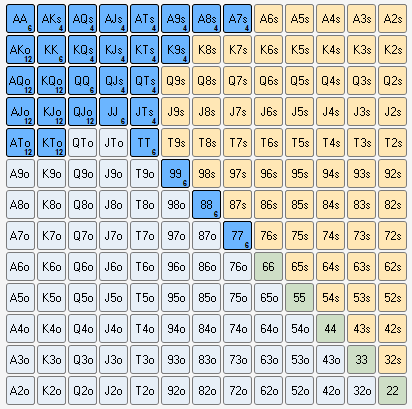
How many of those hands J3s beats preflop? None.
How many of those hands Q4s beats preflop? Only JTs(4 from 200 combinations)
My point is that J/Q high needs to improve in order to win. T9 has way bigger chance to hit straight and more outs against underpair - in consequence against 15% range T9s(35,64%) has more equity than both Q4s(33,30%) and J3s(31,46%)
Originally posted by NextLevel
I was comparing J3s vs 109s and Q4o vs 109s.
That J3s and Q4o have equity over 109s.
And yes, i was thinking all-in situatins particulary.
But accoding to this information. One should go all-in with nothing less than Jx , to maximize long term winning results ?
Cuz you gonna dominate everyone lower than Tx ?
What about suited connectors then ?
Thank you.
When considering an all-in, it is necessary to consider much more than just the strength of the hand you hold.
You need to consider how big a stack you have compared to the players that follow
You need to consider how close you are to the bubble, how many places are paid, and several other factors.
Kyyberi mentioned playability.
Suited connectors are easily played -- you either hit a flop with a decent straight draw, flush draw (preferably both) or you hit two pair or trips or something worth continuing with, or you don't -- and it is easy to tell how good the board is for your hand.
Q4o can be a nightmare to play.
Let's say you flop a Q -- or a 4 on a dry board.
How good is your hand? Tough to tell.
But playability refers to post-flop play, and if you're considering all-in equity, then it doesn't matter as much.
Early in a tournament you might raise 7♦:6♦: from the button, but you'd certainly not shove it.
At least I hope not 
Cheers,
VS
And you have to remember that we don't always go all-in because we want the opponent(s) to call. Sometimes we want the opponent to fold.
There's so much more into poker decision making than just core preflop equity.