



Cross-posting this from the german ps forums:
Disclaimer: PokerStrategy.com is not associated with the following content and is expressly not responsible for the following content, for the content on artgto.com, for the software, or for the Viewer app. Before creating this post, I asked Sven/the mod team for permission, which was granted.
tl;dr
I've built a GTO Solver & Game Tree Viewer and I'm looking for 10 beta testers. PokerStrategy members get top priority.
Website: ARTGTO
Discord: Click Here
YouTube: @ARTGTOCOM
NOTE: I'll give the Viewer (incl. preflop ranges) to anyone who joins the Discord and asks for it 
Hi everyone!
Some of you might still remember me from my active poker days. I'm aaaRt, now 39 years old, and I spent many really good years here on the poker forum and ran several blogs. Naturally, the blogs always revolved around poker (and a bit of life content), and I mostly reported on my tilt escapades, chasing sessions on NL200, and the occasional excursion to NL500 Zoom ;). That was several years ago now, and my grinding days are well behind me. Apart from the occasional session, I haven't really played actively since ~2017, and with the GlüStV (Germany's gambling treaty), which I've also written many posts about, the chapter of poker-as-a-player has simply been closed for me for some time now. Nevertheless, I've always stayed on top of poker topics and followed market developments as far as I could — trying out new tools, playing here and there (either live or online abroad), and regularly reviewing my strategies in GTO solvers. What always really bothered me, though, was that I never found a product that truly fit my needs. Combined with my interest in programming, about 3–4 years ago (before the whole AI wave) I built — more badly than well — study tools on my own that matched my needs exactly but were above all one thing: half-baked.
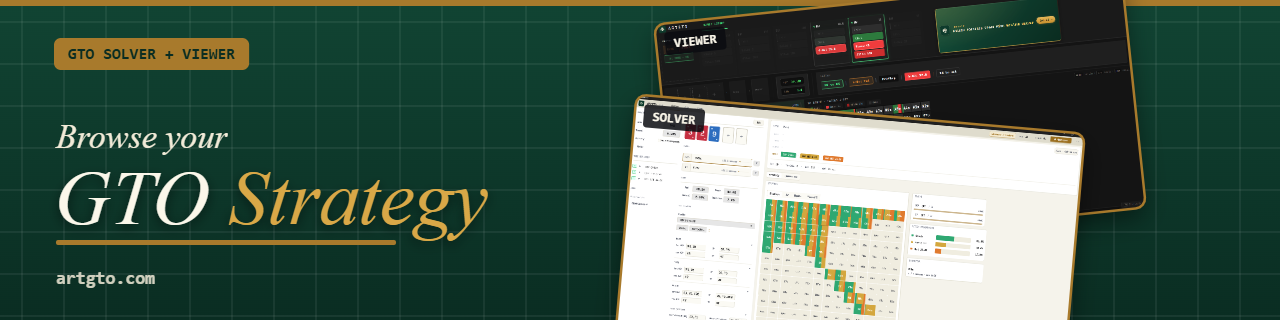
After a few years of development, though, I'm now at a point where I'm pretty happy with my product lineup and want to introduce it to you: the ART/GTO Solver & ART/GTO Viewer — two tools that work hand in hand and let you a) calculate GTO strategies and b) then browse them super fast in a locally hosted web app.
So what's all this about?
First of all, ART/GTO Solver is at heart a "perfectly ordinary" solver that does one thing as well as other solvers do: GTO simulations. It's missing a few features you'll be used to from Pio, GTO+, SimplePostflop (node-locking, aggregate reports, class breakdowns); I'm already working on some of them, but those are fairly large development chunks that I want to tackle after the beta.
The Solver "comes with" a custom-built web app, the ART/GTO Viewer. It's hosted on your own PC via either python or npx http-server -p 8080, and it lets you browse the spots you've solved with the Solver in a nice, fast UI. You can see what the whole thing looks like as an end state here:
Let me highlight a few features:
Solver:
- ART/GTO Solver has its own GTO engine: with a tuned HS-DFCR algorithm. In terms of speed, the Solver can keep up with other commercially available solvers.
- Minimalist, clean UI: I've invested a lot of time to make the UI as user-friendly as possible.
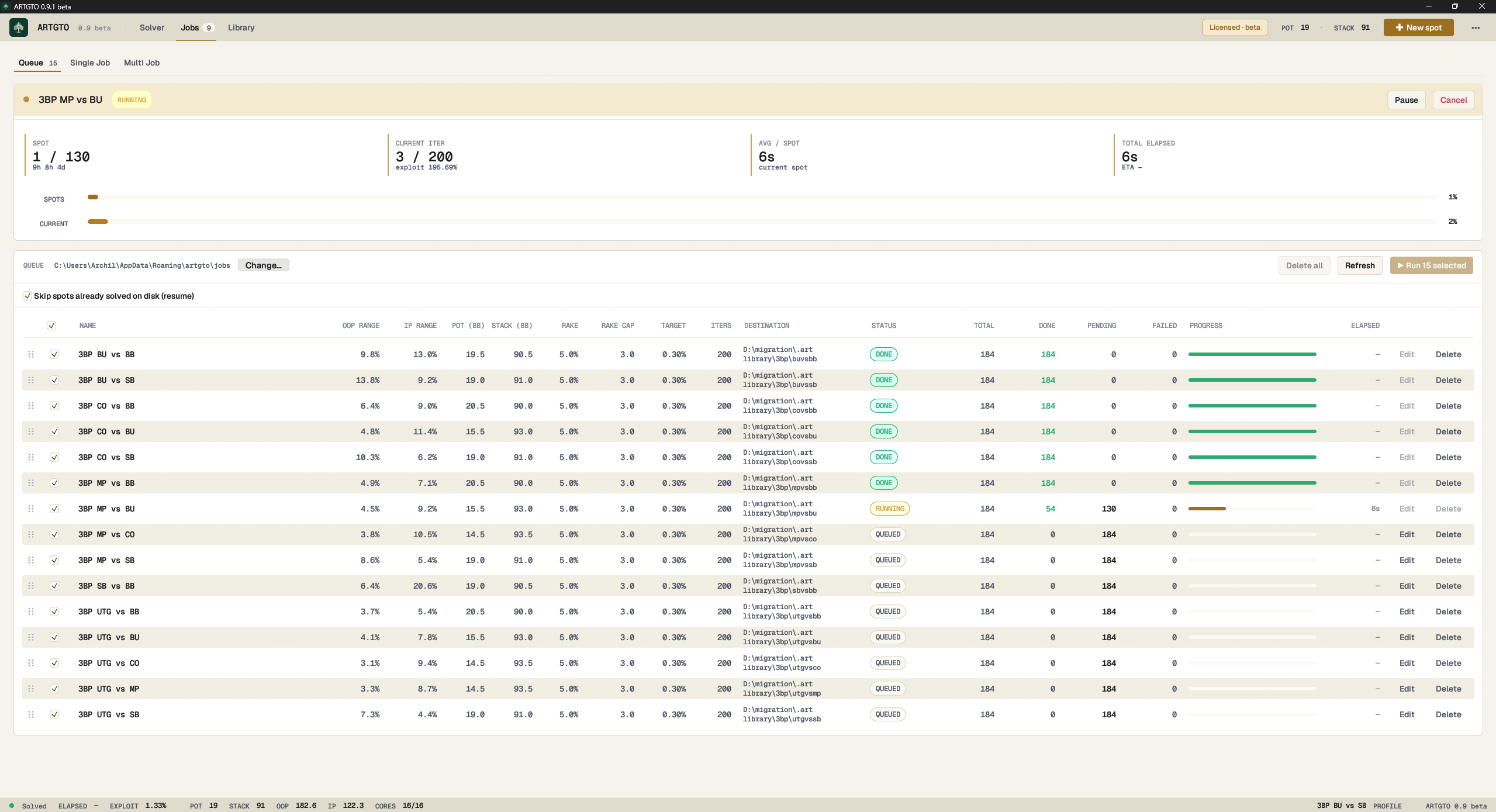
- Job setup and multi-job setup: You can create entire jobs without having to define every single range. ART/GTO's multi-job viewer is able to parse the ranges for the existing position pairs from a minimal selection (pot type, number of boards, betsizing profile) and create the corresponding spots itself. If you have the underlying info, you can create a job setup for any pot type (SRP, 3BP, 4BP) within a minute and then solve through it. No further input is needed from you.
- Batch export: Once you have the solutions, you can export them all to your PC.
Viewer:
- Just a genuinely good UI, for once.
- Locally hosted .html web app — the data is yours forever.
- Uses flop mapping and suit transformation: There are 1,755 "strategically unique" flops. Usually you don't want to solve all of them, because a) it takes a long time and b) it needs a huge amount of storage. For that, ART/GTO provides various presets of flop subsets (25, 74, 184) that you can solve instead, and those then represent, in a sense, the gaps (i.e. boards that exist but that you don't solve). The Viewer knows the corresponding mapping, meaning that for every input the Viewer always delivers the solution for a neighboring board whose strategy is similar to the one on the board you entered / want to look at.
- Suit transformation: With the flop subsets, only one suit variation of a board is ever solved, e.g. 2:h 3:h 9:d but not 2:c 3:c 9:s -> The strategies on both boards are of course identical, which is why it's reduced to one variation. The Viewer uses suit transformation so that, for any input, the equities and strategies are remapped according to the user's input. Reduces effort
Keyboard Shortcuts: So you can train the spot you want really well, you can navigate to the corresponding solutions via keyboard shortcuts (e.g. 345932hhd -> 3BP SB vs BU 932hhd board).
Further features (both tools)
- GTO preflop ranges are pre-packaged.
- Betsize profiles are included as well.
- Spot profiles (basically all of the above combined) for multi-job setups are also in there.
- Open Format Export -> You can use the format to build your own tools. I'm currently also building a trainer based on the open format.
- AI Specs -> For all you vibe-coders: thanks to the AI specs you get instructions for the AI of your choice if you want to build your own custom tools.
Why I went to the trouble of programming a GTO solver and matching viewer when there are already established (and very, VERY strong) products:
- I find that most GTO solvers have a catastrophic, completely overwhelming UI. They can admittedly do more than my product (at least at this point in time), but the barrier to entry is relatively high, overwhelming for the average user, and doesn't meet standard needs.
- Web-based tools, of which GTOWizard is the most prominent — I tried it too and found it very good, but also costly in the long run, and I'm generally not a fan of subscription models as an end consumer. For me there are a few problems: I really only ever use one "solution" / one strategy from the library, so I'm paying for a large chunk of data I don't use at all. GTOWizard can raise prices at some point, the data belongs entirely to them, and you're using the same strategies that everyone else uses in exactly the same way. I'm a fan of as much self-sufficiency as possible — but that's of course a matter of taste.
- Job creation: pretty much all the larger solvers can do it, but the workflow is usually fairly extensive and unstructured, and requires a lot of manual input. I designed my product from the premise: what helps the average player the most, and how can I optimize exactly that workflow?
- With other commercial solvers, exporting entire game trees is often a sticking point: with ART/GTO you can a) save the entire game tree for really all nodes and all cards and export it both human- and machine-readable (from .art files to .artgto files).
The last point is especially relevant if you also want to further process the data, and that's also the key connection point of the Viewer --> it uses the exported game trees and transfers the data into a clean UI optimized for that purpose.
Spoiler

In the image: BU vs SB 3b pot, flop node with SB to act, solution generated in the Solver and read out by the Viewer. As you can also see in the YT video, the entire game tree including river spots can be navigated very, very quickly.
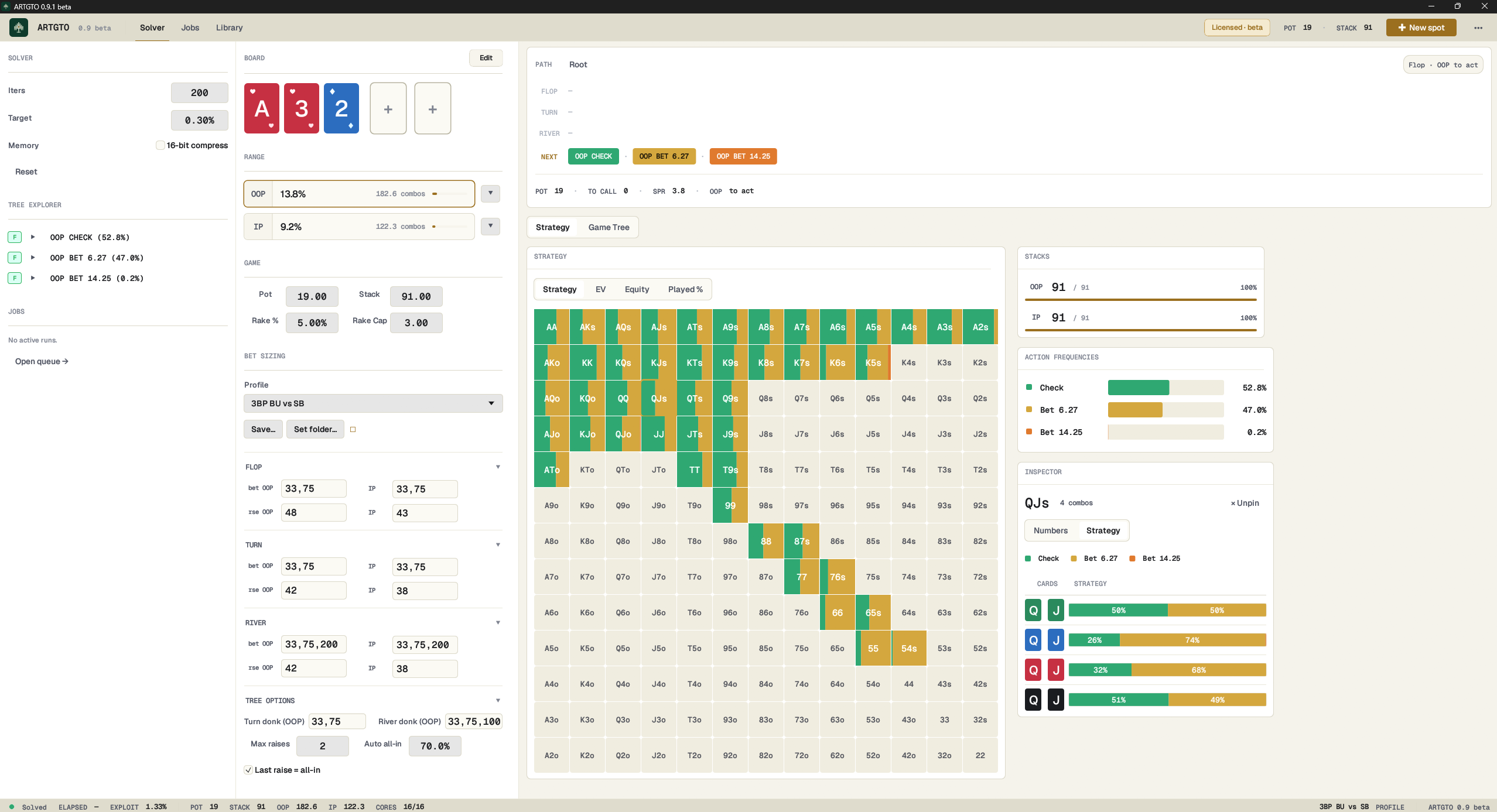
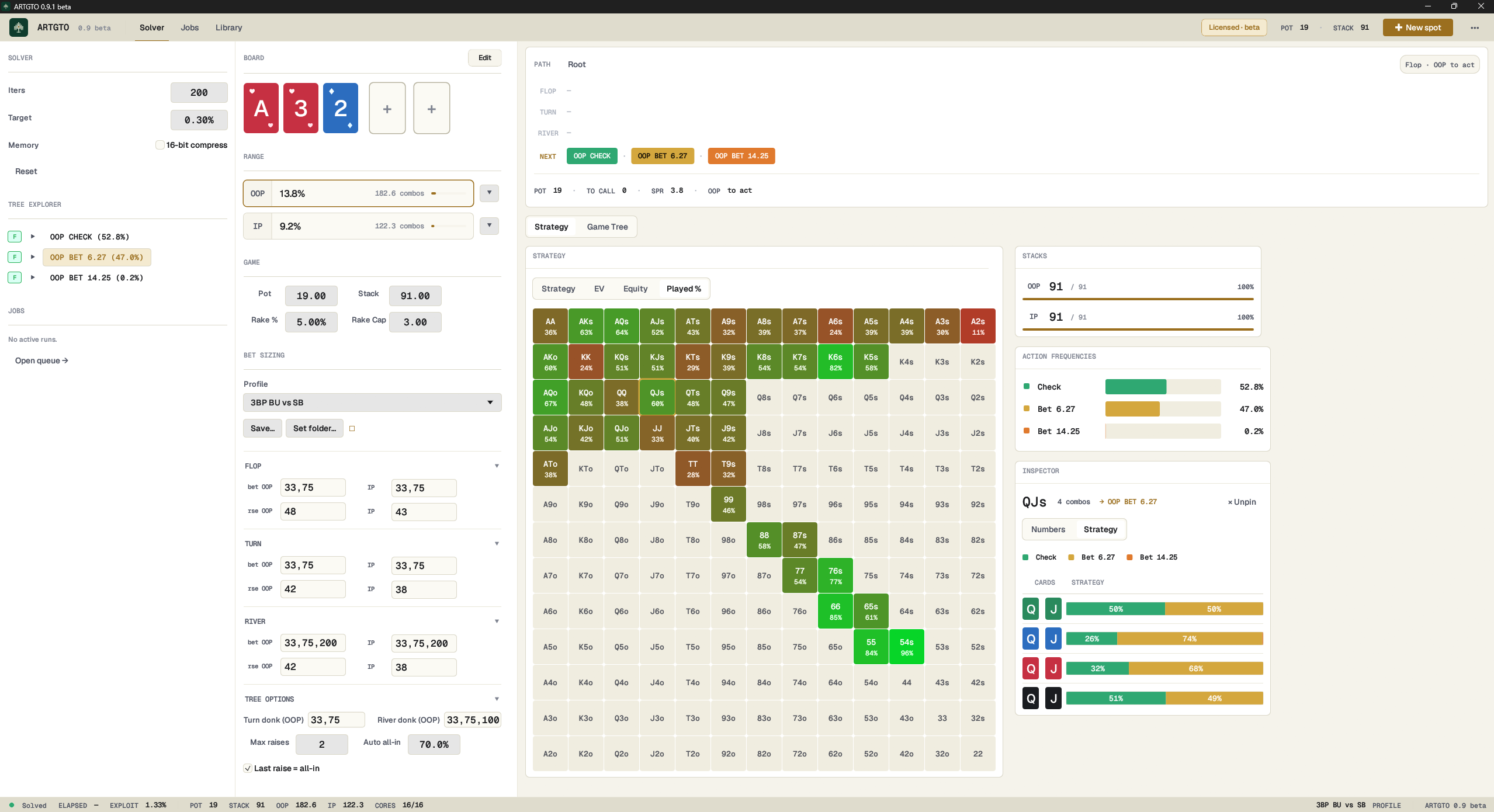
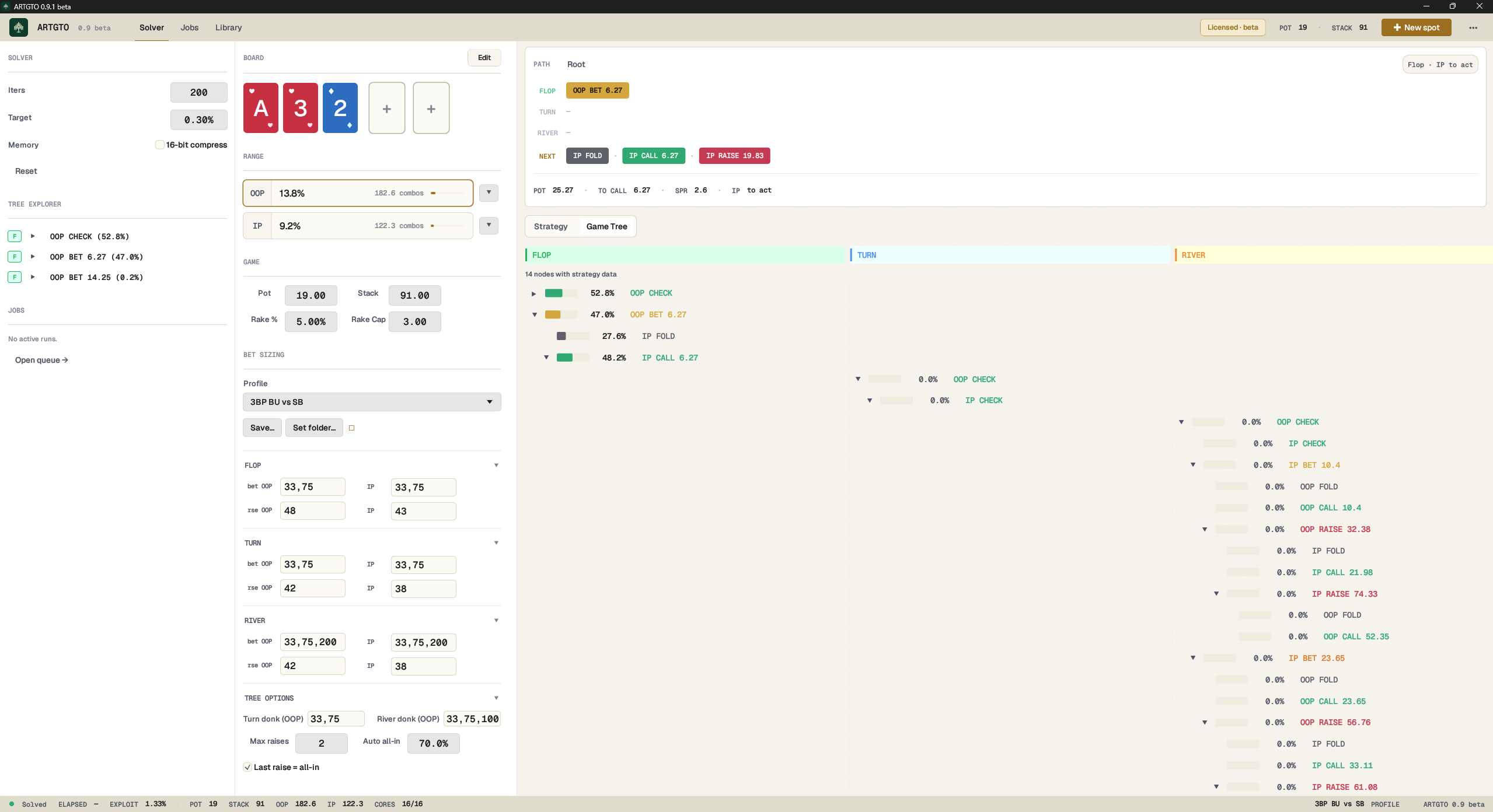
A few screenshots of the Solver:
Spoiler

To close, a call to everyone interested:
I'm looking for up to 10 beta testers who'll put both products through their paces with me in this phase. As a solo developer you run around with blinders on and don't iterate through every possible function, so bugs slip by easily and well-conceived but poorly-executed features may go completely unnoticed. That's why I'm looking for people who REALLY feel like giving good, honest feedback and helping shape the development a bit. The place for this exchange is the Discord server. That means beta testers would need to join the Discord and register via the following list: https://www.artgto.com/waitlist . After that, I'll provide the download link and a personal beta key. You can also put yourself on the waitlist in general if you'd like to receive product updates, early-bird discounts, etc.
I'll keep updating this thread continuously; I've probably forgotten a bunch in this first draft. Regardless of the beta test, I'm of course also curious to hear the community's opinions!