Skip to forum
Notifications
Clear all

asymetric ranges, how to defend with weaker range

45 Posts
9 Users
0 Reactions
13 K Views
serverm07
Joined: 08.08.2012

Originally posted by LemOn36
But I'd like to find out btw and let's setup examples if you guys don't want to share these (if you look at it as a third party, it's quite funny, serverm won't post ranges, ginger didn't either to start solving this on specifics )
say BU v Blinds, we get 3bet
we have this flat range
and 3bettor has this
board:

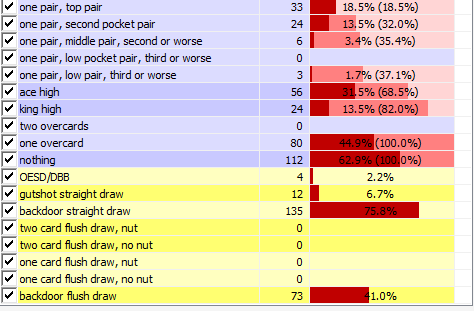
our range breakdown:

He cbets 2/3 pot meaning we need to call 60% of our 1-A range
We have around 29% pot odds (rounded up, say rake did this )

Assuming no raising range, what we need to do is from EV perspective go by specific hands/hand groupings we have one by one, see our *estimate* (cause I doubt it's solvable specifically) if 0> -call amount+pot on next street*%equity we realize*equity and get a calling range, and I'd assume that it would be lower than 1-A? if not in this spot than in others where ranges are assymetric, and it won't really make sense to play -ev hands just to deny villain profit with bluffs in practice?

This is why 1-A can't be really used here if I'm getting this right? Or would it make sense to know that some hand groupings are -EV just to not fold more than 1-A
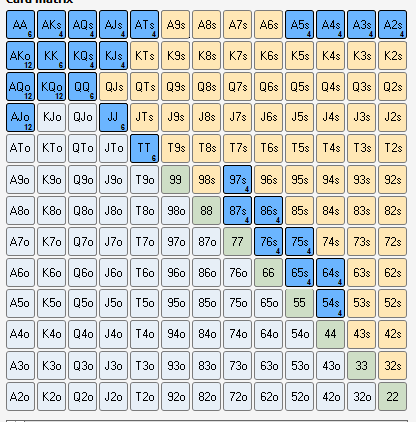
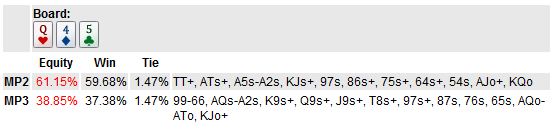
There are a lot of things to go into this. You are comparing the bb's EV of flatting to 3betting the hands pre given that we know folding is lower ev. We then have to realize that when bb bets and bu calls, the bb still has equity with his "bluffs", so now again the ev of betting vs ev of checking is being compared given we think ev of folding is worse, if we think it's close we might have to compare all 3. We then have to account for the fact that BU has position, therefore he could call with two napkins otf and bet ott when bb checks and if the bb folds, the two napkins would be considered value. Once again you are comparing ev's though. Also keep in mind hands that can make nutted hands realize equity better and yield the most ev, especially true the deeper we get imo. Some of these hands become quite close in ev so when you hear guys say x is fine and y is fine or do X 50% Y 50% it's because they are guesstimating that's how close it is, or X 75% and Y 25% so on and so forth. When you implement a raising range for BU, now the BB gets denied some equity, we as humans sometimes can't implement these strategies very well because they are very tough and not practical to remember so it's easier to give up a small portion of EV for practicality, but I strongly believe GTO has some raising range here and plays a mixed strat with some hands.

This is all my personal opinion based on what I know, I have no way of proving it for sure until I solve the game.


Reply
Quote
GingerKid
Joined: 05.08.2007

You have to realize that although I'm ahead of you in the learning process, I'm not some high stakes sicko and I also have to learn more each and every day. I'm very thankful when people respond to my question at all, even if it as short as "NO". Do you 3bet this hand? "NO". Given I trust and respect the person, I use my detective skills to figure out why that person doesn't 3bet that hand. If they answer the question "why?" I'm doing backflips in my head.

Ok, I see your point, I wrote it in a unpolite way, sorry for that, maybe it was tilt by me. Even If I am not happy with the quality of the answer, I could have formulated it nicer, and if I am unhappy with the service I dont have to use it. Well, thanks for point that out.


Reply
Quote
GingerKid
Joined: 05.08.2007

And no, I don't think this has to do with me not being able to accept negative critics and quit cooperating. I'm not sure if you missed it the first time so I will repeat myself again. I have about 0 monetary gain here, I have spent (not sure exact #) easily over two hours responding to you. I might have made $20-$30 from all of that. That's way lower than my hourly, but you can't even compare that to my hourly alone because think back to the big picture, now you have some new info and the info is also pretty much publicly available for the masses to read.

I thought actually that you are guys payed much more for that, i am surprised that it is so little money. So yeah, considering you are litterally doing it for free, thanks even more, and especially thanks that you are respoinding even after my ugly words. Now I feel a bit bad about it, I could at least tell you in private message that i am not happy with answers and not in public, I wasnt thinking about it at all.


Reply
Quote
GingerKid
Joined: 05.08.2007

Assuming no raising range, what we need to do is from EV perspective go by specific hands/hand groupings we have one by one, see our *estimate* (cause I doubt it's solvable specifically) if 0> -call amount+pot on next street*%equity we realize*equity and get a calling range, and I'd assume that it would be lower than 1-A? if not in this spot than in others where ranges are assymetric, and it won't really make sense to play -ev hands just to deny villain profit with bluffs in practice?

This is why 1-A can't be really used here if I'm getting this right? Or would it make sense to know that some hand groupings are -EV just to not fold more than 1-A
Sure 1-A shouldnt be used in every case, that 100% sure. It is just rough guide, to give us feeling how much to defend. E.g. if villian has all hands in range with 100% equity and hero all hands with 0% equity, hero shouldnt defend 1-A. So if we find 1 example where 1-A doesnt hold, then it means that it cannot be used as a general rule blindly.
Now what if villian has 99 combos pure nuts in range, and only 1 bluff. Do we have to defend 1-A, otherwise he will "brutally" exploit us by bluffing that one combo? I dont think so. So I think we should only defend if villian has enough bluffs in ranges so that he can potentially exploit us. If villian has 100 value combos, and 50 bluff combos, and pots, he is balanced, so he is not exploiting us. If he has 100 value combos and 51 bluffs, do we need to defend 1-A just because he can increase his average range EV by adding one more bluff? Now it starts imo to make sense to start defeding. So I think that is precondition to defend 1-A.

Now, coming back to low board example, where CO has better range, is he exploiting BU by betting e.g. 9Ts on 2c3h2s board? I think he is not, because 9Ts cant be seen as pure bluff, it has also a lot of equity vs BU range. But, he would exploit BU with that hand, if BU would be folding all PP and better hands. So I think, he is only exploiting hands that have solid equity , and he cant really exploit hands like e.g. JQo that have anyway low equity vs CO range. So imo 1-A defend should hold only for the hands that are bluff catchers (meaning that it beats significant % of villians hands), and not 100% range.


Reply
Quote
Coach
LemOn36
Joined: 07.02.2009

that's where equity realization comes into play.

I;m actually curious how to build ranges like that when cbetting,

e.g. this example
https://forums.pokerstrategy.com/forum/thread.php?postid=1968864#post1968864

how do we build out cbetting strategy vs villain? basically the more the board favours his range the less we should cbet(cc cr) and more we can check fold and vice versa?
And where both ranges are equal roughly in terms of distributions, what should be the correct frequencies we should play with?

I'm assuming on these boards there is always argument between cbetting, or playing largely with checking strategy as some people like Gogol don't cbet much oop anyways. But doubt we can resolve that here. But I guess the ratio of cf:play back can be discussed?

Do we get the starting point at odds villain's getting preflop?


Reply
Quote