Skip to forum
No Limit Beginners ...
 
Notifications
Clear all

No Limit Beginners course with confidant91

127 Posts
35 Users
56 Reactions
59.3 K Views
blueswimmer
Joined: 03.01.2009

Question on green hands in the post flop video lesson #2 there was a live hand played with A9o from the button ( 38:18 on video ). You faced an early position limp and raised 5BB. I thought with green hands you should fold to a limp as you need to be first in. Also with Zoom surely you cannot mark villain as a fish just because he has limped the once.

Before I started this series I would have most definitely raised with A9o even with a limper, unless I had that limper marked as a possible tricky player looking to reraise a raise with his limp.

I know A9o is close to the blue zone on the button chart. So my question is when can you deviate from the chart and raise the green zone hands when faced with a limper.


Reply
Quote
blueswimmer
Joined: 03.01.2009

Another question on how to take into account flop texture. In your video#2 you lost your stack on a flush heavy draw with a set of 3 ( 30:38 on video )

You open raised 3BB with 33 and were called by 3 villains

Flop is flush heavy with 2 hearts you raise 2/3rds of pot having hit your monster a set of 3's. ( my take here would be to bet pot size for protection. Is this wrong? )
after your bet one villain has called and the turn gives another heart making a flush on his part quite likely, possibly top pair / two pair although I would already be thinking villain is chasing flush draw and then boom it comes on turn.

Turn you bet I get that but at the point he re raises I don't understand going all in given the texture of the board and no information on the player. At this point I would have looked to 1/2 bet the pot to see how villain responds and to a raise folded however this in itself may be a leak of mine as it could be exploited if everytime I fold just because the board looks scary. You also mentioned in the video the EV being about 50:50.


Reply
Quote
janmajay1027
Joined: 23.11.2014

I will understand many things to this thread, your work looks great:f_cool:

i am waiting for more things to know. and wait your more lessons continue this good one.

thanks..
janmajay


Reply
Quote
confidant91
Joined: 02.04.2011

blueswimmer:

Question on green hands in the post flop video lesson #2 there was a live hand played with A9o from the button ( 38:18 on video ). You faced an early position limp and raised 5BB. I thought with green hands you should fold to a limp as you need to be first in. Also with Zoom surely you cannot mark villain as a fish just because he has limped the once.

Good question. We recomend to just fold ou green range. Hovewer if you are confident with your postflop skill you can isolate wider since you will easily outplay your opponents. One tip when you should definitely isolate your opponent wider is when he plays fit or fold style since you wll be making lots of money postflop.

Before I started this series I would have most definitely raised with A9o even with a limper, unless I had that limper marked as a possible tricky player looking to reraise a raise with his limp.

preflop limpping is just bad play. No regs are doing it. The reason for that is for example with AA you dont want to give everyone odds to overlimp with 72o or whatever trash they can have because it allows them to suck you out postflop. You always wnat to raise because of that. Anouther thing why you should raise is that you have iniciative postflop so you can easily represent made hand even with a bluff.

Thats why limping is bad and everybody who does that on micros is definitely weak player.

Flop is flush heavy with 2 hearts you raise 2/3rds of pot having hit your monster a set of 3's. ( my take here would be to bet pot size for protection. Is this wrong? )

Not bad at all, i would normyla bet little bit biggger as well if there is a fish in pot.

At this point I would have looked to 1/2 bet the pot to see how villain responds and to a raise folded however this in itself may be a leak of mine as it could be exploited if everytime I fold just because the board looks scary. You also mentioned in the video the EV being about 50:50.

I ve just followed the startegy from this course. However as you say it should be better to play accordingly to pot odds and implied odds.

You got to understand that following this completely basic strategy you wnt always play perfect line since if poker was this easy there will be no edge. Thats why this course is quite long and it will show you more advanced stuff later on so stay tuned!

janmajay1027: Hope to see you on other coaching!


Reply
Quote
confidant91
Joined: 02.04.2011

Lesson 5: Five minutes to learn, a lifetime to master

In this lesson beginners will learn what a sample career path of a professional poker player looks like.

The lesson is divided into 4 major stages and an additional bonus part:
• Stage 1 - Playing poker with a strategy (NL 2 - NL 5)
• Stage 2 - Basic concepts and thinking in ranges (NL 10)
• Stage 3 - Hand reading and exploits
• Stage 4 - Playing with an adaptive game plan

Stage 1 - Playing poker with a strategy on lower limits

Link to the overview page

What's special about this stage?
Beginners who follow this course don't need a lot of additional information on this stage as they are usually already amidst it, or have already surpassed it.
What's special about this stage is the "aha experience" when realising that it's possible to play online poker profitably by playing fewer hands and sticking to some basic guidelines.

First of all, a beginner is provided with static ranges and sample charts for pre and post-flop play.
Simple guidelines like that ensure that fewer mistakes occur, resulting in a higher probability for success.

A new driver doesn't start his first driving lesson in a Formula 1 racing car, but rather in a standard car in order to make the first steps as easy as possible.

What's the difference to the preceding stage?
In this case, the preceding stage was playing as a recreational player.
A recreational player is an online poker player that doesn't play with any strategy, thereby making more mistakes than a beginner in stage 1.
Therefore, we will be able to win money from these players on lower limits.

Why is this stage important?
Without stage 1 you won't have a solid starting point in a sport you won't automatically get better in just because you're doing it all the time.

A recreational football player who's playing the game every weekend with his friends without any particular training will be better than someone who only plays twice a year.
A poker player who plays poker every week without dealing with any sort of strategy won't learn a lot, staying on the same level as someone who plays less frequently while also not studying any sort of strategy.

The fact that you won't get better at poker by simply playing shows how complex this game really is and why beginners with a strategic approach have the opportunity to win money.

Further links for stage 1:
The first lesson of this beginners' course is just what the doctor ordered for this stage:

• First lesson of the beginners' course - Forum article | • First lesson of the beginners' course - Video

Stage 2 - Basic concepts and thinking in ranges

Link to the overview page

What's special about this stage?
This is a stage that the beginner interested in this course has tackled already!
Topics like odds & outs, implied odds, position, playability etc. are no alien concepts for advanced beginners taking part in this course.

What's special about this stage is that players start to realise that you have to think for yourself when it comes to poker.
The further you advance, the more complex the game will be. Sample charts and standard playing styles have to be reconsidered and any situation has to be evaluated on its own.

What's the difference to the preceding stage?
In the preceding stage players are only focused on their own hand and on what they themselves are doing at the table.
In the second stage we start to think about which hands our opponent could be holding. Furthermore, we try to find out the reasoning behind their moves and how to best exploit and use against them.

Why is this stage important?
If you don't start thinking about the reasoning behind your opponent's moves and with which hands he conducts them, your development as a poker player will stagnate.
From NL10 onwards there will be more and more players at the table that will try to think in ranges and try to outplay us. We always have to be one step ahead of these players.

Further links for stage 2:
There is a lot of additional information on the relevant topics of this stage. You can find everything you'll need in the strategy section of PokerStrategy.com.

Strategy section of PokerStrategy.com

Here's a short list of some of the most important articles on basic poker mathematics that you should read.
Odds & Outs
Implied Odds

After getting accustomed to odds & outs, the next topic on your study list should be equity and related concepts:
Introduction to Ranges
Combos & Card Removal
Introduction to Equity

Stage 3 - Hand reading and exploits

Link to the overview page

What's special about this stage?
The main factor of successfully playing poker is the analysis and exploitation of weaknesses in your opponent's game. Analysing your opponent's style of play is called hand reading. Using information that you're gaining from it against your opponent is called exploiting.

What's special about this stage is that we're increasing our focus on winning money from solid players at our table as well as just recreational players.
In the end, everyone makes mistakes and it's up to us to notice and exploit them!

What's the difference to the preceding stage?
Players in stage 3 should already be familiar with stats displayed by tracking tools like PokerTracker 4 or Hold'em Manager 2 and know how to use them, meaning we have specific information on our opponents that we can use against them.
We don't just think about which hands our opponent could be holding in a given spot, we also start trying to categorise our opponent from a general point of view:
• Which kind of player is our opponent?
• How does he play against different types of players?
• How does he play against me specifically?

Another decisive aspect of this stage are notes that we take on our opponents.
Of course, taking notes on special moves you've seen from your opponents should be done as early as possible (even on NL2 already). However, only from stage 3 onwards are players usually able to use these notes to their advantage.

Why is this stage important?
Certain moves or general playing styles of opponents can be easily exploited, thereby enabling you to auto-profit.
Auto-profit is an exploit with which you can take advantage of a too high folding frequency.

Example:
Your opponent folds 80% against 3-bets.
When 3-betting to three times the initial raise size, you'll only need 66% fold equity in order to make this a profitable move. So if your opponent folds 80% against 3-bets, you can bluff 3-bet against him with any hand and it would still be a profitable play every single time.

Further links for stage 3:
Again, some links to relevant articles for this stage.

Regarding the topic of hand reading the following articles are recommended:
The Five Player Types
The Average Range
Four Tips for Successful Hand Reading

After getting your teeth into the topic of hand reading, you should focus on exploits:
Auto-Profit
Thin Value Betting

Stage 4 - Playing with an adaptive game plan

Link to the overview page

What's special about this stage?
The next step in the evolution of a poker player is planning your entire range in any given situation.

What's special about this stage is that you're trying to consider and incorporate all the other previous stages, thereby enabling you to already know by the flop what you're going to do against different types of opponents.

What's the difference to the preceding stage?
In the previous stages, we've focused on very particular aspects of our own game or the game of our opponent.
Stage 4 is characterised by trying to create increasingly fluid crossovers in your own train of thought. It's the stage at which level thinking begins, for instance "I'm assuming my opponent thinks this and that, therefore I will do the following."

Why is this stage important?
Planning your own game helps you to notice more frequency-based leaks in your opponent's game, enabling you to shape your ranges in a way that you'll always end up with the right range in the right situation.

When playing against proficient players, you shouldn't just focus on exploiting their mistakes anymore. You should also try to remove any mistakes in your own game, thereby preventing your opponent from exploiting them.

Further links for stage 4:
PokerStrategy.com also offers a lot of great articles on relevant topics regarding stage 4. Make sure you've read and studied all of them when reaching this stage in your career.

The single most important article for this stage is the one focusing on "game plan":
Game Plan (1): Introduction


Reply
Quote

Looking forward to the video being posted! cannot watch during the day :)

thanks!
Ron


Reply
Quote
confidant91
Joined: 02.04.2011

No worries Ron, it was recorded so should be online in couple of days :f_thumbsup:


Reply
Quote
confidant91
Joined: 02.04.2011

Hope that you all had great week. Tomorrow dont miss a coaching since we will start to discuss more advanced strategies!

Talk to u tomorrow 20:00 CET!

Btw if u have any hands where u dont know how to aply basic strategy from lesson one or tow feel free to post it here.:f_cool:


Reply
Quote
confidant91
Joined: 02.04.2011

This article refers to lesson 1 of the beginners' course:
https://forums.pokerstrategy.com/forum/thread.php?postid=1999916#post1999916

Lesson 6: 13/03/2015 Adjustments to the beginner strategy - Pre-flop.
In this lesson we will show how a beginner can improve his game and develop an advanced beginner strategy.

You will learn ...
• ... what to take into account regarding an advanced beginner strategy.
• ... how to optimise your pre-flop play.
• MP2 adaption
• MP3/CO adaption
• BU/SB adaption
• BB adaption
• "Multi-way suited connector calls"
• Call on "top pair value"

What you should take into account regarding an advanced beginner strategy
The more advanced the strategy, the more difficult it is to specify it through predetermined ranges, sample charts and standardised playing styles.

Every player has to judge for himself when and how to play and take responsibility for determining whether his playing style will be most profitable in the long run or not.

Therefore, this article won't present any more sample charts or ranges. Instead you will be shown how to start thinking about spots and how to further improve your game on your own.

How you can optimise your game pre-flop
General note:
Observe your table, pay attention to players who are still to act after it's been your turn and write down notes on things that you've noticed.

Examples for possible observations
Your raises are often answered with a 3-bet:
If you realise that your opponents frequently 3-bet your raises, meaning raising again, then you should consider which hands are appropriate to continue with against these 3-bets.

Does it still make sense to raise with smaller pairs when you have to give them up against a 3-bet anyway? Should you rather just raise hands like AQ with which you could continue playing against a 3-bet for top pair value?

Your raises are frequently called by a lot of players
If you're constantly up against 3 or 4 callers on the flop although you've raised first-in to 3-4 big blinds, then you should consider increasing your raise size for stronger hands to 4-5 big blinds.

Players who constantly just call raises are often recreational players not following any particular strategy. Most of the time you will still have a better hand when playing against them, even when increasing your raise size.

MP2 adaption
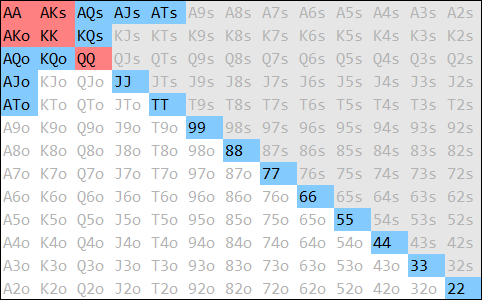
The first position at a short-handed table can be played very differently, either tight or very loose. The reason is that there are 5 more players still to act behind you and the dynamic at a short-handed table can vary much more in comparison to a full-ring table.

What can I change?
As said before, you should definitely try to adapt to the players behind you and the dynamic at the table. A good initial approach is to differentiate between tight and loose tables in general.

Example: When raising from MP2 you often only get the blinds or a single caller.

This would be a good table for playing more hands. Depending on how comfortable you feel, increasing your range to hands like ATs/ATo/KJs/KTs/QJs is recommendable.

MP3, CO adaption
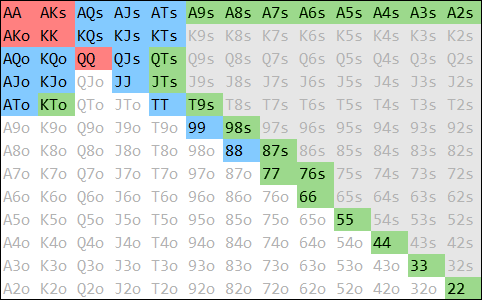
In this case, we're combining two positions. When you're first-in in the CO, you're always in a typical steal spot. That's not the case for MP3.

Therefore, it definitely makes sense to try stealing and raising more hands in the CO than in MP3, given that the BU is not really an active player.

What can I change?
When in the CO, you should try to extend the sample chart logically, thereby attempting more steals.

If other players limped before it was your turn, you don't really want to raise hands like 67s from the CO. However, if everyone folded, that hand is almost always strong enough to steal with.

The same goes for A9o. When allowed to raise ATo even when there limpers are in the pot, it's just logical that you can also try and steal with A9o in the CO, given that everyone before you has folded.

Again it is important to take into account the current dynamic at your table. If you know that the players behind you are playing loose and like to 3-bet, it is definitely not forbidden to play tighter than suggested in MP3.

BU, SB adaption
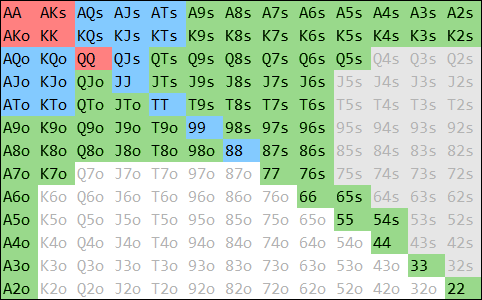
Especially on NL2 to NL5 these are the positions where the chart is really close to the optimum. However, even in this case you shouldn't forget that different types of opponents require different ranges.

Without any particular information or observation on the players behind you, there's no reason to deviate from the chart.

Playing looser than suggested by the chart in BU/SB is almost never recommendable since the chart itself is already based on a loose approach. Of course, you wouldn't want to play T7o against very loose opponents in the blinds.

What can I change?
Pay attention and adapt!

If your opponents frequently react with a fold, then simply continue stealing. If the SB/BB is playing very loose, either by cold-calling or 3-betting a lot, you should stop stealing and just fold with T7o/J7o/Q7o and similar hands.

If you realise that the BB has re-stolen more than 4 times against you, meaning 3-betting your steal raise, then even KQ is certainly strong enough in order to call his re-steal and play a possible top pair in that 3-bet pot like a monster.

However, always keep in mind that you shouldn't make adjustments like that whenever you are unsure about an opponent.

Hand discussions are the perfect way to check whether you've played and adapted correctly against certain opponents or not.

BB adaption
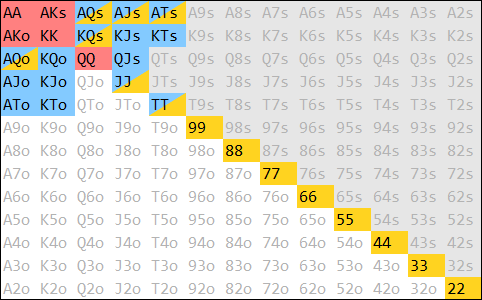
In this case, it's important that you don't start weird re-stealing moves, meaning to 3-bet your opponents' steals with any possible hand.

Re-stealing as a bluff usually just make sense when you're playing with stats from software tools like Hold'em Manager 2 or PokerTracker 4. Since beginners shouldn't use these tools though, we are playing without stats and consequently without bluff re-steals.

What can I change?
You should always feel comfortable at your table.

If you're not comfortable with raising KTo against two limpers in MP2/MP3, that's definitely understandable. In such a case, don't raise and instead simply check when in the BB. Obviously, it's much easier to play against one opponent. So if you're more comfortable with raising KTo against a single limper, simply do so.

Against players who frequently steal and attack the blinds when in CO/BU/SB, you should consider also including hands like KQ/AJ/ATs in your calling range, playing these hands just like AQ.

Remarks regarding CO/BU
Whenever you are in the last two positions in which you can play hands in position, it makes sense to start with so-called "top pair value calls" and "multi-way suited connector calls".

Multi-way suited connector calls
What does it mean?
Multi-way means that you're up against more than one opponent. Typical suited connectors are hands from 45s to QJs (for example 7♥ 8♥ ).

If you are holding such a suited connector in CO or BU, you can start calling in order to hit a post-flop monster whenever there was a raise not bigger than 4BB in front of you and at least one more player calling this raise as well.

This way you will be up against at least two opponents on the flop, increasing the probability to get paid off in case you are able to hit your monster.

With which hands can I do that?
Any suited connector from 45s to QJs

What do I have to take into account?
• Don't make this move in MP2 or MP3!
• Only do it with the presented suited connectors!
• Only call when the raise is not bigger than 4BB!
• Only call when at least one more player has called that raise as well!
• Only call when both opponents have at least 50BB in their stacks!

How do I continue with such a hand post-flop?
When it comes to playing suited connectors post-flop, simply stick to "Step 2.2: You've only called before the flop" in Lesson 2 of this beginners' course.

Special rule for suited ace-high hands
With suited ace-high hands like A♥ 2♥ you can basically play the same way as with suited connectors but you should only call with them when in the BU and when there is one raiser and two(!) more callers in front of you since the playability of these hands is a bit worse.

Top pair value calls
What does it mean?
According to our sample chart, if you're holding a strong hand like AQ, you should fold it in CO or BU whenever there was a raise in front of you. However, most of the time you almost always have a better hand than the raiser.

If you now start calling instead of folding with hands like AQ, you're gaining the advantage that your opponent will almost always continuation bet a favourable flop for you (A♦ T♣ 2♠ ), even as a bluff.

On the other hand, he will often play check/fold on unfavourable flops like 3♥ 6♥ T :club:, again leading to you to profit from it.

With which hands can I do that?
The more hands your opponent raises, the more hands you can call with for top pair value.

Usually, it should, however, be limited to hands like AQ/AJ/KQ since weaker hands lack the advantage in strength against the opponent's range.

What do I have to take into account?
Opponents that raise from MP2 have less hands in their range and tend to play tighter and more careful than players raising from MP3 or CO.

Therefore, it is recommended for beginners to only call with AQ against raisers in MP2 as long as you can't be sure that the player in MP2 has a looser raising range which enables you to call with AJ/KQ or even weaker hands on top value.

How do I continue with these hands post-flop?
When it comes to playing suited connectors post-flop, simply stick to "Step 2.2: You've only called before the flop" in Lesson 2 of this beginners' course.


Reply
Quote
Thor770
Joined: 24.11.2011

Hi Coach.
I apologize for my English (I'm using a translator) I am of the Hispanic community and speak Spanish.
By chance I saw you were giving the train but could not attend for a compromise and that led me straight to your forum. I am a player Bss NL in NL2-NL5
Would you like to ask if I can post my hands with doubt in your forum? Or that space what I can do.

thank you very much, greetings from Colombia.


Reply
Quote
Head Admin
SvenBe
Joined: 19.04.2006

Originally posted by Thor770
Hi Coach.
I apologize for my English (I'm using a translator) I am of the Hispanic community and speak Spanish.
By chance I saw you were giving the train but could not attend for a compromise and that led me straight to your forum. I am a player Bss NL in NL2-NL5
Would you like to ask if I can post my hands with doubt in your forum? Or that space what I can do.

thank you very much, greetings from Colombia.

Hola Thor770,

we are trying to find a way to provide the course also in Spanish in the (hopefully not so far) future!


Reply
Quote
legenyPS
Joined: 10.03.2011

Hi confidant,

Just want to let you know that I have just stared my poker blog, in case you may want to look at it :-)

-legeny


Reply
Quote
confidant91
Joined: 02.04.2011
AlexKozlov
Joined: 26.07.2014

Hi confidant,
some questios about Red hands in chart: We always try to push it on preflop?
If we has AKo, raise/re-raise... and opponent reraise again, and again - should we push or can stop and just call his reraise? What about situation when opp does a lot of min-raise? (we open 3bb, he raise to 5bb, we raise to 15, he raise to 20bb... )
When we have stack 120-150-170bb?
If we just 3bet and opp immediately push?


Reply
Quote
confidant91
Joined: 02.04.2011

Hi AlexKozlov, we recomend to get it in preflop for beginners. Hovewer the poker is dynamic game so there might be some spots where it can be better to just flat. But no worries you will learn pretty soon about those spots with pokerstrategy. For beginners we try to keep it simple so you should always reraise. Usually with 5bet u should be pushing all in, doesnt matter if he just minraise or what ever.

About stack size...same thing as with 100bb up to 130 or 140bb deep. After taht i highly recomend to just sit out if you are playing zoom. If you are playing regular tables u should be more carefull going all in with AK,QQ for 150bb and more and i would usually just call at some point, depends on dynamics....

If we 3bet and he push we are happy to call :f_drink:


Reply
Quote
AlexKozlov
Joined: 26.07.2014
blueswimmer
Joined: 03.01.2009

Had a good session overall tonight and a few interesting points.

I noticed on my tables I was playing with a 2 or 3 other multi tablers this was on full ring 9 players. one of them limped a lot so marked green the other two were TAG's but with a wider range than we play with. Both would quite often resteal my blind steals made from Button, Cut Off and sometimes Hijack postion. What kind of hands can I call them back with?

Another specific hand was raising 3BB with AQs from MP1 in 9 ring game and getting a massive reraise from MP3 for 9.5BB to call. I folded but could this have been a top pair value call?

One more specific hand was raising with KQs for 3BB ($0.06) from MP1 getting called by the CO - ( one of the TAG multi tablers ). I had $4.61 the CO had $2.28
flop comes down Qd, Jc, 10s I put in a standard continuation bet $0.11 into a pot of $0.15 and am reraised to twice my continuation bet $0.33. I then reraise this to 3 times his bet. $0.92 he then goes all in for $2.22 and I fold.

I am thinking I should have folded to his reraise as he probably had the straight with K9 or a set however I did have the OESD so perhaps just flat calling his reraise of my continuation bet was the answer.

Any help with these points appreciated, apologies did not have sidekick opened


Reply
Quote
bacyla
Joined: 09.02.2010

hi there all. I see some of you are using SideKick.. So for those members i have a question. Is Sidekick work fine with Titan Poker? I heard about this program from here and installed. But it is not showing any information.


Reply
Quote
confidant91
Joined: 02.04.2011

blueswimmer: when somebody is 3betting you a lot, you definitely have to adjsut and start 4betting some blocker hands and calling some other hands as well. Basicaly you should take top 35-40% of your opening range and defend it,. That is becasue if you open raise for 3bb and villain 3bet to 9bb he needs 67% FE so therefore you need to call at least 33% in vacuum. Because that player has some equity in the pot you need to defend slightly more. But it all depends on your villain and position you are at, so i would recomend to you to check some videos here on psgy and i think we have some articles about it as well.

If not i think by the end of the course we will cover this topic.

One more specific hand was raising with KQs for 3BB ($0.06) from MP1 getting called by the CO - ( one of the TAG multi tablers ). I had $4.61 the CO had $2.28
flop comes down Qd, Jc, 10s I put in a standard continuation bet $0.11 into a pot of $0.15 and am reraised to twice my continuation bet $0.33. I then reraise this to 3 times his bet. $0.92 he then goes all in for $2.22 and I fold.

Though our lesson 2 says you should cbet i would c/c the flop because it is hard to get 3 streets of value there. If you cbet wich is fine as well calling the raise is the best option. You can try to put it into equilab and see if when you 3bet the flop you have more than 50% equity. I dont think so, so what is happening here is that you are turning into bluff hand that has very good sd value.


Reply
Quote
confidant91
Joined: 02.04.2011

bacyla: ask on pokerstartegy support. They should help you with it. I dont personaly use side kick so i have no idea...


Reply
Quote