Skip to forum
Notifications
Clear all

PLO50 HU zoom, 9653ds bare nut str8 on the flop, money goes in

13 Posts
6 Users
4 Reactions
807 Views
superkurac
Joined: 17.06.2020

Hi dear poker people:

(stats on Villain: VPIP 88%, total AFq 49%, PFR 64%, XR flop 13%)

PokerStars (zoom) - $0.50 PL Hi FAST (2 max) - Omaha Hi - 2 players

Hero (SB): 100.5 BB
BB: 240.18 BB

Hero posts SB 0.5 BB, BB posts BB 1 BB

Pre Flop: (pot: 1.5 BB) Hero has 3♣ 5♠ 9♣ 6♠

Hero raises to 3 BB, BB calls 2 BB

Flop: (6 BB, 2 players) 5♥ 4♦ 2♦
BB checks, Hero bets 5.7 BB, BB raises to 18.26 BB, Hero raises to 60.48 BB, BB raises to 187.14 BB, Hero calls 37.02 BB and is all-in

Turn: (201 BB, 2 players) T♠

River: (201 BB, 2 players) 3♦

BB cashed out 113.7 BB for a fee of 1.14 BB

BB shows 4♣ Q♦ 9♦ 4♠ (Flush, Queen High)
(Pre 52%, Flop 58%, Turn 40%)
Hero shows 3♣ 5♠ 9♣ 6♠ (Straight, Six High)
(Pre 48%, Flop 42%, Turn 60%)

My questions are:

Is it wrong (at 100 bbs) to want to get the money in on the flop, because villain could be freerolling with the same hand + redraw?

Would it be better to just call the XR and get it in on a safe T?

Thanks for your feedback,

Roman


Reply
Quote
12 replies
ghaleon
Joined: 17.10.2007

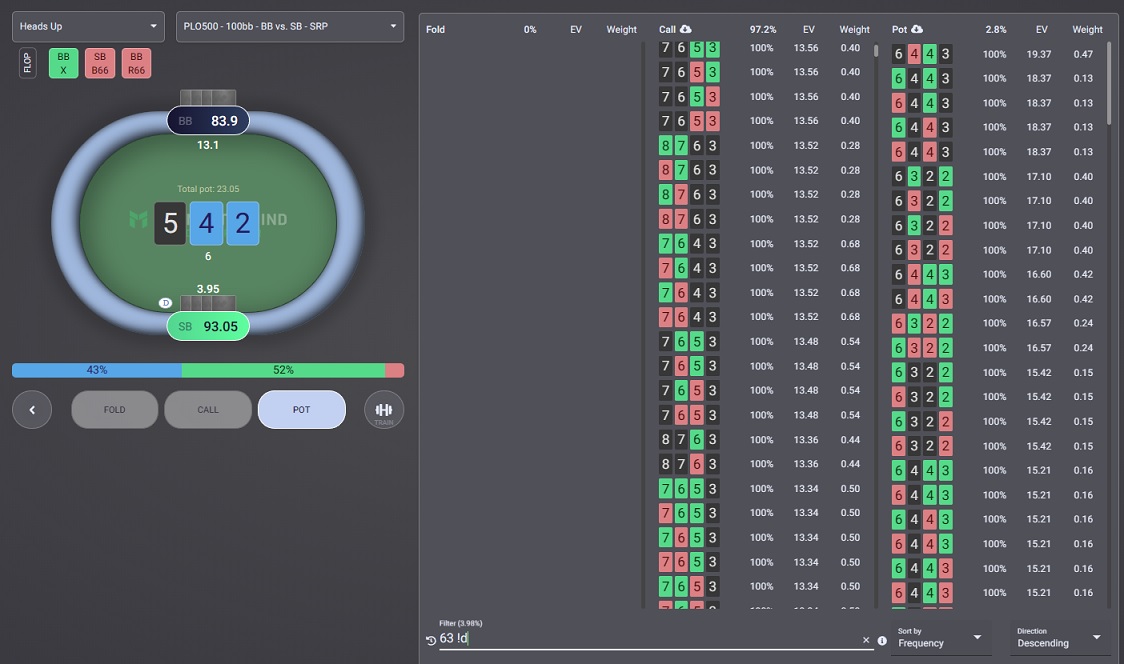
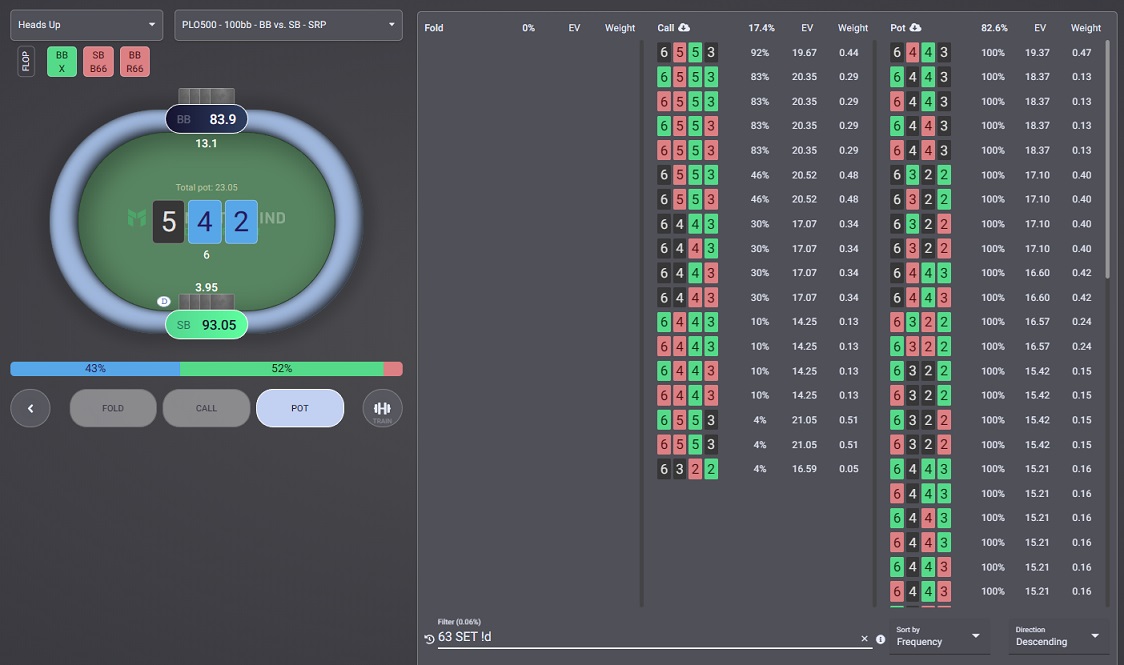
I would say it's not wrong to get it in necessarily as 63 is quite unlikely combo even for HU. But personally I would like to call flop to have call range less capped. We have one of weakest possible nut combos so it does play better overall as call.

Problem with flop 3bet is that we don't necessarily perform that well versus villain stack off range. Best case scenario is probably like weaker straight with nfd. But we will face lot of combo hands. Not necessarily just nuts with redraw but also set/2 pair+fd or wrap+fd type stuff. As we see here versus set+fd we are 40/60 underdog.

Another potential issue is if villain is capable of doing low equity semibluffs. So hand like A866 with nfd blocker could be good example. By calling we keep those in and potentially get big turn barrel. But if we 3bet those low equity hands very likely just snap fold.

Now sort of positive side of flop 3bet is to get folds as depending of runouts we could end up folding best hand versus further barrels. But overall we also save money on nut changing cards versus good chunk of villain value range. So all things accounted I think there is way more positive sides in calling than negative ones.


Reply
Quote
superkurac
Joined: 17.06.2020

Thanks for your input ghaleon and thanks for keeping the omaha hand discussion alive


Reply
Quote
Mascherano95
Joined: 09.10.2010

Well played. With those stats it´s fine to gii otherwise your default flop cbet-sizing would be too big. As an exploit it makes sense though to size it up to get more value.

Is it wrong (at 100 bbs) to want to get the money in on the flop, because villain could be freerolling with the same hand + redraw?

In almost all shorthanded situations: No. Because the nutstraight by itself is already pretty hard to hit and we need some top-range value hands to fill the required aggressive frequencies in order to have a solid strategy. Those occasions are so rare that they should be neglected in a 100bb dynamics (the likelyhood of villain with a vpip 88% top-range holding nutstraight+flushdraw is 1,635...%). Even if villain is a 12/7 nit we actually cannot fold it because they often do or maybe have to loose up their playing style postflop, for this deviation we´d need super-unique nut-peddling reads. It makes sense though to balance our calling range to put some of those into our slowplays against aggressive barreling opponents but we would prefer to hold good side-value like flushdraw or set when doing such slowplays since we won´t fold any turns.

Would it be better to just call the XR and get it in on a safe T?

In this specific situation: No. The obvious potential mistake by calling the check-raise is not a mistake by itself in terms of EV but it might lead to very costly mistakes later on since once you do it you do it in order to make fancy folds on flush or fullhouse completing turn cards at SPR 1 or dabbling around in gray area without awareness of your own defending frequencies. Why costly mistake? Because we usually find ourself in a turn spot with unknown tendencies and often unknown frequencies/ranges both on our and villains part which means we might be folding against sth villain turns into a bluff at an SPR we actually cannot afford to do so or villain decides to shove a loose consensed value range anyways, since this situation is quite specific, you also probably have no plan which hands categories to defend on those different outcomes. Villains check-raising frequency of 13% looks okayish and differs a lot from gaining further information optimizing our play against straightforward reg-tendencies of raising imba ranges like top-set only on Q♥:T♣:5♦: where we´d bet-call our A♠:K♠:J♥:4♣: to give up on pairing turn-cards and save some money. But this idea should not be confused into other places, it´d be usually at higher SPRs and against a different playing style.

But even more important we also would be missing out pushing an (slight to mediocre) equity edge against villains way too wide flop stack-off range beside missing potential Fold-equity. For example against a flushdraw+pair we are around 60% favourit, 15-20% equity edge is pretty significant, we´ll have that against all kind of flushdraw+nonsense stuff, we are decently ahead against naked sets and twopairs and finally we have totally crushed his second nutstraight with 95%, on the other hand we will quite often be just flipping against power-hands like flushdraw+set or combodraws but as explained above with nutstraight vs nutstraight+redraw being so rare we are basically never behind. The lower the SPR gets (usually below 1.5) , the often you see that solver has barely any call-vs-raise range at all since it is hard with equity-denial and instant equity-realization on your side to be outperformed by maneuvring different textures approach, because the amount of cards in the deck is limited (43 cards falling into a few turn-shifting possibilities) making it impossible to distinguish different lines for loose and merged flop/turn ranges battling for the dead money which in the end leads to reraise-or-fold strategies.


Reply
Quote
ghaleon
Joined: 17.10.2007

As this is only HU zoom(?) that vpip is definitely on high side but it's far from being comparable into 3-6 handed stats. If I remember right gto in HU is opening like 80% and defending 60%. Can be easily wrong memories :)

Point being I would not make assumption of villain being bad player from those stats alone. As all hands are versus hero any showdowns etc. are much more important. Of course if villain is stacking off like plain set etc. stack off gets lot better.

PS: I didn't notice cbet size used. I would personally use half pot size on straight flop. Up to 3/4 pot is fine as well but I don't recommend using bigger than that in high SPR spots in flop on any texture. Without good reason that is. Main issue in pot size is simply how expensive it is to use.

PPS: If we call turn SPR is around 2 still. If it was indeed only 1 then shoving flop would be clear with our hand.


Reply
Quote
BradNitt
Joined: 22.07.2011

yes for hu these stats are quite okish
and so its actually pretty likely villain is decent reg, like recs tend to be more gappy, etc., i would say our hand should actually just bet smaller and call vs xr without any diamond.


Reply
Quote
JoePlotter
Joined: 10.11.2012

Though I liked Mascherano gto perspective, I lean towards Ghaleons thinking myself. We can make opponent to make bigger mistakes by calling from position. Don't know the concept, I just think it as safe calling/drawing safecard card vs very likely bigger flop equity. Just take the wind out of their fancy draws and they drop like russian assault helicopters. It also protects your calling range as Ghal mentioned which is always nice. The rest of the hand decisions , you just have to rely ur feeling for it as it is very often in hu but I would say the best line for value here is through calling.

My perspective is ofc using exploitable strategy here.(edit: with balancing elements ofc because it's heads-up)


Reply
Quote
BradNitt
Joined: 22.07.2011

in gto we would just call here( without diamonds). and the small amount of shoves want have a set mainly or very little two pairs at least.

Spoiler

with set

Spoiler


Reply
Quote
Mascherano95
Joined: 09.10.2010

As this is only HU zoom(?) that vpip is definitely on high side but it's far from being comparable into 3-6 handed stats.

Don't know the concept, I just think it as safe calling/drawing safecard card vs very likely bigger flop equity.

in gto we would just call here( without diamonds). and the small amount of shoves want have a set mainly or very little two pairs at least.

I still would not copy GTO 100% without a thought. Probably nobody here is playing this spot GTO anyways. There is always someone that has a GTO-solution for every hand, easy, but nobody is taking thoughts into why to do so and how to play all the other hands in your range, I rarely hear a thought about how to exploit certain tendencies or what strategy makes sense in general. As usual, villain is likely to be far away from having a balanced check-raising range too so equity denial getting it in more often against a merged, value-heavy range here is much more important on boards that are not locked down. The 13% check-raise stat has to be taken with a grain of salt since villain is not check-raising 13% over all textures, we´d need to know how villain distinguishes frequencies altering them on different textures which is impossible to catch on without excessive reads and player analysis away from table.

Some observations what loose-bad opponents do repeatedly, which they really should not be doing, is starting a bluff with a medium-strength hand and stacking-off anyways because of pot-odds. That is a majority of his semi-bluffing flushdraw type of hands like nutflushdraw that´d have significant equity against us. He´d gain massively with a big portion of his draws check-raising for the freecard and he also might decide to back-down with weaker value-hands liek second nutstraight or set that´d stack-off otf. Many of them are devalued on a bricking turn which results in missing out max. value: the pot gets checked down (he starts realizing his non-nutted flushdraws or drawing to the full and we check too since we would not turn our straight into a bluff).

Due to the light texture of this flop you regularly see all sorts of crazy stuff from way lower Vpips. So despite GTO frequencies being so high heads-up, why am I still assuming he is a bad player? Because it is my experience at those stakes. At my place a vpip 80+ player usually sux. Most regulars on PLO50 still keep way lower RFI´s despite getting into HU, I barely see anyone with solid postflop play starting right away with the loose GTO-frequencies which would require him to defend his BB 50% and most people do not 3-bet 18% oop hu. And basically nobody has the right amount of bluff check-raises utilizing blockers and backdoors over various textures.

For the reason we are not facing a polarized check-raise when splitting our nutstraights into reraising/calling it makes sense to put those straights into our calling range that have at least a flush-blocker (or better a redraw as I have mentioned above) because of card-removal effect where we benefit from 1. villain feeling pot-committed with non-nutted made hands at a lower SPR turn, a leaky tendency that has human psychological reasons and a thing that solver is not prone off and 2. blocking the flushdraw where villain having it would getting him the freecard. Studying GTO does not mean we can just throw every theoretical concept over the board, the simple reason it is not optimum to play GTO here is because villain is not either.

- "Poker is not a game of cards played with people, it´s a game of people played with cards."


Reply
Quote
Coach
Kyyberi
Joined: 09.07.2010

We can shove and make our life easy.

Or we can call, and think what good/bad happens with it. To make our life once again easy, I throw gto out and think this in old school.

Opponent can have 3 types of hands:
- value (straight, set or 2pair + fd)
- bluff (33, 66)
- semibluff (fd+straight draw, Add+blocker etc)

If he is not a bad player (who calls pot raise with naked fd) he will fold all but value range. Versus his bluffs we might gain more value on blank turns. The only worrying part is his semibluffing range, which pretty much always has a flush draw. I would call here, but if a diamond comes I would shut down. Our hand looks so much like flush draw when we call a raise, that I don't think he is going to bluff big on diamonds often.


Reply
Quote
ghaleon
Joined: 17.10.2007

Any reads of villain overplaying stuff of course helps case of flop 3bet but we don't have such info. Again I assume stats given are purely from HU hands as this is HU zoom pool as I understood. Not sure if normal 6max zoom can ever even have HU situation (I don't play zoom)? If facing very high vpip player on normal 6max table 3bet could be clearly best.

Anyway this hand is not pushing much if any equity advantage versus reasonable stack off range. Single component hands really should not get crazy here (beside nut straight potentially) and versus combo hands (set/2-pair/straight+fd/sd or fd+sd) we are flipping or behind for most part.

Even if we call some of our weaker nut straights doesn't mean we won't have hands to 3bet. We also have those combo hands that actually push more equity advantage. Issue of using strong nut straight combos as call is that those can be in spot to crush opponent range in flop allin scenarios. Turn changing board can then kill action versus fair amount of those hands we would have loved to stack off on flop.

Also I wouldn't be that worried of getting bluffed out of the pot. As Kyyberi mentioned we will have fair amount of flushes on flushing turn or boats on pairing one. What we will lack by 3betting all nut straights is nuts on blank turn. We will have second nut straights sure but those are actually in tough spot facing turn pot on blank especially without any redraw. Often spot where you really want to continue more often with weaker hand (in absolute hand strength) that can still improve on river. E.g. set with blocker/redraw or fd+sd type combo.


Reply
Quote
Coach
Kyyberi
Joined: 09.07.2010

Stats are quite normal for HU.

HU hands are really hard to discuss, as HU is all about ( or should be) reads, info and constant adjustment.


Reply
Quote
BradNitt
Joined: 22.07.2011

It's also not about trying to apply GTO everywhere or assuming that villain is doing that, but more about having an orientation that could make sense from my point of view.

On Zoom, I would assume that in this case, for example, if we pot! C-bet and villain raises, at the latest when we go over the top again, we shrink down his range to the point where the equities are pretty close and we will only gain a small advantage by not playing the turn and river. We also don't need to insist on villain playing GTO in any spot. But for the most common scenarios, like stacking off on the flop heads-up single raise pot, I think it won't be a huge mistake to give them a bit credit, at least for having some SPR numbers and awareness of what they could roughly stack off with.

Here we are potting the flop, which anyone who has consumed a bit of content could recognize as unusual, and villain is reacting aggressively instead of being cautious. I also don't get the idea of check-raising kind of wide for a free card out of position. Especially as played, if we pot and he check-raises pot, it makes it even more expensive and opens the door for us to raise pot again.

So, we are at the point after the pot C-bet and getting a check-raise. What to do?
The solver basically wants to just call with our hand without any diamonds or possibilities to improve our actual made hand.
Why? It's not that unlikely because we don't block enough strong equity combos in the villain's range, and an equity shift on the turn would do us a big favor. And I think that's a quite solid and not overcomplicated point to go with.

Also, one observation is that the villains at those stakes are too sticky against big turn bets, for example, which could become beneficial for us being in position and with the pot already sized up.


Reply
Quote