MTT beginner course: The early stage
Following this, as well as the next two lessons, you will get a complete training that will enable you to beat your first tournaments.
Tournaments can be divided into three parts: early, mid and late stage. The stages are defined by the progression of the tournament. In this lesson you will learn more about the early stage.
In the early stage you are playing big stacks against weak opponents
The early stage includes all hands from the beginning of a tournament until the point when antes kick in. Antes are additional forced bets, which have to be paid by each player before the cards are dealt. That distinguishes them from the blinds, which are paid by different players in turn.
In tournaments you will generally start with 100 Big Blinds or more:
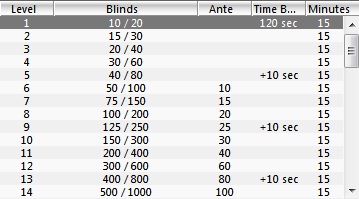
In this tournament you will get 3000 chips to start with, while the blinds start at 10/20. Therefore your starting stack is 150 Big Blinds deep. The early stage ends when level 6 is reached and the blinds hit 50/100. At this point the antes kick in. The average stack at that point is around 35 BB.
Only play selected strong hands before the flop
During the early stages there are a lot of weak players still left in the tournament. These players are usually very curious to have a look at the flop, even with their bad hands. If they hit anything it's rather difficult to get them to fold their hand. You can exploit that behaviour by waiting for strong hands and playing these hands very aggressively. Therefore you will get into a hand by raising it preflop. That way you will end up with the better hand on average in a bigger pot, postflop against a bad player.
The second strategic trick is the so called blind-steal. If you are able to attack the blinds directly, meaning that you are seated on the button or small blind and all other players fold to you, you can open raise very wide. Your goal is to get a hold of the blinds.
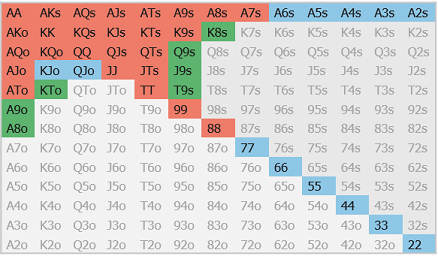
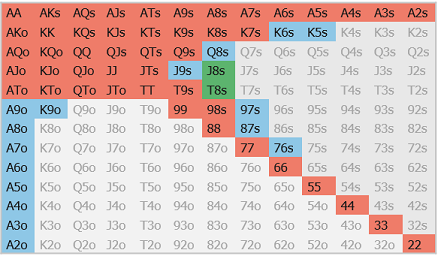
The following charts will show you which hands you can profitably play from which positions:
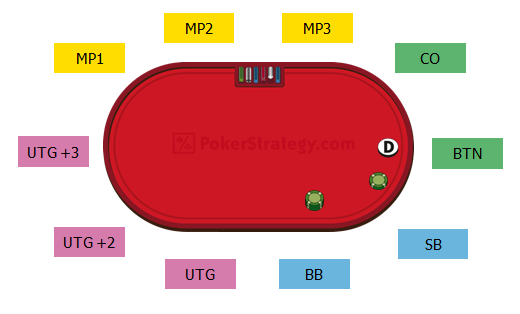
Positions at a poker table:
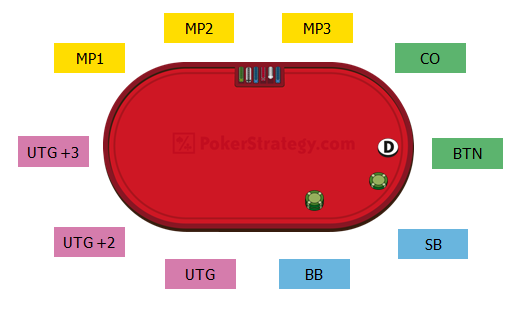
With these hands you can engage from early positions (UTG, UTG+2, UTG+3, MP1):

These hands can be profitably played from MP2, MP3 and CO:
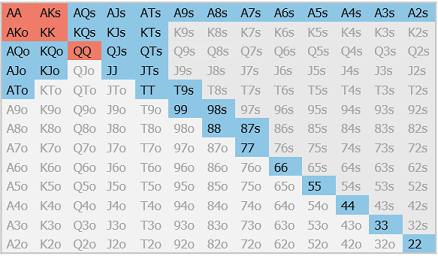
These hands are a good option for attacking the blinds from BU and SB:

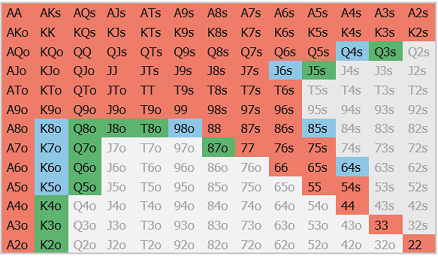
You can defend your big blind with the following hands:
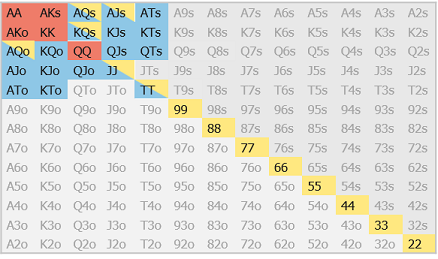
During the early stages of a tournament you will open raise for 3 Big Blinds.
If another player already limped (open call) into the hand you will raise to 3BB + 0.5BB for each player that limped.
Blue hands are already better then the hands that your opponents will call preflop on average. You play them,
... if no-one else already entered the hand
Exception: If another player entered the hand with a call, you will only raise hands that are marked for the position UTG (this does not apply for the big blind range).
Red hands are your strongest holdings and you play them,
... if no-one else already entered the hand.
... if other players already entered the hand with a call.
... if there was an open raise already or another player 3-bets against your own open raise. In these situations you re-raise to 2.5 times the amount of the last raise and you go all in to each further action.
Yellow hands are only available if you are the big blind. These hands are strong enough to call them against steal attempts. You play these hands if there was an open raise from BU or SB.
Postflop: Determine your hand strength
Made Hands: Top Pairs,
For example: You are holding A :heart:J  on J :diamond:9 :diamond:3
Monster: Overpairs and all stronger hands, i.e. two pair, three of a kind or a flush.
Example: You are holding A :heart:K  on 4 :heart:3 :heart:Q
Strong draws: Flush draws as well as open ended straight draws.
Example: You are holding J :club:9 on 4 :spade:8 :heart:T 
Worthless hands: All hands that do not fit into one of these categories are worthless for us.
Determine how to play your hand postflop
Case 1: You were the last person to raise preflop.
Made Hands: You are betting on Flop, Turn and River for 50% pot size. If your opponent raises, you fold.
Monster: You are betting on Flop, Turn and River for 50% pot-size. If your opponent raises, you re-raise to 2.5 times the amount he raised. Your goal is to get all in.
Strong draws: You are betting flop and turn as a bluff for 50% pot-size and fold if your opponent raises.
worthless hands: Against a maximum of one opponent you bluff for 50% pot-size. If your opponent does not fold, or you face more then one opponent, you give up on your hand.
Special rule:
Your opponent bets first (donk bet):
If your opponent bets ≤ 2BB you ignore the bet and pretend it didn't happen. If he bets >2BB you only continue playing the hand if you have a monster. If so raise for 2.5 times the size of his raise. If not simply fold.
Case 2: You only called preflop
Made Hands: You check/call the flop for a maximum of 2/3 pot-size. If your opponent checks, you bet the flop for 50% pot-size. The same applies for turn and river play.
Monster: You immediately bet yourself on all streets for 50% pot size. If there is another raise behind you, you re-raise to 2.5 times the amount. Go all in if there is another raise afterwards.
Strong draws: You check/call on flop and turn for a maximum of 50% pot size. If you haven't improved on the river you give up on your hand. Check/fold your hand in that case.
Worthless hands: You check on the flop if possible and fold against any bet.