Hey Asaban,
How are you?
Do you know when the 2nd video be available?

Nice Work !!! 
Hey Asaban,
How are you?
Do you know when the 2nd video be available?
Nice Work !!!
Originally posted by Kingsbull
Hey Asaban,How are you?
Do you know when the 2nd video be available?
Nice Work !!!I was hoping it would be available today. DThat didn't work unfortunately. Maybe we can get it up and running tomorrow. If not the release will most certainly be on monday. Sorry for the delay
Regards,
Asaban
I got some news regarding the video of our 2nd lesson. If nothing goes wrong it should be released during the weekend.
Regards,
Asaban
Hi and thanks for the coachings!
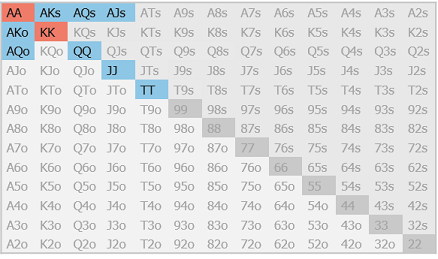
I wonder about some premium hands in UTG - MP1. Only AA and KK are marked red there and AKs, AKo and QQ are marked blue. As I understand it this suggests that we will only play hands marked red if someone already has raised before us. That would mean we should fold AKs and AKo in UTG - MP1, while we should use the call20 rule for QQ.
That seems too tight even from a beginner's point of view. If that's so, could you please expand the strategy for AKs, AKo, AQs and QQ from UTG - MP1?
On another topic, and at the risk of being a party pooper, I wouldn't cry if you didn't kept score on the answers to the questions.
The final quiz would have prices. I hope it's not depending on the fastest answer (wether or not the question had been asked ).
Cheers
"With these hands you can engage from early positions (UTG, UTG+2, UTG+3, MP1):
You can defend your big blind with the following hands:
During the early stages of a tournament you will open raise for 3 Big Blinds.
If another player already limped (open call) into the hand you will raise to 3BB + 0.5BB for each player that limped.
Blue hands are already better then the hands that your opponents will call preflop on average. You play them,
... if no-one else already entered the hand
Exception: If another player entered the hand with a call, you will only raise hands that are marked for the position UTG (this does not apply for the big blind range).Red hands are your strongest holdings and you play them,
... if no-one else already entered the hand.
... if other players already entered the hand with a call.
... if there was an open raise already or another player 3-bets against your own open raise. In these situations you re-raise to 2.5 times the amount of the last raise and you go all in to each further action.Yellow hands are only available if you are the big blind. These hands are strong enough to call them against steal attempts. You play these hands if there was an open raise from BU or SB."
What should we do with AT, KJ, KT, QJ, QT, JT in the big blind? If there are limpers we should only raise hands in the UTG - MP1 open raise chart and those aren't in that range?
Originally posted by ZeroDegrees
Hi and thanks for the coachings!
I wonder about some premium hands in UTG - MP1. Only AA and KK are marked red there and AKs, AKo and QQ are marked blue. As I understand it this suggests that we will only play hands marked red if someone already has raised before us. That would mean we should fold AKs and AKo in UTG - MP1, while we should use the call20 rule for QQ.That seems too tight even from a beginner's point of view. If that's so, could you please expand the strategy for AKs, AKo, AQs and QQ from UTG - MP1?
On another topic, and at the risk of being a party pooper, I wouldn't cry if you didn't kept score on the answers to the questions.
The final quiz would have prices. I hope it's not depending on the fastest answer (wether or not the question had been asked
Cheers
Thanks for your feedback!
There really is a small problem regarding the hands you described. Since our opponent raises from UTG, a 3bet with a hand like AQs wouldn't be the best idea.
AK, as well as QQ weren't coloured red, because I was trying to make it as simple as possible to make profit, while also avoiding difficult situations and postflop play whereever possible.
While folding these hands might not be the perfect solution, 3betting them leads into difficult spots preflop as well as postflop. So I basically made the decision to lose some equity in order to avoid problematic spots that might lead to a bust very easily.
For the hands you described, the best play for beginners might be the call. However, my editor suggested to keep it simple by not introducing another colour into the mix (that would be rarely needed and would only include a couple of hands). Therefore there is no "call-colour".
Improving the things that you learned from others by yourself is always a very important part in learning poker. Therefore feel free to adjust anything to your liking and post your results here in order to get feedback on your ideas. For future courses I might adjust the charts to reflect these problems. For now we will have to deal with what we have.
On a sidenote the quiz sessions at the end of each coaching are basically just some kind of gamification, in order to get all of you to participate and remain attentive at the same time. The final quiz will be done in a different fashion and won't reward the fastest answer, but ALL correct answers within a certain timeframe. I will announce the details when we get there 
Regards,
Asaban
Originally posted by ZeroDegrees
What should we do with AT, KJ, KT, QJ, QT, JT in the big blind? If there are limpers we should only raise hands in the UTG - MP1 open raise chart and those aren't in that range?
I edited your post in order to reflect the quote as such. Makes it a bit easier to find your question
The answer:
There is an exception from the exception
(this does not apply for the big blind range)
That means, that you basically ignore limpers from the BB and raise the complete BB Range against them.
Regards,
Asaban
In the very early phase my base play will be to cold call QQ, AKs and AKo. The pots will be small and my hand is well disguised. I don't wanna win 150 chips preflop with QQ when I can potentially win a stack postflop.
With 25 bb's I'm leaning towards shoving all-in preflop with these hands.
Originally posted by ZeroDegrees
In the very early phase my base play will be to cold call QQ, AKs and AKo. The pots will be small and my hand is well disguised. I don't wanna win 150 chips preflop with QQ when I can potentially win a stack postflop.With 25 bb's I'm leaning towards shoving all-in preflop with these hands.
Perfectly fine 
MTT beginner strategy: the mid phase
After you survived the early stages of a tournament, you will arrive at it's mid stage. In today's lesson you will learn how to successfully beat the mid phase of a tournament in order to make it into the money.
In the mid phase you are facing a lot of allins while your stack is getting smaller.
As soon as the antes kick in, you are in the mid phase of a tournament. The mid phase goes on until you reach the payouts. In most cases there will be 10 to 15% players left when that happens.
Gameplay in the mid phase is characterized by decreasing chip stacks as well as many allins. Meanwhile you should try to attack your opponents with steals and resteals as often as possible. If you are getting pressured yourself, a solid push or fold play will help you to get out of trouble. You will always orientate yourself after the size of your stack.
Your stack is bigger then 25BB
With more then 25BB you play the charts from the early stage. To make regular steals more profitable you will decrease your open raising size to 2 to 2.5BB.
With these hands you can engage from the early positions (UTG, UTG+2, UTG+3, MP1):

These hands are meant to be played from MP2, MP3 and CO:
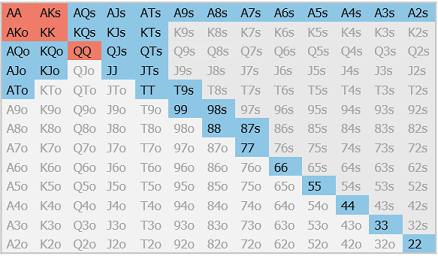
These hands can be open raised from BU and SB:

Defending your big blind is possible with these hands:
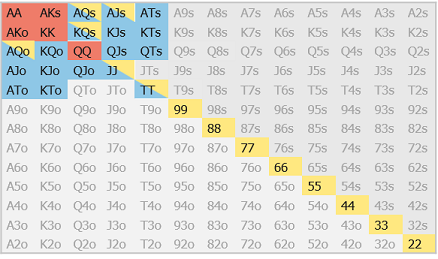
Further information: see lesson 2
Between 15 and 25BB:
With 15 to 25BB you will continue to follow the charts above. Due to your stacksize you will go allin immediately instead of 3betting with red hands. In addition you will always go allin, if you see the possibility for a resteal.
This is possible, if...
- our opponent has at least 20BB
- our opponent open raises from CO, BU or SB and we are sitting behind him
- there was no further raise after the initial open raise
If our opponent open raises from the Cutoff, we can resteal as follows:

Against an open raise from BU we push:

If the open raise is made by the Small Blind we resteal:
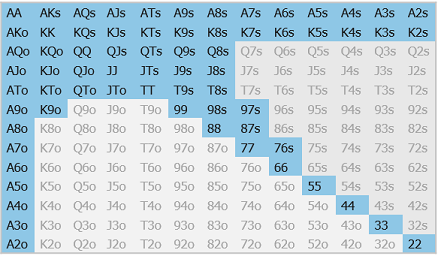
Your opponents will frequently try to resteal themselves of course. With the following ranges you can call their resteals.
This is possible, if...
- we open raised from CO, BU or SB
- our opponent has 15 to 25BB left and pushes allin
- there were no further calls of his allin
If our opponent resteals while sitting at the Button, we can call his allin with this range:
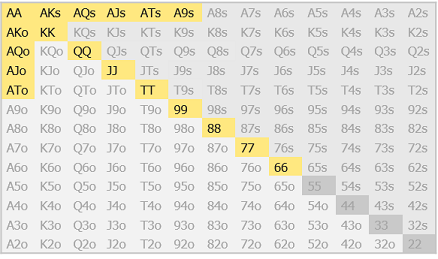
If our opponent pushes from the Small Blind we call as follows:
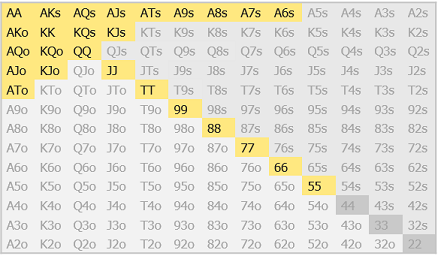
If there is a resteal from the big blind we call these hands:

Less then 15BB:
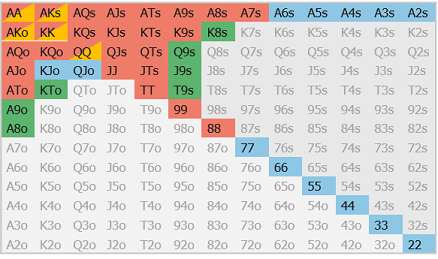
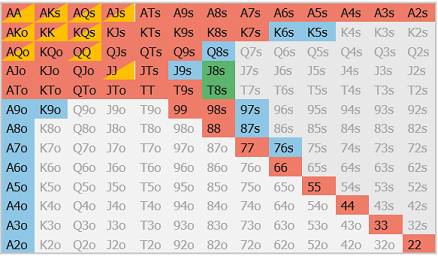
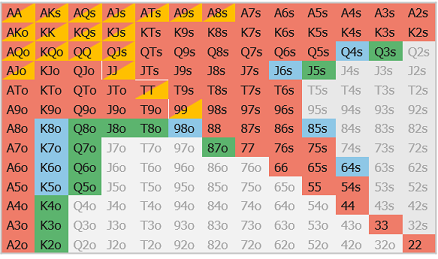
If your stack is smaller then 15BB you will only play push or fold. The concept, that you learned in our first lesson, is therefore enhanced:
UTG to MP1:
MP2 to CO:
BU and SB:
Colour coding:
red hands should be pushed as soon as our stack is at 15BB or less
blue hands should be pushed in addition if our stack is 5 to 10BB
green hands should be pushed when our stack is 5BB or smaller
red/orange hands can still be pushed even if there is an open raise and a maximum of one call. If there are more then two players involved in the hand, or if there was more then one raise we only push QQ+, AK.
Attention: Players that limped do not influence our decision in any shape or form.
Postflop: Concepts from the early stages still apply
There are no changes in comparison to the early stages here. You will soon discover, that the game is pretty much shifted to heavy preflop play, with less and less postflop play along the way.
Hello Asaban,
Thank you for the MTT coaching and strategy articles.
I got 2nd place in a $2.50 180man SnG on stars using the strategy outlined here.
The steals/re-steals strategy outlined here made a big difference to my game. Before, I was not aggressive enough when my stack went below 25bb
The charts show us what to push with stacks < 15bb, but what about calling <15bb open shoves?
Thank you!
We had a discussion about that in this weeks coaching. I guess it makes sense for you to watch the video as soon as it is released. If it is still unclear afterwards just post here again and I will answer it in length
Short version:
There are no calling charts, because the ranges are more dependent on our opponent and less on ourselves. Therefore you will need to work on that part yourself. How to do it is described in this weeks coaching.
Regards,
Asaban
MTT beginner strategy: the late phase
In this lesson you will learn how to play as you approach the money bubble, how to get to the final table and how to win a tournament in the end.
Getting in the money
To reach the payouts you will have to survive the bubble situation first. In this situation only a few players need to bust out of the tournament without receiving money. The left over 10 to 15% of the players reach the payouts and compete for the win.
Abusing the money bubble
In a bubble situation you will see changes in the way other players are behaving at the table. Especially the players with a small stack are playing way tighter and often use their complete timebank before folding anyways. Abuse your opponents' passive behavior in order to increase your stack.
As a bigstack you should always try to pressure smaller stacks. Open Raise additional hands against small stacks. Against stacks that are smaller than 10BB you can open push immediately from the late positions. Especially weaker players tend to fold nearly all of their hands in such situations in order to get into the money.
Being a shortstack puts you in the very same spot. You will have to play against big stacks that put pressure on you constantly. Avoid close situations and play slightly tighter than usual. Don't play the weakest part of your range in these situations.
The bubble phase ends as soon as the money bubble is reached. From this point on you resume your normal game. Use the charts from earlier lessons.
12 players left: Apply pressure while also avoiding confrontation
When only 12 players are left in a tournament the most important part of the tournament starts. The next minutes will decide who takes the most money. In order to make the most out of it, you should adjust your strategy to the payout structure.
The most important change occurs whenever there are several shortstacked players while you have a big stack. In these situations you should avoid to risk your stack against opponents with the same or even bigger stacks. At the same time you should try to keep up the pressure on smaller stacks. Your goal is to out-live the shorter stacks.
Attention: If the smaller stacks are still playing actively, you should only open raise with hands that you are willing to call against their allins.
That doesn't mean that you should start folding strong hands just because a big stack is already in the hand. If a bigger stack, or one similar to yours, is getting involved in a hand you should just be a bit more careful and avoid close situations. If a very active bigger stack is sitting behind you, you should open raise the slightly tighter chart from an earlier position (for MP use UTG).
This is possible, if...:
- you don't have the biggest stack and your stack is not similar to the chip leaders'
- a bigger stack was already involved in the hand or a very active bigger stack is sitting behind you
- you have at least 15BB and there are smaller stacks then yours
UTG to MP1:
MP2 to CO:
BU and SB:
BB:
If the requirements are not met, you play according to the charts from our earlier lessons.
The final table: less players, more action
If you reach the final table your game depends on two main factors.
How many players are left?
What's your position in the total ranking?
The fewer players there are, the more active you will need to play in order to not time out. Meanwhile it is still important to pressure smaller stacks and avoid confrontation with bigger ones. Your position in the total ranking decides who you can put pressure on. You orientate on our known ranges, but adjust them to the very situation one way or the other.
The heads up: time to reward yourself!
After reaching the heads up you are playing for the tournament win. Start with open raising a lot in order to identify weaknesses in your opponents' game. Adjust your game to suit the play style of your opponent and try to abuse his mistakes.
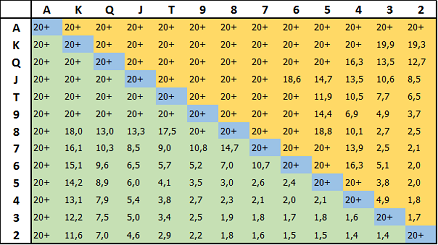
If one of the two players has less then 20BB left you can use the following chart:
Push
Call
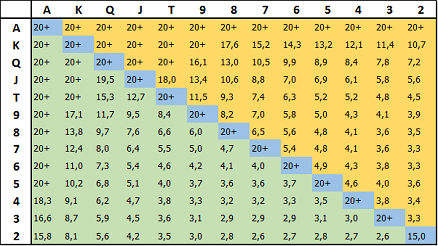
Green: offsuited hands
Orange: suited hands
Blue: pocket pairs
The numbers in the first chart always shows the amount of big blinds, that you can still go allin with with a given hand, as a maximum, first in from the small blinds. The second chart shows the amount of BB you can call an allin for at maximum.
Attention: Just because it is profitable to open push with AA for more then 20BB, it is most certainly not the best play in any given situation.
Deals help to lower the variance
Reaching the final table, you will often be asked for a deal by other players. Whether a deal makes sense or not depends on particular situation.
The weaker the other players are, the lower your interest in a deal should be.
If you decide to take a deal there are several different methods:
- chip count deals
- ICM deals
- custom deals
The chip count deal is the standard method to distribute payouts. It is especially profitable if you are the chip leader. The calculation is made depending on the current stack sizes. The money that is still left to be played for is divided according to the current chip stacks.
The ICM method uses the ICM concept in order to calculate the payouts. This is especially profitable for short stacked players, who get way more then they would using the chip count method. To make the calculations an ICM calculator is required.
If you would like to learn more about making deals, I recommend our existing strategy article, which covers all of it in detail: http://www.pokerstrategy.com/strategy/mtt/1556/1/
Someone asked me to post my thoughts on rebuy tournaments that I wrote down during our recent coaching:
Why should I always take the addon?
Example:
Buyin 11$ 2000 chips
Rebuy 10$ 2000 chips
Addon 10$ 3000 chips
As you can see you are getting more chips for the same price if you take the addon. That's why it's always +EV to take it. Same goes for rebuys where you don't have to pay the rake on most sites.
Since taking rebuys and addons is +EV you should do so. That means that you will have to fit these extra expenses into your bankroll management.
For the example above you should take between 51$ (Buyin, initial rebuy, one double rebuy, addon) and 71$ into account, depending on your play-style and the tournament structure (a triple turbo rebuy will most likely need even more buyins on average).
If we try to fit above tournament into our bankroll management we would therefore need 150*51$=7650$ as a bankroll.
Regards,
Asaban
The video from our third lesson was finally released. I linked to it in the first post
Regards,
Asaban
The recording from this weeks coaching (4th lesson) is already available. You can find the direct link in the first post.
Regards,
Asaban
Originally posted by Asaban
Short version:
There are no calling charts, because the ranges are more dependent on our opponent and less on ourselves. Therefore you will need to work on that part yourself. How to do it is described in this weeks coaching.Regards,
Asaban
In theory this isn't much harder, to create calling charts by stack sizes, you will just need to assume that other guys are shoving nash ranges and build your charts from there, you wont be able to use those charts always but if you play turbo games regularly, it could be useful as you will find most of the regs in those games quite fast and if you do some research reviewing your hh and taking note you will now how to play against them quite fast.
That's true for mid- or highstakes tournaments. However, in micro and low stakes tournaments you won't find many players that are pushing nash ranges or even close to them. Therefore the calling ranges wouldn't make a lot of sense in most situations.
In addition I wouldn't recommend turbo's for beginners.
Regards,
Asaban