Lesson 1: Getting started with the [SH] Big Stack Strategy Part 1 - Pre-flop
You already know:
• The rules of Texas Hold'em
You will learn ...
• ... why position at the table is important.
• ... which hands to play pre-flop.
• ... how to utilise our starting hands charts.
• ... which variant to play depending on your free poker money.
Which hands should you play before the flop?
A good poker player always answers the question "Why?" first. The answer is simple: in order to win money. But how exactly can you do that? You have to differentiate between two cases: are you in a blind steal situation or do you want to fight for the pot with the best hand?
At a short-handed poker table 3 to 6 players take part in a game.
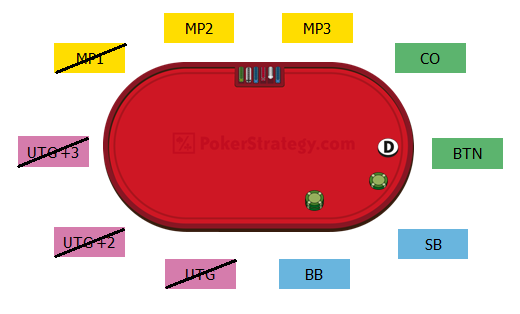
If less than 6 players take part, the early positions are discounted first. Hence at a table with 4 players the positions only range from CO to BB.
The blinds are of particular importance in poker. If they weren't part of the game, you could simply wait until you are dealt aces in order to move all-in with them right away. Nobody could beat your strategy. However, poker is a game for the blinds. You shouldn't attack them directly from the positions MP2 and MP3. Instead, you should play decisively less hands in these positions and focus on stronger hands compared to later positions. However, in the cut-off, button and small blind you can and should attack the blinds directly!
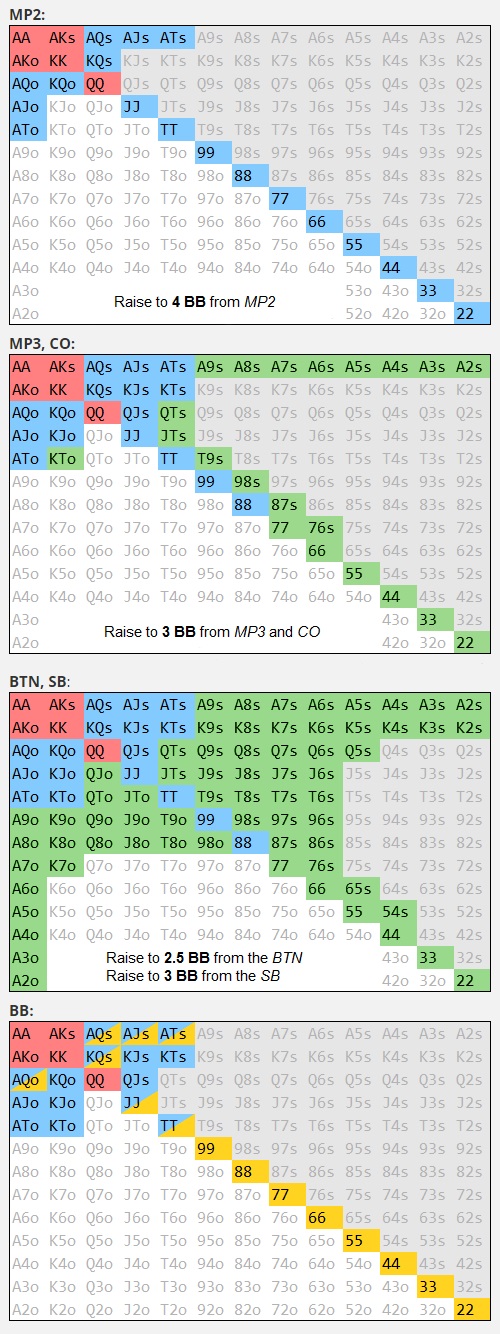
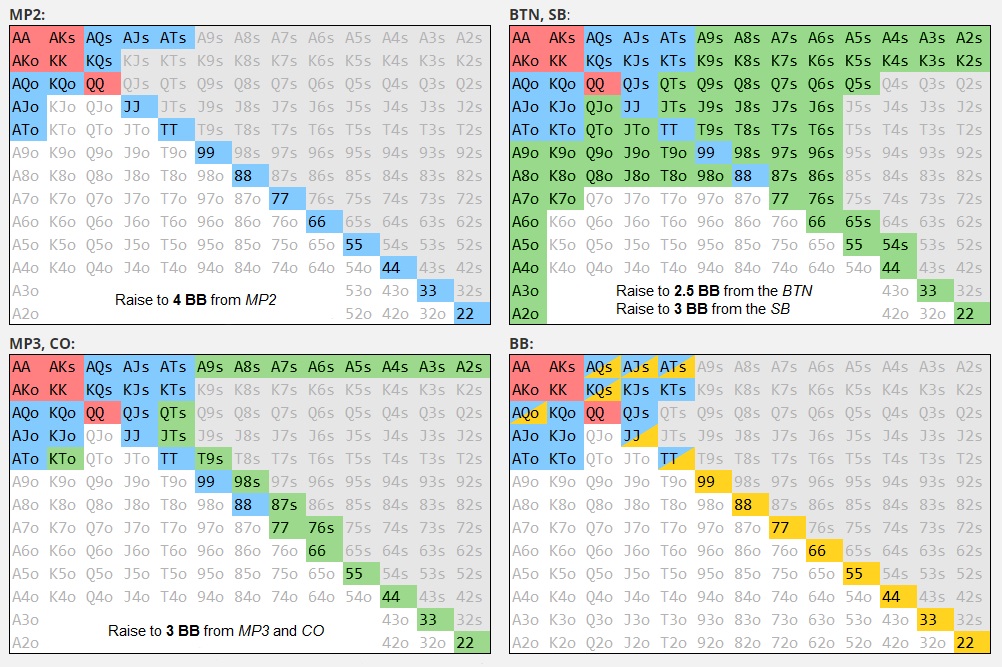
The following tables show you which hands to play in any given position.
A No-Limit Hold'em hand consists of two different cards. The following abbreviations apply:
A = Ace, K = King, Q = Queen, J = Jack, T = Ten (10)
"s" stands for "suited" and means that both cards have the same suit
"o" stands for "off-suited" and means that both cards have different suits
For example, ATs stands for:
A :heart:T :heart:, A :club:T :club:, A :spade:T :spade:, A :diamond:T 
While KJo stands for:
K  J :heart:, K J :diamond:, K J :club:, K
  J :diamond:,
K J :club:, K J :spade:, K J :spade:, K J :heart:,
K J :club:, K  J :spade:, K J :heart:, K J
MP2:
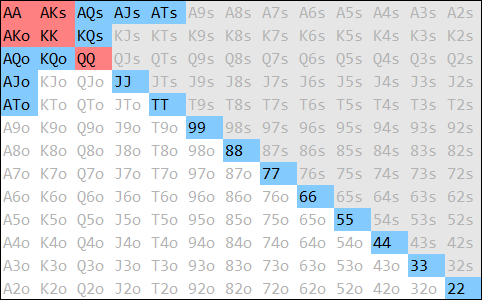
In MP2 you should raise any coloured card to 4 BB if all players in front of you folded their hands.
MP3, CO:
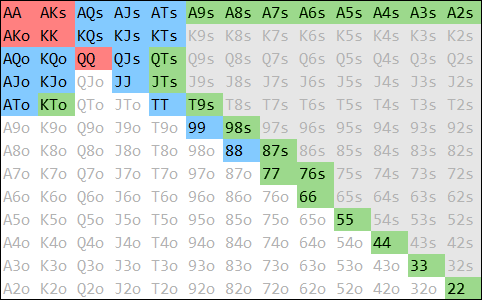
In MP3 and the CO you should raise any coloured card to 3 BB if all players in front of you folded their hands.
BTN, SB:
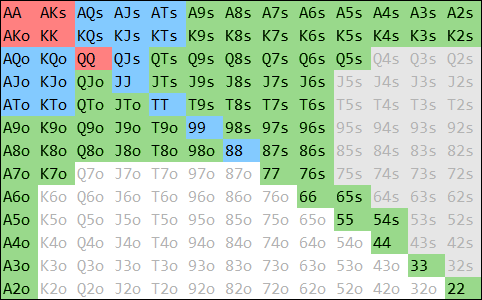
On the BTN you should raise any coloured card to 2.5 BB if all players in front of you folded their hands.
In the SB you should raise any coloured card to 3 BB if all players in front of you folded their hands.
BB:
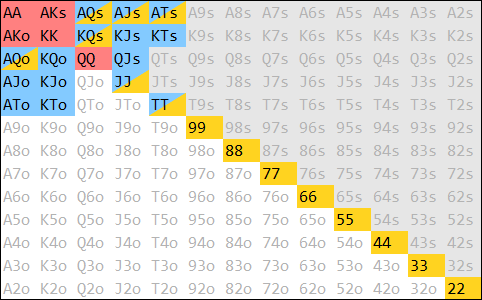
All ranges in one file to save and view whenever needed:
Spoiler
1. Vertical format:
2. Tiled format:
What do the different colours mean?
Note regarding limpers: If you're holding a hand that you should still raise even when players limped before it was your turn, you should raise to 4 BB + 1 BB for each limper, no matter what position you're in.
Green hands are the weakest hands you should play. You should play them mostly in order to simply steal the blinds. Furthermore, you should only play them when no one has joined the hand before it was your turn.
You don't play these hands anymore when ...
... there has been a raise before it was your turn.
... a player has joined the hand with a limp before it was your turn.
... there has been a raise after it was your turn.
On average, Blue hands are usually better than the hands with which your opponents call pre-flop. Therefore, you should play them when ...
... nobody has joined the hand before it was your turn.
... a player has joined the hand with a limp before it was your turn.
You don't play these hands anymore when ...
... there has been a raise before it was your turn. EXCEPTION: You are in the BB. In this case, you should continue to play yellow/blue marked hands and yellow hands.
... there has been a raise after it was your turn.
Red hands are your strongest hands. You play these hands when ...
... nobody has joined the hand before it was your turn.
... a player has joined the hand with a limp before it was your turn.
... there has been a raise before it was your turn. In this case, you should re-raise to 3.5 times the initial raise.
... there has been a raise after it was your turn. In this case, you should re-re-raise to 3 times your opponent's raise. If there are several raises after it was your turn, you should simply move all-in right away!
Yellow hands are only relevant when you are in the Big Blind. These hands are strong enough to call with against steals from players with at least 50 BB. You play these hands when ...
... there has been a raise before it was your turn from the CO, BU or SB to 4 BB at most.
You don't play these hands anymore when ...
... there has been more than one raise before it was your turn or when there has been a raise from MP2 or MP3.
Call 20 rule: Pairs have a very special characteristic. It's possible to hit a set with them on the flop without people actually realising. Therefore, you can and should limp with pairs when at least one player also limped before it was your turn. If there has been a raise before it was your turn, you should only call with a pair when your own stack and your opponent's both equal at least 20 times the amount required to call the raise.
This rule only applies to pairs that we shouldn't continue to play according to the colours in the tables. If that's not the case, we simply continue to play our hand as described in the chart!
Min-raise rule: If you are min-raised pre-flop, you can basically continue to play any hand that you've raised as long as your opponent's stack is at least 50 BB. In these cases, your opponent is giving you a good price to see the flop and you don't have to win the particular hand too often in order to make this move profitable in the long run.
If there has been a min-raise to 2 BB before it was your turn that doesn't constitute a steal, you should simply regard it as a limp!
If you re-raise against a min-raise you have to raise to 4 times the amount of the min-raise + 2 BB for each caller of the min-raise
Blind posting rule:
If a new player joins the table and is not willing to wait for the BB to join the game, he has the option to post the big blind right away to be able to join the game. This is called "blind posting".
How do we treat such a player?
When it comes to hand strength selection, we simply ignore this player and act as if he had folded. However, if we decide to raise a hand, we have to consider the additional chips in the pot and therefore raise to 4 BB + 1BB per limper.
What is bankroll management?
You should always regard the money that you're bringing to a table as an investment, similar to buying stocks. You would only buy those if they promise a profit and a reasonable risk of loss.
You can achieve the same in poker by using a bankroll management.
It will tell you in which limits to invest (meaning which limits to play) in order to find a balance between your wish to ...
• ... make progress and as much profit as possible when winning and ....
• ... not fall back too far and lose too much of your poker money when you're on a losing streak.
You want to win as much as possible when having a good run, without being hit too hard when losing. This can only be accomplished when sticking to our 25 buy-in bankroll management. It tells you excatly when to move up in limits once your bankroll is big enough, and when to move down in limits when you've lost too much on your current limit.
The bankroll management for the BSS beginners' strategy looks as follows:
• You always buy-in with a full stack (100 big blinds) at a table. 100 big blinds are one "buy-in".
• You always recharge your stack to 100 big blinds as soon as you've lost chips at the table and fallen below 100 big blinds.
• If you have 25 buy-ins for the next higher limit, you can move up to that limit.
For example, you can play NL5 with $125 (NL5 blinds: 2c/5c)
• If you only have 25 buy-ins left for the next lower limit, you have to move down to that limit.
For example, you have to move down to NL2 if your bankroll is only $50 again (NL2 blinds: 1c/2c)







 Hopefully the recap video will be up soon and I can catch up before next week