New Update for my 2 latest logs at the Bankroll Challenge.
Week 38-53 (11.03.-22.06.)


I left out the Hands played at GG (lots of Rush tables) in the screenshot filters as I do not play there anymore and not planning to do so. I mean I always thought I could beat at least the regular tables, but in fact together with the Rush tables it was just break-even over such a big sample. The skill difference is significant so I considered it is just not worth it. If you compare it with my Bankroll-Challenge Login from 23. June 2023 I played like 30k hands for less than 100$. My winrate of 22,83 bb/100 is surely not sustainable but having that over 30k hands is not bad either. I mean on lower stakes a bigger part of winnings is made by bringing good value-bets that do not show up in the Allin-adj. bb/100.
Week 53-64 (23.06.-09.09.)


Low C-bet otf again, but I managed to correct my River frequencies. This was quite laborius since I have to import those complex situations into Monker every time, and GTO at the river is already deviating a lot from what we have and what we should be doing exploitatively once we get there. But it helps to have a rough picture of what solver does on different turn-river runouts. I am not sure how bad the low Cbet is, since often I am up against people that just call too much oop. But since they do not check-raise I guess I am still not aggressive enough ip. My RFI´s from EP and MP in both scenarios are a little high, but it is not getting exploited in any sense (3bets, coldcall+solid postflop play) so I am getting away with it decently. The rake (2.547$ over 60k hands!) is pretty high but my solid winrates (7,49 bb/100 with 14,41 Allin-Adj. this time) make up for that. I am running quite below EV but that is fine as long as I am still winning. ♠_biggrin:
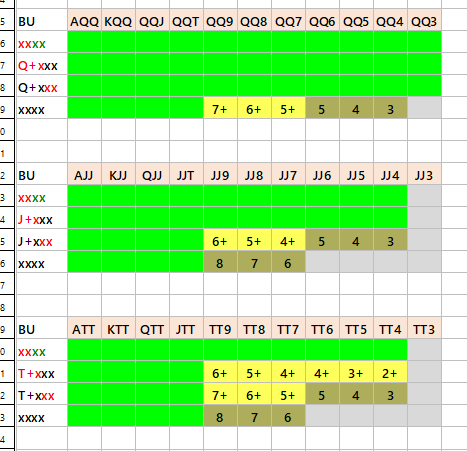
I nearly finished my RFI´s at my gameplan. Ofc I also traing with PLO-Vision in postflop spots, but the range construction process is still dabbling with preflop hands. I once more adapted the GTO ranges which I´ve already written into my excel sheets and modified them in a way, the frequencies remain roughly the same but the sidecards, structures, ranks etc. become easier to memorize. For example on the Button, where range gets bigger, I need a more rough orientation. So I do not care if too much if we raise T♥:T♣:7♣:4♦: but fold T♣:T♥:7♦:4♦: cause studying those nuances in detail would take too much time. So a table for high pairs stealing from the Button would look like this:
Furthermore it looks like I am succesfully implementing my routine to follow the daily plan and I recently improved small aspects of my life using artificial intelligence (namely Google Bard) who tells me stuff like "add oatmeal to your wholegrain muesli so the complex carbonhydrate delivers an energy surplus of up to 1 hour. This way you can work on your gameplan longer after the 30 minutes cardio session." or "when you have x $ amount of cash reserve and monthly cashouts of y $ with a standard deviation of 140 and a winrate of 10bb/100 etc.. you might put x% of your bankroll into the stock portfolio and y% on the pokerroom to reduce the risk of a total loss below 5%." You have to be a little tricky with your questions though about your finances cause "Google Bard is not an financial advisor and be aware with stocks your capital is at risk".  Or when I was looking for stuff that could in general help me in life beside the known to me "approximation process" and "exclusion process" which I use more often after I brought them more into awareness several years ago, he told me "further concepts for daily life including the following scientific/mathematical procedures are:
Trial and Error: This is a simple process where you try different options until you find the right one. This can be helpful, for example, when you need to try a new recipe or solve a problem.
Logical Reasoning: This is a process in which you draw conclusions from information you have. This can be helpful, for example, when you need to solve a puzzle or make a decision.
Intuition: This is a process based on your gut feeling. This can be helpful when you need to make a decision for which there is no clear information.
Inspiration: This is a process based on your creativity. This can be helpful when you need to find new ideas for a project or problem.
Then poiting out application examples. I even invented a new German word which was approved by Google Bard. The technical method of using Inspiration would be "Schöpfungskraftverfahren" which would be translated into sth. like "Creative Power Process". Crazy and funny af. Helps a lot in many aspects.
So. The rough fundamental structure of my day now recommended by Bard is basically repeating this following structure:
1. consume food to produce energy
2. convert energy into relaxation through physical activity
3. use a relaxed state of mind to do concentrated mental work
I use this sheme multiple times a day to have a optimum input-output relationship that might look like this:
1. have breakfast
2. go jogging 30 min or go for a walk 1h
3. finish 1 table of my SB RFI range
then repeat but slightly varied
1. buy groceries, roast and eat a burger, put in the dishwasher, digest on the couch watch some news on TV
2. do a 15 min workout with your fitness app, warm-down with some stretching and a cold shower
3. grind 2 poker sessions each 45 min with a 10 minute break inbetween
My whole day is structured like that, the trick is, I dont need tons of willpower and discipline, activities just flow into each other as they should.
AI improved my life! 








 hands beside to obvious made hands and draws, weak-pair+gs too.
 Avoid becoming mentally exhausted is critical too. That usually always came from having barely any physical activities or playing videogames before the poker sessions, I needed some time to even recognize that. So those household activities actually fit the gap perfectly for the purpose of step "2. convert energy into relaxation through physical activity" and in the end even help to play higher quality sessions.
 ) over the
  and
and  (:9x: ). Villain is more likely to have a missed straightdraw when we unblock a
