I hope for you, that our hard work will payed of for the future, and normaly this will be for sure.
Only problem by poker is, that the frame-conditions sometimes change so fast - that the future has no time to pay us for hard work.
Hupefully the Poker-ban for players from Austria become never reality.
Notifications
Clear all

Rare to find a good PLO blog within these stakes (20-100) . I'm in a kinda similar situation - at the moment I'm struggling with money a bit you could say: bad variance this year I am pretty sure - and some other things that messed up my playing routine pretty hard (on top of that, I have never managed to have ANY playing routine - which usually leads to me taking to many days of --> not getting in the volume needed to overcome the crazy PLO variance on a monthly basis. I have never really studied the game at all (solvers/ranges) and my preflop game is just FISHY (too loose), but post flop there is not the same kind of discipline required, so I've managed to win pretty good in pl50 especially for the last 4 years -
Yeah but actually the thing I wanted to ASK YOU: I'm interested to know what kind of Standard deviation values you have had in your PLO ring games (in your poker tracker, assuming you use one) , for stakes like 20 , 50 , 100 - and let's say 5 player or more dealt into the hands - I'm asking this because my values are EXTREMELY high around 300 for large samples - and I think this must be crazy - also leading to huge variance (assuming this is mostly due to my playing style and not the variance in it self causing it) - but yeah - would be nice to know what a solid GTO type of player's standard deviation has been ?
And also: how many hands per month do you usually put in ?

Originally posted by PokerSpass
I hope for you, that our hard work will payed of for the future, and normaly this will be for sure.
Only problem by poker is, that the frame-conditions sometimes change so fast - that the future has no time to pay us for hard work.
Hupefully the Poker-ban for players from Austria become never reality.
Yea. I mean, you just have to get to PLO100 which is enough income to live almost everywhere on this planet as long as you have internet. So the goal is basically to get independent from job-income and to get mobile.
Originally posted by skeida
Rare to find a good PLO blog within these stakes (20-100) . I'm in a kinda similar situation - at the moment I'm struggling with money a bit you could say: bad variance this year I am pretty sure - and some other things that messed up my playing routine pretty hard (on top of that, I have never managed to have ANY playing routine - which usually leads to me taking to many days of --> not getting in the volume needed to overcome the crazy PLO variance on a monthly basis. I have never really studied the game at all (solvers/ranges) and my preflop game is just FISHY (too loose), but post flop there is not the same kind of discipline required, so I've managed to win pretty good in pl50 especially for the last 4 years -
Yeah but actually the thing I wanted to ASK YOU: I'm interested to know what kind of Standard deviation values you have had in your PLO ring games (in your poker tracker, assuming you use one) , for stakes like 20 , 50 , 100 - and let's say 5 player or more dealt into the hands - I'm asking this because my values are EXTREMELY high around 300 for large samples - and I think this must be crazy - also leading to huge variance (assuming this is mostly due to my playing style and not the variance in it self causing it) - but yeah - would be nice to know what a solid GTO type of player's standard deviation has been ?And also: how many hands per month do you usually put in ?
Talking about bad variance: I had a 70 buyin downswing in August which was insane, but even more insane is, I did not go broke. I managed to move down and to not fall into a deadly spiral of tilt but keep grinding, I am already back on the lane having an insane upswing this week (90bb/100 >10k hands so far). Lost surplusses of months of grind but I still feel so confident cause I survived this shit comparatively stress-free. 3 years ago I would have had to head back to register at the AMS (labour market service for unemployed) for sure.
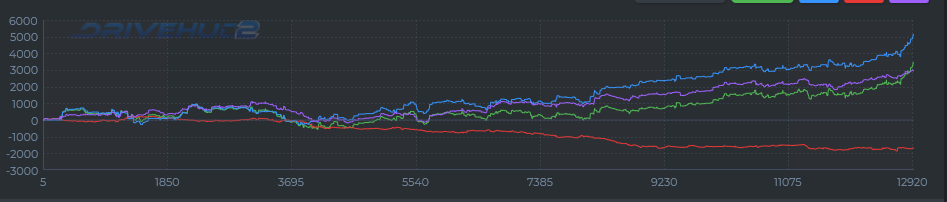
after getting my new HUD:
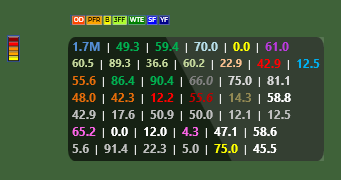
Hands / VPIP (pos. coldcall)/PFR fold-3bet ip&oop) / 3BET (pos. sqzs' & 4bet-ranges IP&OOP) / AF (AggFq's) / WTSD (W$SD)
Pos. RFI's (positional fold to 3bet)/Fold to Steal (BB&SB)/ Fold to steal from BU vs CO (resteal bu vs co)
cbet flop-river ip / bet-fold (srp&3bp ip & oop) / fold to probe ott (srp&3bp ip) / fold to probe otr ((srp&3bp ip)
cbet flop-river oop / check-raise (srp&3bp) / probe bet ott (srp&3bp) / probe bet otr (srp&3bp)
fold to cbet's in srp ip&oop
cbet flop-river in 3bp ip&oop
fold-cbet flop-river in 3bp ip&oop / check-fold flop as pfr in 3bp (turn&river) / bet-vs-missed flop cbet in 3bp ip (turn&river)
That was quite some work, im pretty proud of it. had to create many custom stats on my own (you can create custom stats at drivehud!!!). the template was from the jnandez 10-week transformation week6 advanced hud. i modified it in a way, that most significant lines deviating from cbetting are shown. so i have bets oop srp 4th row left for example. any skipped cbet would results in a check (otf) for this the first non-cbet stats would be 1. how often villain is check-raising (defending actively against a stab), 2. if hero decides to check-back we'd knowing villains probe 3. if we have a BX-line we'd knowing what how often villain bets otr (after X-X ott). Not losing too many small and medium sized pots in the probe/BXB lines and stealing more in suitable spots helped me a lot to stabilize my redline. 3 days of work and my NSD-winnings improved about 50% (so far)!!
I usually pendle around 30k hands per month, if I am running bad I usually add volume up to 40k hands. I'll upload some graphs later, but I made a backup recently due to my transition to DriveHud2. For this reason Idk my Standard deviation yet, but it is not too high, I usually calculate with a SD of 140-160. 300 is definitely too high imo.
Massing volume usually is not that helpful I think as I thought of it. I calculated my winrated and it looks sth. like this.:
>7 tables my winrate is barely positive anymore
5-6 tables it could be somewhere around 5-6 bb/100 and playin
2 tables it's actually really high like 14-16 bb/100.
I'd say it makes no difference if I play 3 or 4 tables.
3 tables x 12bb/100 = 12bb/100
4 tables x 9bb/100 = 12bb/100
So I'd rather play 3 than 4 tables cause it makes no difference and you rather want to keep it relaxed and make some notes despite I could still make profits with more tables. Quality of your hands played is still important, you should have some feeling for what kind of dynamics on the table is going on right now. Start with 2 tables if you have decent cognitive capabilities (like if you already were playing video games or play music intrument etc.) otherwise 1 table and add them slowly one by one if you feel bored out consistently despite observing villains. Quality matters but it is blurred since someone is tempted to make a rough assessment after some 10-50k hands about his WR. This does not make sense in PLO. I never have a month with exactly 12bb/100 over 35k hands. Usually it's either 0bb/100 (bad month) or 30bb/100 (good month). So I had to learn the hard way to save cash bolsters for bad times and not spend it all after a good month. In the beginning if you are fresh from work to grind and you are not entering mid-stakes already you do have to tighten up your private finances, save as much as possible and count your pennies.
Playing routine is crucial. Don't stay longer for fish, don't quit after a lucky streak. It's so much of a long run that having session routines makes the difference. What helped me lot is to time limit your sessions. I got Tiltbreaker in 2017, now I don't need it anymore but the most important thing I kept was just closing tables at certain parameters. I have a session timer of 45 minutes and start sitting out next big-blind right after the ringtone. You also avoid playing in a tired mood you might not be aware of. Concentration usually is dropping really hard after 1 hour for most people and after 90minutes 99% of people can barely focus actively (but you are not aware of it cause you still make your decisions but the quality of your thought process usually dropps hard). Negreanue for example used to play around 30min sessions online.
You probably want to play longer than 20 minutes and you can extend the focus within the 40-60 minute zone with training but after 90 minutes you are usually crawling on your limits. So having those 3-hour sessions with multiple tables opened is killing your profits actually, most people cannot adapt to such thing and if they try to they will usually burn out after one month or another. Recovery also plays a role, I need a minimum of 15-20 minutes whereas more than 1 hours seems to not make a lot of sense either (you also gotta avoid depleting your concentration power by passively consuming media like TV, Smartphone or internet - playing video games is the hardest sucker among those distractions, so if you do this in your break it leads the purpose of a break to absurdity).
My graph flattened out since shotting at PLO100, pressing my Winrate down to 25bb/100. The sideways movement is kinda discouraging. There seems to be another level increase to PLO50, without overvaluing a sample below 100k hands. I feel like Fishes are more cautious and regs are more adaptive, I will try to find ways to beat the stakes though.
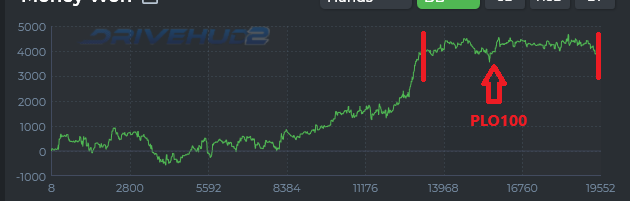
Villain is the most competent opponent I have met in my whole PLO career so far, all stats are solid even stuff like "Fold-vs-Probe in 3BP".
How do you defend on static textures at low SPRs?
Hand History driven straight to this forum with DriveHUD 2 Poker Tracking Software
PL Omaha 0.20(BB)
UTG ($20) [VPIP: 30.8% | PFR: 21.5% | AGG: 35.3% | Hands: 175]
HJ ($20.86) [VPIP: 51.7% | PFR: 28% | AGG: 26.2% | Flop Agg: 23.3% | Turn Agg: 32.1% | 3Bet: 5.8% | 4Bet: 8.6% | Hands: 3073]
CO ($13.24) [VPIP: 34.6% | PFR: 13.5% | AGG: 50% | Hands: 52]
BTN ($14.60) [VPIP: 71.6% | PFR: 23.4% | AGG: 29% | Hands: 143]
SB ($66.79) [VPIP: 22.3% | PFR: 13% | AGG: 32.5% | Hands: 299]
HERO ($20) [VPIP: 27.5% | PFR: 20.8% | AGG: 28.6% | Flop Agg: 30% | Turn Agg: 32.2% | 3Bet: 9.8% | Fold to 3Bet: 23.6% | 4Bet: 8.4% | Hands: 21760]
Dealt to Hero: 8♥ T♥ Q♣ A♣
UTG Folds, HJ Raises To $0.70, CO Folds, BTN Folds, SB Folds, HERO Raises To $2.20, HJ Calls $1.50
Hero SPR on Flop: [3.96 effective]
Flop ($4.50): 9♣ 5♠ 9♥
HERO Bets $1.53 (Rem. Stack: $16.27), HJ Raises To $4.54 (Rem. Stack: $14.12), HERO ? ...
(Rem. Stack: $13.26)
Spoiler
...HERO Calls $3.01
Turn ($13.58): 9♣ 5♠ 9♥ 3♥
HERO Bets $13.26 (allin), HJ Folds
HERO wins: $13.17


Most competent, VPIP 52, PFR 28? Flop agg 28, 4bet almost 9?
Those boards create interesting dynamics when opponent starts to fight for them. First thing is to figure out how often opponent raises them and how often he just folds. If he is over-raising them, the first adjustment is not to bet-fold too much.
Once hero starts to fight back at him, like here, keep an eye how he reacts. After couple fight backs (in SRP or 3BP) he might switch to valuemode.
Originally posted by Kyyberi
Most competent, VPIP 52, PFR 28? Flop agg 28, 4bet almost 9?Those boards create interesting dynamics when opponent starts to fight for them. First thing is to figure out how often opponent raises them and how often he just folds. If he is over-raising them, the first adjustment is not to bet-fold too much.
Once hero starts to fight back at him, like here, keep an eye how he reacts. After couple fight backs (in SRP or 3BP) he might switch to valuemode.
They might be blurred from HU (not sure though since I actually filtered those out?). Also Stats do not always tell the whole story, he played way better than most 23/19 regulars.
I hovered over his AF and saw that his Flop Agg% was around 25% and his Raise-flop% 12%... So no clear indication nowhere, clearly he does have some bluffs here. IMaybe I have a bigger sample from the old database on him, but in tendency his stats are not bad. If we'd keep playing 6-max I would assume his flop cbet% to go up, his vpip to go down etc.. but he was really tough in heads-up games.
Ingame I had a really hard gut-feeling or call it intuition that he was bluffing. If that was true, it must be something with the timing (I was not aware of though). Or just random luck. Anyways, funny hand kinda, cause the turn card was lucky indeed. Also I am kinda in troubles if his bluffing range is not pure air. Cause solver ie. also does raises with overpairs(+B) on those paired textures in SRP.
Originally posted by Kyyberi
Yeah, if HU hands are in the stats it screws everything.
For this I try to avoid tables with less than 3 players. My WR there is not great anyways... I am probably not a good HU player either
Today I cleaned up the mess in my databases. Put all those files on my hard drive...
I made an entry in the BR-challenge which I did not for quite some time now. It says due to 9th September so it is over? Hm, I will stay active here in my blog though. If there is a new challenge maybe someone could tell me. This year I played around 150k hands so far with a winrate of 15bb/100 running quite above EV (9bb/100) - but maybe that's also from valuebets since when you are tight you don't go all-in that often Anyways. I took that opportunity the make a screenshot. Redline looks quite problematic, I hope this will become better with my HUD. Quite some nut-peddling and fit-fold involved.
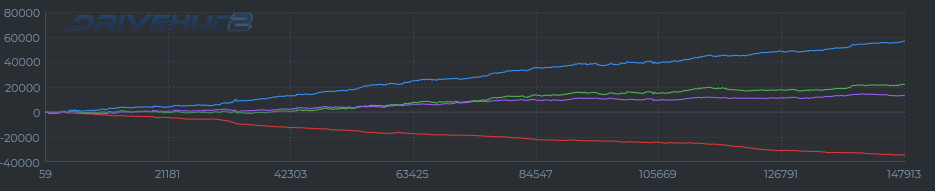
Outside of Poker I have been cleaning the house for weeks now. Such a mess everywhere. God. How often do you clean your rooms?
MAKE IT ALL CLEAN! 
You can play 3way almost like normal BU, SB, BB in 6 max. But once it goes to HU, the whole game changes. But it's also a spot that will have huge impact on winrate if hero plays them. What I often see is that at lower stakes the recreationals and regs that come to HU are too passive. They mimic fast and might increase the aggression, but they don't drop it once it goes 3way.
HU is relatively easy versus one-dimensional players. Just throw solver from the window and exploit. Versus more balanced players it's a rake trap at lower stakes, so reg vs reg HU is quite often -EV for both. No shame in sitting out then.
Originally posted by Kyyberi
You can play 3way almost like normal BU, SB, BB in 6 max. But once it goes to HU, the whole game changes. But it's also a spot that will have huge impact on winrate if hero plays them. What I often see is that at lower stakes the recreationals and regs that come to HU are too passive. They mimic fast and might increase the aggression, but they don't drop it once it goes 3way.HU is relatively easy versus one-dimensional players. Just throw solver from the window and exploit. Versus more balanced players it's a rake trap at lower stakes, so reg vs reg HU is quite often -EV for both. No shame in sitting out then.
So people are too timid 3bet pots? But as the 3bettor you are always oop so Idk how much of an edge it is actually if you do play better at low SPR.
Another problem is, I did not drill HU yet in solver so I barely have an idea yet how ranges in several spots look like. Also when players tighten up, it is not that attractive anymore to let HU tables opened aside if you are also multitabling other tables, they drain too much attention.
Yeah, I feel like I do not make profits against other regs in HU. Sometimes I still keep playing them when my ego wants to have a say but I feel like it's only a trap for becoming tilt.
But thanks for the hint about HU vs 3-max. So I will avoid HU-play...


On HU solver wise you are supposed to open like 85% on BU and BB is supposed to 3bet around 18%. But assuming average opponent is even close to these numbers would be very questionable. I think numbers like 60 and 10 could be way closer to reality.
One potential advantage of being 2-3 handed is halved rake cap which I think is common practice? Still though no point to play HU versus ok looking opponent.
With aggression I mean RFI and postflop mostly. In 3bet pots often hands play themselves, so the important thing is hand selection for 3betting. But what I see often at lower stakes is these mistakes, even from regs:
- Open sizing is less than a pot
- Not opening enough -> folding too much preflop -> free money for hero
- Folding too much to hero's opens preflop
- Not 3betting wider than normal
- On the flop they either cbet too much or too little
- Flop cbets might be bluffs, but turn and river are mostly value betting
In HU the key is to figure out what kind of player the opponent is, as fast as possible. Like if the opponent folds hands preflop too much, the most simple adjustment is to open 100%. With super trashy hands it's one and done for instant profit, if opponent calls just give up unless the flop is really good for cbetting (high FE). Once you start to get postflop hands to showdown, always check what opponent had. Is he calling with gutshots etc. on the flop? Is he playing medium strength or even strong ones passively? If he raises, did he do it with value hand, blockers or pure bluffs etc.
Then you create a player profile in your head and understand what is your opponent's strategy, and start to exploit it. That's why HU is really fun game, especially versus not-so-great players. It's like a logic puzzle.
Originally posted by ghaleon
On HU solver wise you are supposed to open like 85% on BU and BB is supposed to 3bet around 18%. But assuming average opponent is even close to these numbers would be very questionable. I think numbers like 60 and 10 could be way closer to reality.One potential advantage of being 2-3 handed is halved rake cap which I think is common practice? Still though no point to play HU versus ok looking opponent.
Yes I know those freqs but how do you translate those deviations into profits? If someone is not 3betting enough, you'd just RFI more theoretically, but I feel like it does not bring that much gain opening up to 90-100% RFI if postflop continuation is somewhat solid. Villain will usually pick up on it and adapt by defending looser which leads to myself tightening up again as a counter-adjust falling back towards 60/10 just like others in order to avoid some more marginal postflop spots I have poor knowledge on. I mean on PLO50 or lower you'd still have to play lots of hands for to make those blinds and small pots lost to actually hurt someones Winnings in terms of $$$.
Originally posted by Kyyberi
With aggression I mean RFI and postflop mostly. In 3bet pots often hands play themselves, so the important thing is hand selection for 3betting.
It is true handselection for 3BP is important, I assume this is also a big part where my edge lies in general. Not having solid 3bet ranges is surely not a problem in my game, I have memorized several GTO 3bet ranges from my gameplan and I have almost mastered them, it's rather continuation in 3BP under varying conditions (I know all the single combos and borderline hands and which structure occure how often - the part of how they interact with flop textures is missing though, something still to be done). But yes, Idk how a 15-20% 3bet range would look like as I have non constructed since you don't use that kind of a range in 6-max so I am also working with a 10-15% range in HU (still more loose than the 8-12% most other regs have).
3BP are still hard to play cause ranges are supposed to loose up and me among other regs struggle with this, cause you naturally try to avoid variance. Especially turn and river play can become very tricky and they are barely possible to play if you have no sound flop fundamentals (optimal frequencies, sorting out the right hands into lines accordingly).
But what I see often at lower stakes is these mistakes, even from regs:
- Open sizing is less than a pot
I rarely see that. You'd have to defend more. I'd also start to donk more which sometimes work. My rangeawareness for this 1-2 bet lines is not good enough to gain an edge oop, but yes I am probably overrealizing but it rarely wins me a whole stack, often it's just fractions of a pot for the cost of having a range disadvantage oop.
- Not opening enough -> folding too much preflop -> free money for hero
Yes, but those blinds seem to add so slowly in terms of $$$. One bad big bet paid off kinda kills it all.
- Folding too much to hero's opens preflop
Yes, but those blinds seem to add so slowly in terms of $$$. One bad big bet paid off kinda kills it all.
- Not 3betting wider than normal
That's an advantage yes (which slowly fades away when villain reaches the 8% mark or higher).
- On the flop they either cbet too much or too little
Regulars ony my stakes usually have solid cbet freqs. (40-60%)
- Flop cbets might be bluffs, but turn and river are mostly value betting
True yes. It incentivizes you to overfold... So you are folding oop but you don't necessarily get your own turn and river bluffs through either as they seem to call more loose (correctly) once they pick up on it?
The points you mentioned about player profiles I am aware of. I feel like it is still not easy to turn this knowledge into profits. Probably also because my knowledge is not extensive enough. What does GTO look like and how much am I bluffing when I turn one specific kind of blocker into a bluff? etc.. I feel like bluffing has to be done quite selectively and in 6max you get so much more credit in 1-2 street lines, players somehow seem to just be lazy or not interested in smallish pots. Finally there is something I have read recently where Mike Corisell mentioned,
Villain does A so to exploit that I play B. - Wrong
Villain deviates from GTO play C by doing A so I deviate from C towards playing B. -Right
Knowing play C is much work though. So in the end you'd still have to drill and study HU hard to get an rough picture of a solid strategy, and I am already fully occupied with my 6-max gameplan.
I have completed my preflop ranges so I have a gameplan for the most important spots here. Most players in 6max don't even have that settled and in HU you lose that "positional edge". But postflop my knowledge drops. For example in the Vision Trainer I had 90% for all preflop spots (80%+ for "facing squeeze"). Then on the flop I am at 80%+ - 70%+. For more MW-Flops, Turns and Rivers it drops to 60% or even less. When I play by intuition, pouring that all into an approximative Gameplan and applying it well against all sorts of random tendencies is another story.
If it was easy, we would have tables full of good players. :f_drink::f_drink::f_drink:
Funny thing was when Galfond had this HU challenge going on. In the very first match versus VeniVidi, neither player really played solver poker. They started to play the opponent quite fast with a lot of non-solver sizings to confuse the opponent, and VeniVidi was VERY aggro on the rivers with even remote blockers. And once he had Galfond on downswing, the aggression really hurt Phil who started to question his bluff catching or value raising ranges.
They both knew solver strategy for HU for sure, but in HU you play the player so with 2 great players it deviated from solver quite fast.
HU is cruel game too. As you said, piling those bb's is slow and then one hand can wipe it all away. It's like playing black jack for small bet and then putting it all-in on one hand when the deck favors you. +EV, but huge variance. Same in HU. Even versus significantly worse opponent the variance is still huge.
I love HU, as it's a trip back to old school poker where you play the player, not the solver or balance. But versus good regs I skip it, as it might be -EV for both or at least my EV is not that great due to rake. If one is not comfortable to play HU, no shame in sitting out. It's not about ego, it's about finding +EV spots. I remember back in my early days sitting out when I got over 200bb, as I wasn't comfortable in deep stack PLO. Now it seems funny to me, but back then I chose to skip situations that I weren't sure +EV in my opinion, until I practised and learned them.
Originally posted by Kyyberi
If it was easy, we would have tables full of good players. :f_drink::f_drink::f_drink:

Funny thing was when Galfond had this HU challenge going on. In the very first match versus VeniVidi, neither player really played solver poker. They started to play the opponent quite fast with a lot of non-solver sizings to confuse the opponent, and VeniVidi was VERY aggro on the rivers with even remote blockers. And once he had Galfond on downswing, the aggression really hurt Phil who started to question his bluff catching or value raising ranges.
They both knew solver strategy for HU for sure, but in HU you play the player so with 2 great players it deviated from solver quite fast.
I think it is the match where Galphond took a lot of hands from to analyze in his video series "This is PLO". I mean I could barely follow up the river thought process, HU the ranges went just way more loose from how I play but then on certain texture-shifts it went back to ridiculously tight. So I think it is really a thing to understand which frequencies contain what hand classes.
HU is cruel game too. As you said, piling those bb's is slow and then one hand can wipe it all away. It's like playing black jack for small bet and then putting it all-in on one hand when the deck favors you. +EV, but huge variance. Same in HU. Even versus significantly worse opponent the variance is still huge.
Probably, but against the passive fish at least you rarely have variance. Taking their stack can still take some while if they just refuse at one point to pay you off big.
I love HU, as it's a trip back to old school poker where you play the player, not the solver or balance. But versus good regs I skip it, as it might be -EV for both or at least my EV is not that great due to rake. If one is not comfortable to play HU, no shame in sitting out. It's not about ego, it's about finding +EV spots. I remember back in my early days sitting out when I got over 200bb, as I wasn't comfortable in deep stack PLO. Now it seems funny to me, but back then I chose to skip situations that I weren't sure +EV in my opinion, until I practised and learned them.
I can understand that. For me it kinda disturbs the gameflow so when looking for Variety I rather try 5-card PLO. The amount of fish there is just another level, it's like 4card in 2015 right now.
In my pool the player types are very similar, sometimes I even meat the same fish just climbing stakes. Here the Color Labels I use:
There are 2 types of passive fish = Cyan
80/14/0 AF<2 (checking out every flop but then continue very tight continuing with more or less selective calls, a raise usually is nuts)
40/12/2 AF <2 (more selective preflop but capable of getting it in more loose primarily in low SPR spots)
Aggressive fish = Yellow:
46/21/3 AF >2 (often they raise and call too many hands pre and try a O&D approach postflop, calling off single bets bad but are cautious in big pots)
Then there are the bad LAGs = Orange:
52/31/6 AF~3 (pounding on any weakness and starts handstrength evaluation depending on who calls, some are capable of turn/river bluffs)
And then there is a mix of reggish and recreational, but also weak:
32/12/4 AF 2-3 (somewhat solid cbet frequencies but bad preflop game, usually very cautious postflop aswell) = Yellow
23/7/2 AF ? (same playertype but more tight and not raising preflop) = Purple
Finally regulars:
23/19/6 AF ~2 (pretty solid but if they have consistent cbet stats above 50% but some with 30% are weak and play overly tight postflop and bad in 3bp) = Red for solid Tags and Lags and purple for weak Tags
18/13/2 AF ~2 (clueless nits who are overly tight but still stack-off comparably weak hands postflop, bad game both post and pre) = Blue for all nits with VPIP below 20%
Real maniacs like 80/43/16 AF>3 are actually very rare. So they together with all spewish player types get a Green.